This article was featured in Eurofish Magazine 6 2025.

Founded in 2015 within the Vytautas Magnus University (VMU) Agriculture Academy, the Aquaculture Centre is a facility for applied aquaculture research and advanced training.
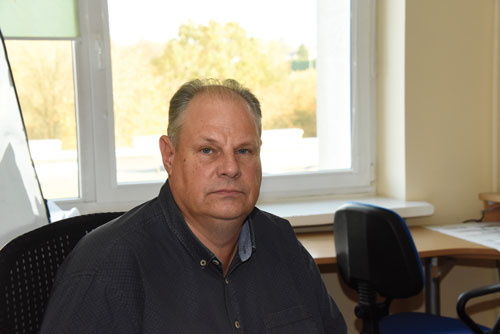
From the outset, VMU’s Aquaculture Centre has combined a strong laboratory infrastructure with industry projects, positioning itself as a bridge between science, skills, and the needs of a fast-evolving sector, says Alvydas Žibas, the head of the centre. Its facilities include a complex of closed recirculating aquaculture systems (RAS) for fish breeding and grow-out, analytical equipment, and pilot plants that enable trials across a spectrum of technologies, species, and production intensities. This infrastructure underpins both research and hands-on teaching for university programmes in fisheries, aquaculture technology, and allied water engineering disciplines.
The centre’s remit covers a wide range of research themes, many of them at the cutting edge of Europe’s transition to a circular, low-carbon bioeconomy. Important lines of work include innovative technological solutions in aquaculture; RAS design and components; productivity gains in pond aquaculture; feed trials; biofloc systems; wastewater treatment and sludge valorisation; and biotechnology for fish and microbial systems. These efforts are supported by projects with farms and technology partners to create a mechanism for testing and improving laboratory work by implementation in the field.
From laboratory to regulation and market
According to Mr Žibas, a defining feature of the centre is its habit of turning research into concrete outputs for the sector—normative guidance, feasibility studies, and deployable technologies. In 2023, after carrying out the research staff prepared a report with recommendations for the development of technological norms for fish farming in aquaculture ponds and closed systems. On the strength of this work, Lithuania’s Minister of Agriculture approved Technological Norms for fish farming in both ponds and closed systems. For farms and regulators alike, these norms establish practical, legal reference points for the main parameters for various fish growth stages for different species of farmed fish.
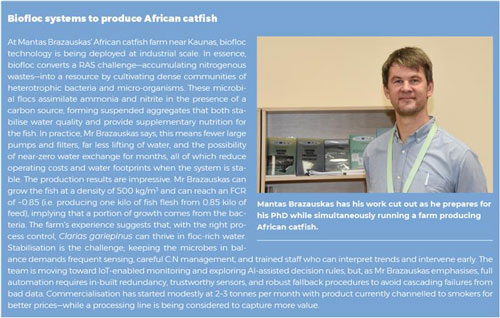
Alongside influencing policy, the centre routinely undertakes assignments that provide useful information for the commercial aquaculture sector. Examples include a 2018 feasibility study that helped secure a permit for industrial whiteleg shrimp (Litopenaeus vannamei) production in RAS, a technology assessment for wastewater decontamination at a catfish farm, and evaluations of membrane filtration in RAS. These studies demonstrate a practical approach to problem-solving—from licensing support to process optimisation—often in areas where European operators are still building capacity (warm-water shrimp, for instance). The centre also acts as an incubator for new production models. Working with a university spin-off, UAB Aquaculture co-owned by Mantas Brazauskas, a PhD student, it is advancing a multi-year R&D effort to develop biofloc-based technology for African catfish (Clarias gariepinus)—elevating a prototype system from Technology Readiness Level TRL-6 to TRL-8. By targeting TRL-8, the team is explicitly engineering for near-market deployment, not just proof of concept.
Education that aligns with climate and digital transitions
The centre’s research is tightly coupled with VMU’s study programmes, ensuring that graduates leave with both theoretical knowledge and practical proficiency. Last year it renewed a bachelor’s programme in water engineering (in Lithuanian) that includes aquaculture-related subjects (e.g. aquaculture biotechnology). It supports laboratory work, field projects, and dissertation research across programmes, including the Aquamatics double-diploma Master’s. This programme blends natural and engineering sciences to train environmental engineers who can model hydrological processes, monitor water quality, and design climate-resilient solutions across the water economy, including fisheries and aquaculture. The curriculum—taught in English and offered in cooperation with partners—covers digital modelling, wastewater technologies, aquatic biology, and Innovative Technological Solutions in Aquaculture, among other modules.
Mr Žibas highlights that the Aquamatics programme confers a Master of Science in Engineering, with clearly defined ECTS content across hydrology, GIS, climate crisis management, fisheries and aquaculture, and thesis work. In parallel, it seeks to address skills shortages, strengthen applied research links, and meet climate and digitisation imperatives in water sectors across Lithuania and the EU.
DiBluCa, distance learning designed by a network of European universities
At the heart of the centre’s recent international engagement is DiBluCa – The Digital Blue Carrier for a Post-Carbon Future, an Erasmus+ project led by VMU. DiBluCa’s aim is to strengthen higher education in aquaculture and fisheries by modernising curricula to reflect the benefits of increasing digitalisation as well as the threats from climate change. The programme emphasises robust e-learning, remote assessment, and cross-border knowledge sharing. DiBluCa is structured in four stages—design, localisation, and curriculum and learning materials modification—with outputs that include a comprehensive handbook (in English), an interactive e-book available in English and all partner languages, video files, and a user-friendly e-learning platform for self-paced learning and best-practice dissemination. The project anticipates transnational workshops, an international conference, and multiplier events providing students with opportunities to build networks across research and industry communities. VMU leads a partnership spanning Turkey (Balıkesir University), Ukraine (Odesa National Technical University, ONUT), Greece (University of Thessaly), and Croatia (University of Dubrovnik), ensuring geographic and aquaculture-system diversity.
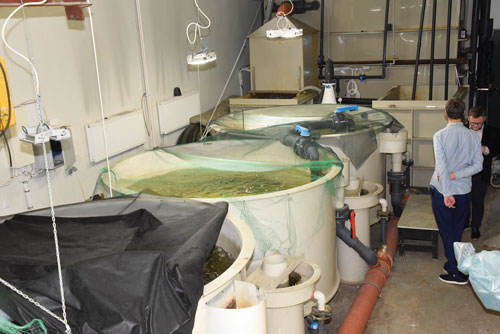
One of the recirculation aquaculture systems at the Aquaculture Centre
Mr Žibas describes the DiBluCa learning environment as open, attractive to younger audiences, and multilingual, with digital books, slide decks, best-practice videos, case studies from different regions, and a pathway to certification under exploration. The material is intended for master’s students, working professionals, and public-sector staff. Some five hundred learners have registered from the countries of the participating universities furthering DiBluCa’s goal of upskilling technical staff and expanding career opportunities across the blue economy. In practice, DiBluCa also complements the Aquamatics master’s. Where Aquamatics trains environmental engineers with strong digital and analytical skills, DiBluCa supplies modular learning for students wishing to focus on fisheries or aquaculture. Combining the two programmes equips students with skills that are useful in several work contexts.
Among the centre’s work is the development of biofloc approaches for warm-water species, with a current focus on African catfish. Using knowhow from earlier shrimp (L. vannamei) biofloc trials Mantas Brazauskas and Mr Žibas designed freshwater systems that minimise water exchange, cut pumping -energy, and convert dissolved nitrogen into microbial biomass that becomes supplementary feed. In the lab and in partnership with farms, the centre is testing variants ranging from pure biofloc to semi-biofloc configurations, supplied with sensors and moving toward IoT-enabled control.
Outreach and pipeline development
A sustainable aquaculture sector needs a pipeline of talent. The centre actively engages schools—around 500 pupils annually—through laboratory visits that explain systems and species, and promote Lithuanian farmed fish as a healthy, modern food. This engagement was part of the EU’s Farmed in the EU programme that was implemented by the Ministry of Agriculture through its Agriculture Agency. The centre also advises prospective investors and collaborates with national and international partners to broaden Lithuania’s participation in European research consortia. Across Europe, aquaculture enrolments are under pressure, yet industry demand—especially for digital and RAS skills—continues to rise. As the centre continues to develop sustainable water-use innovations suitable for Lithuanian conditions and beyond, it is making tangible contributions to sector competitiveness, environmental performance, and workforce renewal. In short, it is exactly the kind of applied, outward-facing institution Europe needs to succeed in its blue and green transitions.