OPAGAC, the Organization of Associated Producers of Large Tuna Freezers, is making changes in its fishing system with the objective of making fishing a responsible, sustainable industry that responds to the market’s concerns. The organisation is promoting a standard that fully describes the minimum level needed for a responsible fishery.




The standard “Atún de Pesca Responsible” (APR) or Responsible Tuna Fishing responds to the market’s growing demand for certification of good practices by the world fishing industry. Until now good practice certification has focused on the sustainability of the fishery resource alone. This standard primarily addresses the distribution chain, which demands assurance that the product it sells has been fished not only legally (a point that is guaranteed by Spanish fish inspection authorities), but also responsibly and sustainably. The standard includes five main requirements:
− Decent, well-paid working conditions for crews. More specifically, the basic conditions stated in International Labour Organization (ILO) Convention 188.
− Fishery control and transparency, with satellite ship-tracking systems and catch reporting.
− Compliance with good practices in seine fishing for tuna. Good practices guarantee that the impact on the ecosystem is kept as low as possible. Compliance is verified by voluntary on-ship observers on all our vessels, including the use of electronic observers.
− Compliance with the EU’s required minimum food sanitary conditions in respect of our tuna catch.
− Maritime safety control, in accordance with the International Maritime Organization (IMO), ship classification systems and protection and indemnity (P&I) insurance.
A standard with global ambitions
Because of the spirit in which it is created, the APR standard is entirely open to all the world’s tuna-fishing fleets, as an endeavour to establish a minimum standard for responsible fishery in all oceans. In fact, OPAGAC has ships that members have registered in the coastal countries where they have invested, and those vessels too will be certified under the APR standard. This shows how open and international the standard is. In the near future, the organisation will try to have it made into a European standard, and then perhaps even an international ISO standard. although the requirements will be hard for OPAGAC’s competitors to live up to. The Spanish fleet is the fleet that is already meeting the APR standard’s requirements, and it is spearheading efforts to ensure that all can compete under equal conditions in the global tropical tuna market.
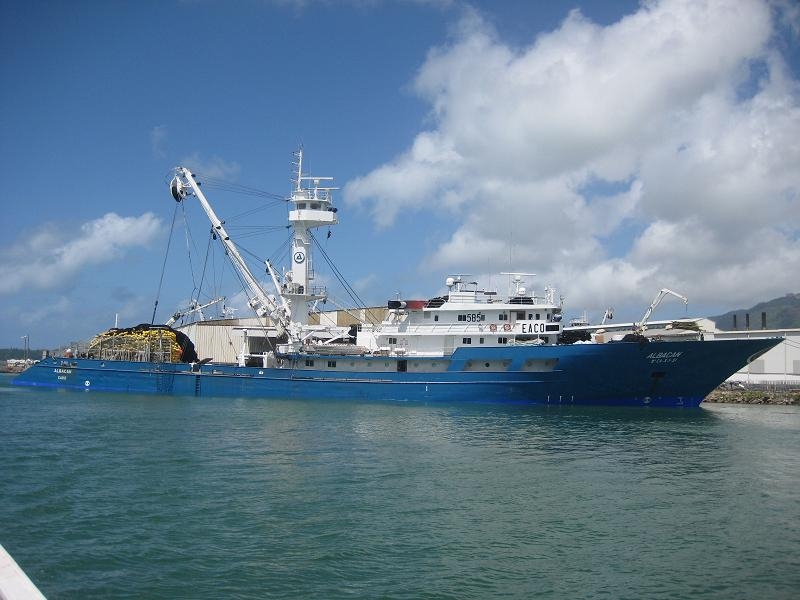
OPAGAC comprises eight companies that own 40 tuna purse seine vessels, which catch roughly 300,000 tonnes of tropical tunas per year. This accounts for 6% of the world catch of tuna species, which is upward of five million tonnes a year. OPAGAC sails all three of the world’s major oceans. In the Atlantic Ocean the organisation’s catch accounts for 19% of the region’s total; in the eastern Pacific, 9%; in the Indian Ocean, 6%; and just 3% in the western Pacific. The main species are skipjack tuna (Katsuwonus pelamis), which makes up 60% of the catch, yellowfin tuna (Thunnus albacares), which accounts for 35%, and bigeye tuna (Thunnus obesus), which is 5%. The OPAGAC fleet supplies canneries the world over, since a great deal of the catch is sold at plants sited in coastal countries, where some members have invested heavily in processing plants that employ many people. The European tuna industry as a whole (that is, the fleet plus the processing industry) is estimated to provide jobs for over 25,000 people all over the world, since the EU market consumes a whopping 500,000 tonnes of canned tuna, making it the world’s number-one consumer. Processing factories primarily employ local labour and women form the vast majority of the workers.
Standard defines conditions for employees
The APR standard is remarkable because it is the first standard in Europe and maybe the world to include a labour component. The OPAGAC fleet employs more than 2,000 seamen, approximately half of whom are from coastal countries. Fishing is under EU fishing agreements and private agreements with third-party countries, which require vessels to take on crew from coastal countries. The working conditions of all crew members, regardless of their nationality, must meet the minimum requirements set by ILO Convention 188. Reports are common nowadays of cases of bad labour practices and even slavery in the fishing industry throughout the world. The APR standard responds to the concerns that many markets are displaying over this issue. Labour has always been a paramount issue for the organisation, which considers its labour practices a strength, in contrast to the unfair competition of other operators who do not safeguard their crews’ working conditions.
OPAGAC would like this standard to be the minimum requirement for all fishing production that at least imports into the EU, because the organisation is keenly aware of the kind of abuse that goes on in many of the fleets that compete with it on the tuna market. They base their competitiveness largely on the fact that they do not have rules such as those in the APR standard. The cost of operating a vessel that meets the standard is much higher, because compliance requires a sizeable investment to guarantee that the very risky business of fishing on the high seas is conducted under minimum safety standards and conditions in accordance with European legislation, the most advanced legislation in the world in terms of guaranteeing all these fundamental elements.
Market recognition of the standard will help fight illegal fishing
As is well known, the proliferation of illegal fishing is associated with illegal fleets’ shocking on-board conditions. Poor on-board conditions contribute to the depreciation of the catch, too, and often lead to overfishing. It is therefore fundamental for the market to recognise the effort made by law-abiding, responsible fishermen to try and close down the sales of illegal fishermen. To do so, the APR standard establishes minimum requirements, so that tuna fisheries will comply with the kinds of prerequisites that guarantee responsible fishing. Hopefully, the market is capable of acknowledging this effort, because it will be very hard to wipe out the illegal exploitation of seamen and thus fishery resources without the market’s help. In addition, the organisation will try to have EU imports held to the same requirements, and, while many controls are already being conducted by
law, compliance can be improved.
OPAGAC would like to acknowledge all the members of the technical panel who wrote the APR standard for their participation. It appreciates in particular the Secretariat-General for Fisheries, which has always encouraged the utilisation of the standard to differentiate members of the organisation from their competitors. In fact, the fishery control efforts Spain has been making (Spain has earned ISO 9001:2015 certification for its fishery control system) have been the foundation and inspiration for OPAGAC’s effort to highlight the work its fishermen are doing to implement responsible fishing. Spain now leads the responsible management of fishery resources, and the hope is that the APR standard will help spread the good work the organisation’s fishermen are doing all over the world.
Julio Morón, Director, OPAGAC