
 Capital: Copenhagen
 Population: 6.0 million
(2025, Eurostat)
Population: 6.0 million
(2025, Eurostat) GDP: €392 billion
(2024, Eurostat)
GDP: €392 billion
(2024, Eurostat)- GDP/capita: €65 650
(2024, Eurostat)
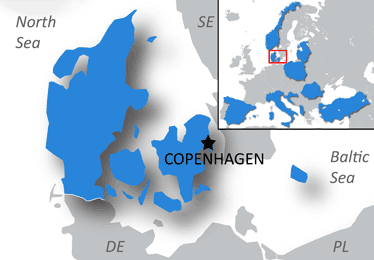
Overview of the Danish fisheries and aquaculture sector



Marine fisheries

The fishing industry plays a significant role in Denmark’s coastal and rural economy. Fisheries constitute a very important economic activity in specific regions, e.g., in western and northern Jutland. Minor fishery is still present in the Baltic Sea around the island of Bornholm, however quota restrictions on key species such as cod and long supply chains to the national market have seen the fishery decrease significantly. Norwegian lobster in the Kattegat and blue mussels in Limfjord are also of significant local importance.
The capture fisheries sector consists of the following three main categories:
- the pelagic fishery for human consumption, mainly herring and mackerel landed whole and stored in CSW (Cold Sea Water) tanks;
- the demersal fishery for white fish (cod, hake, haddock, whiting, saithe), flatfish (sole, plaice, flounder, etc.), Norway lobster, and deep-water prawns; and
- the industrial fishery for fishmeal and fish oil, mainly for sandeel, Norway pout, blue whiting, and sprat.
In 2024, the fishing fleet consisted of 1.774 vessels with a gross tonnage of 63.241 tonnes and a total power of 194.804 KW. A large proportion of the enterprises own a single vessel and the rest own two to five vessels. Small vessels (less than 10m) represent the bulk of the registered fleet (38%), while vessels longer than 24 meters account for less than 3% yet represent almost 71% of the total gross tonnage. This segment mostly consists of large pelagic trawlers. In general, around 38% of Danish vessels are classified as liners and gillnetters, while 21% are divided almost evenly between purse seiners and trawlers (11%). The regions of mid and north Jutland have the largest number of vessels registered (about 56% of the total fleet). They also contribute the greatest volume of gross tonnage (over 83%). Significant ports in these regions are Hanstholm, Hirtshals, and Skagen. In 2023 the number of fishing enterprises amounted to 550, providing jobs for 1.398 people, of which 699 were employed full-time.
In 2024, the total catch landed in live weight by Danish vessels in Danish ports amounted to 462.157 tonnes with a total value of over €419 million. The share of the catch for human consumption was around 40% of the total in volume and around 77% in value and consisted of pelagic fish (mainly herring and mackerel), demersal white fish (cod, hake, haddock, whiting, saithe), flatfish (sole, plaice, flounder), blue mussel, Norway lobster, and deep-water prawn.
Inland fisheries
In Denmark, there are about 500 lakes and ponds, mostly small and shallow. The largest lake, Arresø (41 km²), is located on the island of Zealand. Only two rivers are longer than 100 km, and five are longer than 60 km, with the principal river being Gudenå at 158 km long. The main commercial inland fishing areas in Denmark also include Lake Arresø and the estuaries of Ringkøbing Fjord, Nissum Fjord, Limfjord, Randers Fjord and Isefjorden/Roskilde Fjord. In addition, there is limited commercial fishing in 20–30 other lakes and a few rivers.
Commercial inland fisheries in Denmark are of minor importance, and catches have declined during the past 20–30 years. Inland fisheries are distinguished from marine fisheries by being “carried out in freshwater,” and professional fishing is distinguished from sport fishing by being “allowed to trade catch”. The main species in inland fisheries are European whitefish, roach, European perch, bream, pike, pike-perch. Commercial lake fisheries target pike, pike-perch, and perch. There are also some small-scale fisheries for crayfish, mostly in small lakes and ponds.
In 2024 the total inland catch was 74 tonnes valued at almost €270 thousand. European whitefish was the largest species and contributed to 46% of the volume and 75% of the value. The number of entities involved in freshwater fishing was 14 and they employed 19 people, none of which full-time.
Aquaculture

The main species farmed in Denmark is rainbow trout (Onchorhynchus mykiss) which, including golden trout, constitutes over 75% of the total production. In 2024 total production amounted to 46.405 tonnes in volume and €195 million in value. Mussels (15%), salmon (7%), amberjack (1%) and pike-perch (1%) are among the other species farmed. In the past five years Denmark’s annual aquaculture production has been declining at an average rate of 3% annually.
Production is divided into two segments: land-based farms and sea cages. The tradition of land-based farming dates back to the mid-19th century. The techniques used today are ponds, raceways, and recirculation systems (RAS) producing small portion-size trout. In 2022 the share of trout production in RAS systems amounted to 43% of the country’s total aquaculture production. Another important freshwater species is the European eel (Anguilla anguilla), which is farmed in land-based recirculation units. However, the production of eel, 101 tonnes in 2024, has been decreasing on average by about 37% per year over the 2020–2024 period. In 2023, the number of aquaculture companies was 144, with 244 active sites, of which most are freshwater farms primarily in Jutland.
Sea cage farming in Denmark was introduced in the 1970s and now represents 20% of the total trout production. Around 70% of the farming takes place in the Baltic Sea area. Blue mussel farming (primarily on suspended long lines) is a new activity that started in 2006 and has shown significant growth recently: the total volume reached 6,970 tonnes in 2024 – a decrease of 15% compared to 2023. Farming takes place mainly in the Limfjord in the northern part of Jutland, but also in the Skagerrak and Kattegat. In 2023 there were 561 employees in the sector, of which over 72% were employed full-time.
Processing and trade

Denmark is a large exporter of fish and seafood mainly to other EU countries. In 2024 about 74% of Danish exports stayed within the EU. Denmark is also a major importer of raw materials that are further processed and then exported. Most of the processing facilities are in northern Jutland close to the major landing sites. Production volumes in the last five years have fluctuated between 446 and 565 thousand tonnes, with 462.352 tonnes produced in 2024. The total value of processed products that year reached €1.699 million, and the total number of employees was 2.216 (FTE) across 86 factories.
The production of fish meal and oil accounted for 61% of the total volume while the processing of fish for human consumption accounted for 72% of the production value. In 2023, there were six factories producing fish meal and oil, and employing 205 (FTE). Of products destined for human consumption, preserved and canned fish products are about 45% of the total volume. Fresh fillets are the second largest product group, reaching up to 13% on average, followed by smoked, salted, and dried products (15%), and frozen fillets (9%). Herring products account for up to 29%, salmonids up to 32%, and cod up to 10% of the total volume of products for human consumption.
In 2024, Denmark imported fish and seafood valued at €3 billion. Norway was the main source of these imports (35%), followed by Greenland (21%), Faroe Islands (6%) and Sweden (6%). Imports arrive either from foreign fishing vessels landing their catch in Danish fishing ports or from fish landed abroad that is then brought to Denmark by ship or truck.
In 2024, exports of fish and seafood reached a total value of € 4 billion. The majority of these were destined for EU countries, with Germany as the largest single market, receiving 14% of the total value, followed by France (8%). Outside of the EU, the largest importer was China, with 7% of total value. The main exports included salmon, shrimp (mostly cold-water) and cod. Fishmeal and fish oil, as well as freshwater fish and various shellfish, are significant as well.
Consumption
Consumption of fisheries and aquaculture products in Denmark amounted between 20 and 25 kg per capita in 2022, compared to the average 23,5 kg for the EU as a whole. Cod, hake, herring, mackerel, and salmon are the most popular species.
Older age groups – 40-54 and over 55 – are the most frequent consumers of fish in Denmark, while people aged 15-24 and 25-39 eat seafood products less often. Purchases are typically made in supermarkets, with fishmongers, markets, and direct sales from harbours or producers also playing an important supporting role. Unlike much of the rest of the EU, buying fish online is becoming increasingly popular in Denmark
Useful Links for Denmark
If any of the above listed links do not work or if you have a relevant link to add, send us an email here