

 Capital: Riga
 Population: 1.86 million (2025, National Statistics)
 GDP: €40,4 billion (2024, Eurostat)
- GDP/capita: €21 640 (2024, Eurostat)

Overview of the Latvian fisheries and aquaculture sector




Marine fisheries

Latvia’s fishing sector is rooted in longstanding traditions and history. Today, it consists of a coastal fishing fleet, an offshore fleet operating in the Baltic Sea (including the Gulf of Riga), and a high-seas fleet. In 2024, Latvia landed about 61.433 tonnes of fishery products, with European sprat and Atlantic herring remaining the dominant species.
The coastal fishing fleet segment is represented by 619 fishing boats (2024) with overall lengths of 12 m or less, many of which are without engines. This category constitutes 93,4% of the total number of fishing vessels. Many of these boats are used by family-owned commercial fishing enterprises for sales or even for own consumption. This sector plays an important role in the socio-economic environment of small coastal villages, where fishing is often the main source of subsistence and employment. The catches include herring (Clupea harengus), round goby (Neogobius melanostomus), flounder (Platichthys flesus), and smelt (Osmerus eperlanus), as well as inland species found in coastal areas. Although this is the largest fleet by number of vessels, its overall contribution to Latvia’s total catch is small: around 3% in 2024.
The Baltic Sea (including the Gulf of Riga) offshore fleet sector consists of 37 fishing vessels (2024), representing 5,6% of the total fishing fleet. Their lengths range from 12 to 40 m. These vessels operate exclusively in the offshore waters of the Baltic Sea (including the Gulf of Riga), within ICES subdivisions 22–32. The main gears used in this fleet segment are midwater and bottom otter trawls. The major targeted species are sprat (Sprattus sprattus) and herring (Clupea harengus). In 2024, this fleet segment accounted for about 47% of Latvia’s total catch.
The high-seas fleet segment is represented by 7 vessels (2024), accounting for 1% of the total fishing fleet, yet it contributed about 50% of Latvia’s total catch. These vessels operate in waters governed by the North East Atlantic Fisheries Commission (NEAFC) and the Fishery Committee for the Eastern Central Atlantic (CECAF), including the waters of Mauritania and Morocco under EU Fisheries Partnership Agreements. They mainly use pelagic and bottom otter trawls.
In the NEAFC area, the target species were northern shrimp and Atlantic cod, while in the CECAF area the main species targeted were horse mackerel (Trachurus spp.), mackerel (Scomber scombrus), sardinella (Sardinella spp.), and sardine (Sardina pilchardus).
Inland fisheries
Inland fishing catches amounted to about 1.000 tonnes in 2024. This fishing segment has decreased significantly over the past few years due to prohibitions on fishing with traps and nets in many lakes and rivers, introduced in favour of recreational fisheries and angling. However, inland fisheries have never been a dominant part of Latvia’s fishing sector. This type of fishing is limited by the number of fishing gears permitted for use in freshwater bodies. In areas where fishing is allowed, opportunities have been regularly enhanced through governmental restocking programmes for valuable fish species.
Around 20 fish species are caught in inland waters, of which river lamprey (Lampetra fluviatilis), freshwater bream (Abramis brama), tench (Tinca tinca), and pike (Esox lucius) are the most common. Angling is a strong competitor to inland fisheries and is closely linked to the development of ecotourism in Latvia.
Aquaculture
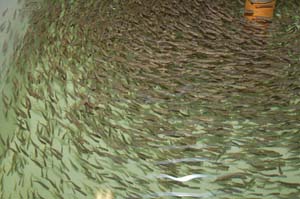
Currently, aquaculture in Latvia is limited to freshwater sources, with no farms operating in coastal marine areas. However, there are indications of growing interest in developing marine aquaculture, particularly for local shellfish species.
In 2024, there were 117 registered aquaculture farms; however, based on data from the Central Bureau of Statistics, only 66 companies were actively operating, employing 288 people. In recent years, the number of ponds has decreased, while their average size has increased. Another notable trend is the expansion of recirculation aquaculture systems (RAS): in 2012 the country had 25 RAS units, and by the end of 2024 this number had increased to 111.
The aquaculture sector produced 742 tonnes (2024) of fish and crustaceans worth over €3,1 million, of which 41 tonnes were sold in foreign markets. The main species sold, both fresh and processed, is common carp (Cyprinus carpio), followed by trout (Oncorhynchus mykiss), catfish (Silurus glanis), and sturgeon (Acipenser spp.).
Processing
The fish processing industry in Latvia is a well-developed and locally significant sector, located mainly along the country’s coastline. Historically, Latvian fish processing companies have produced for both the domestic and export markets. According to national statistics, in 2023 there were 93 fish processing companies employing 2.604 persons. More than half of these enterprises are small units with no more than 9 employees. The production value amounted to €308,5 million.
There are many different types of fisheries products produced in Latvia, including frozen, salted, and smoked products, preserves, ready-to-serve items, and canned fish. To diversify their product range, fish processors use marine species such as Atlantic herring (Clupea harengus), mackerel (Scomber scombrus), sardine (Sardina pilchardus), and sardinella (Sardinella spp.). Freshwater species such as pike (Esox lucius), catfish (Silurus glanis), and common carp (Cyprinus carpio) are used in smaller quantities.
Trade
Latvia maintains a positive trade balance in fish and fish products, with exports consistently exceeding imports. In 2024, 111.300 tonnes of fisheries and aquaculture products (including canned products) were exported, valued at €342 million. Canned products were the largest category both in value (€158,8 million) and in volume (39.900 tonnes), followed by whole frozen fish and fish fillets.
Most exports were destined for EU markets, with major shares going to Germany, Lithuania, Sweden, Poland, and Estonia. Prepared and/or preserved fish and seafood products accounted for over 30% of Latvia’s exports to the EU. Outside the EU, Canada and Ukraine were the main destinations for Latvian fish and seafood exports, together absorbing more than half of the non-EU export volumes and about one-third of their value.
In 2024, Latvia imported about 108.000 tonnes of fishery and aquaculture products worth €277 million. These imports ensured an adequate supply of raw materials for the fish processing sector and helped expand the range of fish products available on the domestic market. EU countries provided most of Latvia’s import volumes, with Lithuania, Estonia, and Sweden being the major sources. From outside the EU, the main suppliers were Norway, the United Kingdom, and Iceland. The principal imported species were salmon, cod, mackerel, and Atlantic herring.
Consumption
Despite Latvia’s strong tradition of fish consumption, the consumption levels are vary from year to year. In 2023, per capita fish consumption was 21,6 kg. The Latvian market is saturated with a wide range of fish products, including domestically produced seafood as well as a substantial variety of imported items. The highest demand is for fresh and frozen fish. Salted or smoked products and non-sterilized preserved fish are also popular among local consumers. In contrast, sterilized canned fish is less favoured. Canned tuna, anchovies, mollusc- and shrimp-based products, and other premium preserved fish items also have a steady consumer base in Latvia. Fish consumption levels and product preferences differ between rural and urban areas, with urban consumers generally accounting for the higher share of total consumption.
Publications
The latest version of the Guide to Recirculation Aquaculture is available in Latvian here:
Useful Links for Latvia
- Ministry of Agriculture
- BIOR Institute – Institute of Food Safety, Animal Health and Environment
- Union of Latvian Fish Processing Industry
- The Central Statistical Bureau of Latvia (CSB)
- Baltic News Network
- The Latvian Institute
If any of the above listed links do not work or if you have a relevant link to add, please let us know by sending us a quick email here.