This article was featured in Eurofish Magazine 6 2025.




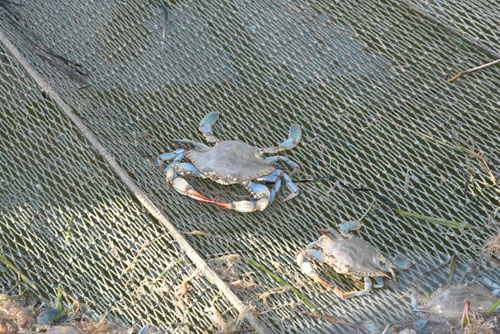
The introduction of the blue crab (Callinectes sapidus) into the Mediterranean, specifically into the Ebro Delta in 2012, has led to a marked shift in the local ecosystems. Originally native to the Gulf of Mexico, this invasive species has spread rapidly across the region, posing challenges to both marine biodiversity and the local fisheries. The management of the blue crab population in the Ebro Delta has therefore become a priority, as it threatens native species and the health of the delta’s ecosystems.
One of the methods under investigation for controlling the blue crab population is through its natural predators, notably the common octopus (Octopus vulgaris) and the loggerhead sea turtle (Caretta caretta). These two species, both present in the Mediterranean, have shown potential for top-down regulation of blue crab numbers. Recent research conducted by Patricia Prado and colleagues from the Catalonian Institute of Agrifood Research and Technology (IRTA) in collaboration with researchers from the Polytechnic University of Valencia (UPV) and the Oceanographic Aquarium of Valencia has explored how these predators impact the blue crab population, examining their feeding behaviours and the effectiveness of predation on different sizes of crabs.
The blue crab’s invasive impact
The blue crab, while not native to the Mediterranean, has adapted well to the region, spreading across various habitats such as lagoons, rivers, and even the open sea. Its ability to feed on a wide variety of organisms, including clams, algae, and organic matter, has made it a formidable competitor in these ecosystems. Its rapid proliferation has raised concerns about its impact on native species, particularly those that rely on the same resources. For instance, blue crabs have been found to negatively affect clam populations, particularly in the Fangar bay, where they feed heavily on clam nurseries.
This invasive species also competes with native predators for food, disrupting the balance of local marine food webs. As a result, managing the blue crab population is essential not only for maintaining biodiversity but also for sustaining the region’s fisheries.
Octopus as a predator of blue crab
The common octopus, a highly intelligent and versatile predator, has long been known to feed on a wide range of marine organisms. In the Ebro Delta, studies have shown that octopuses readily consume blue crabs, with subadult and adult octopuses both participating in this predation. The experiments designed by IRTA included various sizes of crabs to determine octopus preferences and their feeding efficiencies. Interestingly, while subadult octopuses showed a preferential trend towards smaller crabs, they were also capable of capturing and consuming larger crabs, demonstrating the octopus’s adaptability in its prey selection.
The predation studies revealed that octopuses, even those as small as one kilogram (subadults), could consume crabs that were half their size, with larger individuals consuming up to 500 grams of blue crab biomass per day. The feeding efficiency of the octopus was particularly high because it consumed only the soft tissues of the crabs, leaving the exoskeleton behind. This means that the total biomass consumed by octopuses is higher than what is often reported, as the discarded exoskeleton is not considered in the calculations.
Moreover, the ability of octopuses to feed on crabs of various sizes, coupled with their relative abundance in the region, makes them an effective predator for controlling the blue crab population. The IRTA study concluded that octopuses are likely the most effective natural predator of blue crabs, particularly in the absence of other significant predators like larger fish or reptiles.
Turtles and their role in blue crab predation
Loggerhead sea turtles are another potential natural predator of blue crabs, though their impact on crab populations may not be as pronounced as that of octopuses. Loggerhead turtles, which are present in the Ebro Delta, have been observed to consume blue crabs, though they tend to be more cautious and less efficient predators compared to octopuses. Turtles were less likely to display a preference for specific sizes of crabs. Instead, they were willing to consume both small and medium-sized crabs, with larger crabs sometimes proving more difficult to handle. In fact, when results from all sizes of turtles were pooled, a trend towards enhanced consumption of smaller crab sizes was observed. The experiments were conducted at the Oceanographic Aquarium with turtles that had sustained injuries in the field and were recovering at the institute. No turtles were captured for the experiments.
The key difference between turtle and octopus predation is that turtles consume the entire crab, including its exoskeleton, which means their biomass consumption is higher than that of octopuses. However, while turtles were found to consume a significant amount of biomass—especially in larger individuals—octopuses were more efficient predators, consuming more blue crabs per day, and exhibited less handling difficulties (shorter predation time).
The challenges of using predators for blue crab control
Despite the promising results from studies on octopus and turtle predation, there are several challenges to using these predators for effective blue crab management. For one, the presence of these predators in the Ebro Delta is not guaranteed. While octopuses are relatively abundant, loggerhead turtles are less so, and their numbers have been declining in recent years. The ability of these predators to exert significant control over the blue crab population is further complicated by the size and availability of crabs. Larger blue crabs may be more resistant to predation, requiring even larger predators to handle them effectively. Additionally, factors like the salinity of the water, which can affect the health of octopuses, also pose barriers to successful predation.
Another consideration is the ecological impact of introducing or encouraging certain predators in an area. While octopuses and turtles are native to the Mediterranean, increasing their numbers for the purpose of controlling the blue crab population could have unintended consequences for other species in the ecosystem. For example, fish or birds that may also feed on blue crabs could be displaced or affected by the shift in predator-prey dynamics. Moreover, the researchers only explored predation on large blue crab sizes, while most of the predation occurs on smaller ones, a further subject for exploration in the Mediterranean.
Integrated management strategies
Given the complexities of managing the blue crab population, a more integrated approach is needed. The research conducted by IRTA, UPV and the Oceanographic Institute has shown that natural predators, particularly octopuses, play a role in controlling blue crab numbers, but they cannot be relied upon solely. Instead, a combination of strategies—including targeted fishing, habitat management, and monitoring of predator populations—will be essential for effective blue crab management.
The development of a co-management approach, as outlined in the blue crab management plan for the Ebro Delta, brings together stakeholders from the fishing sector, public administration, and scientific communities. By incorporating data from predator-prey studies, these stakeholders can work together to create a balanced and sustainable approach to managing both the blue crab population and the overall health of the ecosystem.