This article was featured in Eurofish Magazine 6 2026.

A just-launched project aims to use digitalisation to optimise the use of resources—water, feed, and energy, among others—in the aquaculture sector in the Danube River Basin and the Black Sea Region.
A new Horizon Europe innovation project is placing fish farmers’ needs at the heart of the energy and digital transition of aquaculture in the Danube and Black Sea region. The project brings -together 20 consortium partners, including Eurofish, with fish farming and technology SMEs forming the core of the consortium, complemented by research and innovation institutions and governance organisations.
Digitalisation could alleviate some of the pressure on fish farms
Across Europe, aquaculture producers face a difficult combination of rising operating costs, climate-related pressures, competition and increasing expectations for environmental performance. For fish farmers energy is essential for all day-to-day operations on a farm. Digital solutions can help, for example, by optimising feed consumption, pond aeration, or temperature levels.
Launched on 1 September 2026 the DANUBEAQUA project develops and demonstrates renewable-energy and digital solutions adapted to aquaculture in the Danube River Basin and Black Sea region. It is one of four projects selected under the Horizon Europe Mission “Restore our Ocean and Waters” call on digital technologies and energy transition in fisheries and aquaculture, with one project selected for each sea basin. DANUBEAQUA focuses on aquaculture, with innovations selected to address the specific needs and challenges of the region’s most relevant aquaculture production systems. Coordinated by the Hungarian Aquaculture Technology and Innovation Platform (HUNATiP), the three-year project has a total budget of approximately €5.65 million, including nearly €4.97 million in EU funding. It aims to turn promising innovations into practical, tested solutions for freshwater and marine aquaculture. Dr Béla Halasi-Kovács, the DANUBEAQUA project coordinator from HUNATiP, explains that aquaculture in the region has considerable potential, but producers are under growing pressure to use energy, water and other -resources more efficiently. DANUBEAQUA is important, he says, because it brings farmers, researchers, technology developers and policymakers together to solve problems identified by the farmers themselves. “Our ambition is to demonstrate solutions that improve competitiveness and resilience and can be taken up well beyond the project’s pilot sites.”
Different production systems, shared challenges
The Danube and Black Sea region is characterised by a diverse aquaculture sector including extensive and semi-intensive carp ponds, trout raceways and freshwater cages, intensive recirculating aquaculture systems (RAS) and marine cage farming. Their requirements differ substantially. A solution that works in a land-based RAS facility may be unsuitable for a traditional pond farm or an offshore installation. DANUBEAQUA therefore combines common monitoring and assessment methods with technologies adapted to each production system and species. Seven demonstration sites in Hungary, Austria, Czech Republic, Slovakia and Romania provide opportunities to test innovations under commercial conditions. The project will establish baseline data and compare performance before and after interventions, taking into account energy and water use, production efficiency, environmental impacts and operational feasibility.
The project addresses several closely connected innovation areas. In pond aquaculture, it will investigate how solar energy can be better integrated with water management, including the timing and control of pumping and other energy-demanding activities. It will also assess smarter monitoring and operation of large pond systems, where timely data can support decisions on nutrient and water management. For intensive production, the work includes developing more energy-efficient RAS designs for African catfish and species-specific biofloc systems, with particular attention to microbial processes, water-quality stability, aeration demand and the requirements of fish at different life stages.
Testing technologies under real world conditions
In freshwater and marine cage aquaculture, DANUBEAQUA will investigate the potential of more independent, reliable energy supplies using locally suitable renewable sources and energy-storage or management solutions. This is especially relevant for installations where access to the electricity grid is limited, costly, or impractical. Improved water-quality monitoring, for instance, will be linked to decision-support and automated control tools. More accurate feeding will be investigated through machine vision, other sensors, and artificial intelligence, helping farmers respond to fish behaviour and appetite and to optimise use of inputs. The technologies will be tested under real
farm conditions.
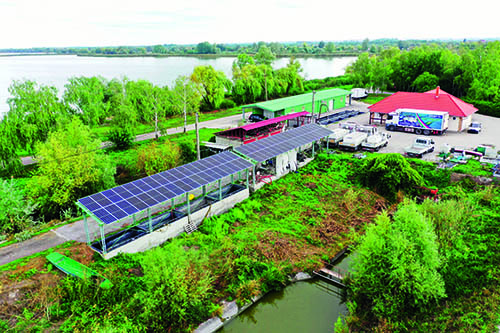
Solar energy is already used in aquaculture, but further innovations are needed to integrate renewable energy more efficiently into fish farming operations.
Farmers will contribute their operational knowledge, identify constraints, and help assess which solutions are robust yet manageable in daily practice and also economically defensible. Ferenc Lévai of Aranyponty Fish Farm in Hungary highlights that recent droughts have shown how vulnerable traditional pond fish farming has become. We cannot assume that the water management methods and operating practices of the past will remain sufficient, he states, so at Aranyponty we want to demonstrate how better use of solar energy, more informed water management and practical digital tools can help fish farmers adapt while maintaining productive pond systems and the environmental benefits they provide. Jindřiška Knowles from the University of South Bohemia in Czechia points out that the scientific value of DANUBEAQUA lies in testing innovations across different species and production technologies under realistic farming conditions. By combining monitoring, experimental work and comparative assessment, we can generate the evidence needed to understand not only whether a digital or energy solution works, but when it works, what its limitations are, and how farmers can apply it effectively, he says.
Governance that supports innovation and protects heritage
Access to finance, permitting, water-use rules, environmental requirements and energy regulations can enable innovation or slow it down. DANUBEAQUA will involve farmers and relevant stakeholders in identifying these barriers, defining requirements, and developing recommendations for a more supportive governance framework. The time is also ripe to give due recognition to the environmental, cultural, and economic roles of pond aquaculture. In Lower Austria, the traditional carp pond landscape of Waldviertel was recognised by the Food and Agriculture Organization of the United Nations (FAO) in 2024 as a Globally Important Agricultural Heritage System (GIAHS). Leo Kirchmaier of the Lower Austrian Chamber of Agriculture says good governance should make it easier for fish farmers to invest in useful technologies while recognising the wider value of aquaculture landscapes. The Waldviertel ponds are not only production facilities, but part of our cultural heritage and provide important ecosystem services. We need policies that maintain this heritage and help farmers adopt the energy and digital solutions required for its future, he adds.
Cătălin Platon of ROMFISH, the Romanian Fish Farmers Association, explains that European aquaculture policies set important objectives for sustainability, competitiveness and the green transition, but that their success depends on how they are implemented at national level. DANUBEAQUA will bring evidence and the direct experience of producers into that process, he says, which can help us identify practical barriers and develop better targeted national measures and investment support, particularly for farmers who need affordable and dependable solutions.
Awareness, skills and wider uptake
DANUBEAQUA includes awareness-raising, training, stakeholder exchange, and replication activities to connect project results with the wider farming community. In addition, the consortium plans to turn its results into practical guidance and policy messages, supporting uptake beyond the seven demonstration locations. Thus, for aquaculture producers throughout Europe, DANUBEAQUA represents a way in which the energy and digital transition can future proof the sector.
Tamas Bardocz, Eurofish,
tamas@-eurofish.dk