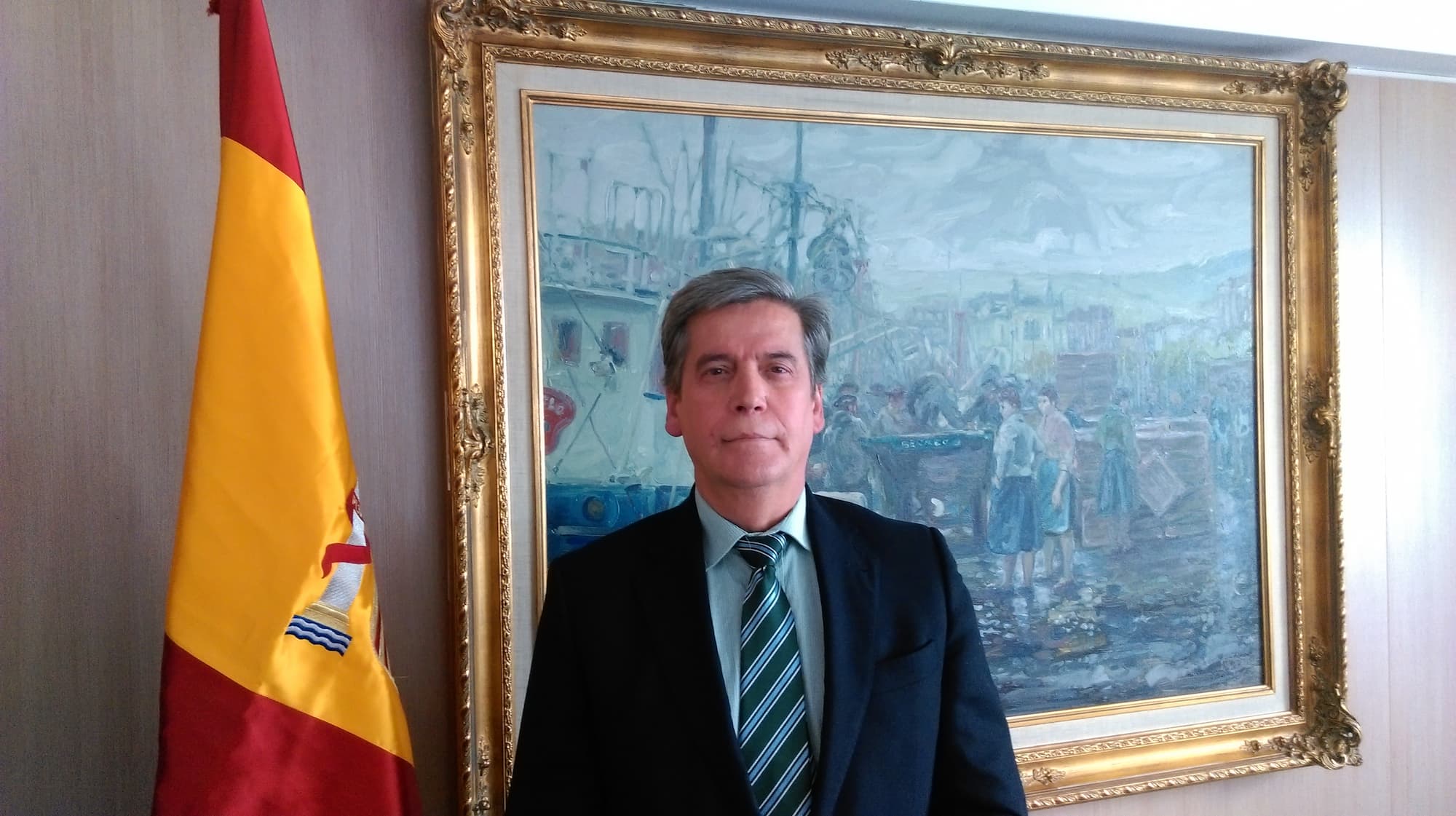
Carlos María Larrañaga, General Director for Fisheries Management, Ministry of Agriculture and Fisheries, Food and Environment, Spain

The General Directorate for Fisheries Management in the Spanish Ministry of Agriculture and Fisheries, Food and Environment is responsible among other things for inspection and control, structural, and market policies. Led by Carlos María Larrañaga, the directorate plays a key role in the fight against IUU fishing, the certification of fisheries as well as the organisation of the market.
The Traceability Observatory was established to, among other things, promote a level playing field in the EU market for canned tuna; ensure compliance with regulations governing this product; and to promote the sustainability of tuna and the enforcement of IUU regulations. Now that the observatory has existed for a year, what would you say are its most significant achievements?
The Ministry of Agriculture and Fisheries, Food and Environment has since the outset supported the Traceability Observatory, as an integral part of its Steering Committee through the Secretary-General for Fisheries. The collaboration between the Spanish private sector and the national administration has been even more successful since the observatory was created as it is a platform to discuss best policies and actions to achieve our shared objectives. As well, it has promoted all these issues in different international forums, such as Infofish World Tuna Trade Conference & Exhibition in Bangkok this year. We believe international cooperation and dissemination of information about all problems and possible solutions are essential to achieve sustainability of fisheries, a level playing field in tuna sector and improvement of social conditions for workers.
Earlier this year tuna fishing vessels belonging to the Opagac association were awarded a sustainable fishing certificate. What implications does this have for these vessels, and what repercussions will this have on other segments of the Spanish fleet? Will they also seek certification? Is there increasing demand in Spain for products that have been fished sustainably?
We congratulate OPAGAC for helping develop the so called Tuna from Responsible Fishing standard jointly with AENOR. It establishes the conditions for responsible fishing and certifies compliance with “best practices” in three areas: environmental, socioeconomic, and control systems. This is the first step to achieve more ambitious objectives like Marine Stewardship Council (MSC) certification. At the moment, WWF and OPAGAC have completed the plan of action of its Fishery Improvement Project (FIP), which will be implemented over the next 5 years. They agreed the roadmap to achieve certification by MSC of its fleet. This marks the initial step to establish an appropriate management framework and good fishing practices. We all hope and strongly believe that OPAGAC will reach the standard set by MSC within the next five years. This certificate will allow tuna produced by OPAGAC to be placed in a better and more profitable market position. With regards to other fleet segments, it will be more difficult to implement schemes like this, although it would be desirable and will always be supported by this ministry. The reason is that to achieve this sort of certification, proper technical and economic resources are needed. And most of the Spanish fleet lacks this due to low profits in their activity.
Increasing demand in Spain for sustainable certified products, which is a fact nowadays, can help to modify this situation, since it can contribute to increased added value and, therefore, to implement these schemes in other fleet segments.
Some countries have been developing and promoting labels for their seafood that refer to a certain area or origin (eg. Mejillón de Galicia), or a specific quality or process that distinguishes them from comparable products. How does the ministry regard these developments? Does it consider them as bringing about real improvements in terms of higher quality, bigger sales, and better prices for producers?
From my point of view, all these quality marks add value to the product and are completely necessary in today’s globalised market. As they follow strict standards, consumers can buy a reliable product produced under quality marks. Not all consumers pay more for quality, but demand for products with these labels is increasing.
The Common Fisheries Policy emphasises that at the latest by 2020, all stocks should be fished at MSY. The importance being given to sustainability is something that was introduced with the latest reform of the CFP. What impact does this have on the Spanish fishing fleet and Spanish catches, and what changes has it led to on the ground?
The achievement of the MSY has different impacts depending on the status of the stocks. As an example, northern hake is in MSY since 2014 and the stock keeps growing every year increasing the revenues for the fishermen, but, on the other hand, southern hake is far from reaching the MSY due to a high fishing mortality what means severe reductions of quota every year with a huge socioeconomic impact.
Spain is the biggest market in Europe for fish and seafood and Spaniards are among the most enthusiastic consumers per capita. How do you see the Spanish market evolving in the future? What changes can be noted in terms of tastes, products, packaging, distribution, ways of shopping, and cooking?
Fish and seafood products are a basic part of Spanish diet, the so called Mediterranean diet. Despite changes in tastes and demands of consumers, they continue being an essential part of this diet, since they are viewed as synonymous with health and with tasty products. The market will have to evolve according to these changes, adapting the supply to what it is demanded by consumers. Increasing demand for quality products, preferably fresh and locally produced, as well as for traditionally produced canned products, has been noticed during the last few years. New presentations, more attractive and better adapted for the needs of some consumers (single consumers, small families, food service, etc.) will be needed as well. Finally, there is also increasing demand for low price products, like some imported species, especially for catering services. About this issue, market transparency and consumer information will be fundamental. This situation represents a big challenge for the Spanish sector, but undoubtedly will be faced properly by all the actors involved.
Spain has taken a strong stand against illegal fishing by supporting FAO efforts to fight the problem, the incorporation of EU legislation against illegal fishing into Spanish law, and the subsequent launch of proceedings against Spanish companies implicated in IUU fishing. High profile cases and heavy fines will hopefully deter companies and individuals from engaging in illegitimate fishing activities, but are there also other measures that can encourage better behaviour in the first place?
Spanish Government is deeply committed in combating IUU fishing. We have very strong inspection and control systems (including Vessel Monitoring S
ystem, Electronic Reporting System, successful control on imports, license verification system) that have made our country a leader in the fight against IUU fishing. Changes in national legislation and improved cooperation with third countries helped to achieve it.
Most companies in this sector carry out their business complying with legal requirements. Even though the culprits represent only a small percentage, it is our duty to combat these illegal practices since they jeopardise the sustainability of resources, badly damage the image of the sector, and are unfair to the law-abiding majority. Furthermore, public awareness-raising campaigns can be an additional tool, as well as international cooperation with less developed countries to help them to implement proper control systems and to train their staff properly.
This way we have initiated is a road of no return. Good results obtained during the last four years mean we are rowing in the right direction.
Public private partnerships are one of the ways to make the implementation of policy more effective. The world congress series of events, which are jointly organised by FAO and the trade association Conxemar, are a good example of this collaboration. How does the ministry view this cooperation? Does it take active measures to encourage the spread of efforts that bring together private bodies with public institutions?
The current legal framework allows such kind of collaboration in marine reserves for actions such as disclosure and awareness campaigns among civil society, specific research projects or specific actions such as the building renovation to be used as visitor centers. In this sense, the Ministry of Agriculture, Food and Environment, through this General Secretariat, is also exploring the possibility of going further with such kind of public private partnerships, identifying and establishing contact with entities that could be likely to provide funds for such initiatives.