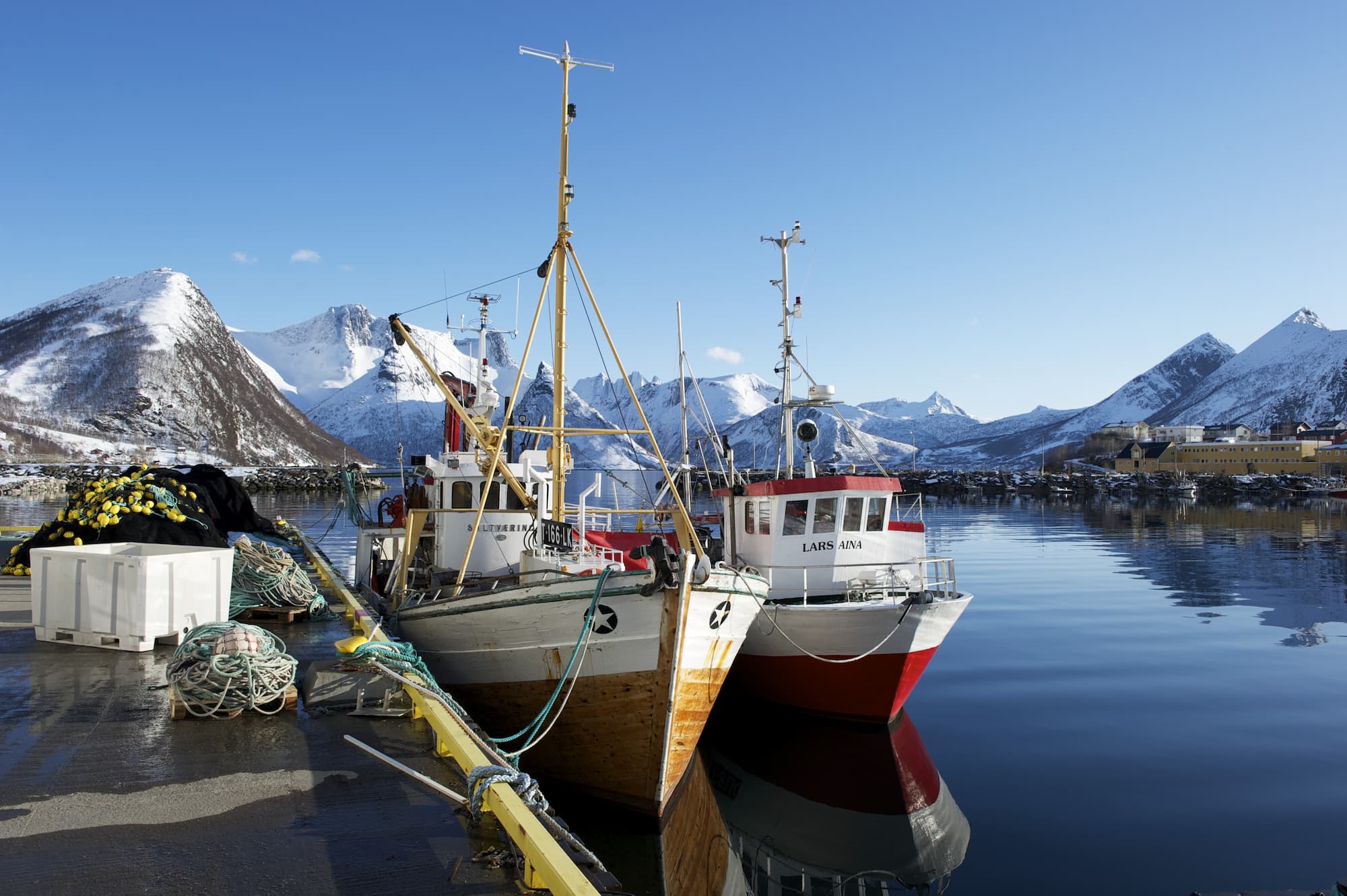
Norwegian fishing vessels target a variety of whitefish, pelagic, and crustacean species in the seas surrounding the country.

The Norwegian seafood sector had another dream year, the second in a row, in terms of its export performance in 2014. Overall, the country’s seafood exports at NOK68.8bn (≈EUR8.2bn) represented a 12% increase over 2013 and this despite the sudden closure (for political reasons) of their biggest market, Russia, in August last year.
Exports of Norwegian seafood can broadly be divided into salmon and trout, whitefish (primarily cod), pelagic fish, and crustaceans. Salmon dominates the export figures. Norway produces almost 55% of the Atlantic salmon sold globally, earning it the sobriquet “Norway’s Ikea” from the Norwegian prime minister. In 2014 the export value of salmon increased by 11% to reach NOK43.9bn, a new record. Volumes grew 4% to reach just under 1m tonnes.
Whitefish exports in 2014 reached their best level ever increasing by a fifth year on year to NOK12bn. Exports of cod in various forms, fresh, frozen, and as clipfish, accounted for the bulk of whitefish exports helped by an increase in cod prices after years of decline, and larger volumes of fish. Clipfish is also produced from whitefish species other than cod including saithe, tusk, and ling, and the combined export of clipfish in 2014 was also at an all-time high at NOK3.7bn, nearly a fifth more than the year before. Exports of dried fish and salted fish also increased, by 23% to NOK900m in the case of dried fish and by 18% to NOK909m for salted fish. Frozen whitefish exports either whole or as fillets also made substantial gains reaching a value of NOK4.4bn, while fresh whitefish exports increased by 23% to NOK2.4bn. While exports of pelagic fish rose in total by 9% to NOK7.5bn the growth was mainly attributable to mackerel, which increased 43% to NOK4.1bn. Exports of herring, the other main pelagic species, on the other hand dropped 14% to NOK2.7bn, due to smaller quotas and the loss of the Russian market. Exports of crustaceans, both raw and cooked, climbed by almost a quarter to NOK1bn helped both by a higher unit price and by larger volumes. The latter increased by 25% to reach 38,000 tonnes*.
Seafood makes a valuable economic contribution
Not only is Norway a long country, but its border with the sea is punctuated with fjords, bays and islands giving it a coastline almost 101,000 km long. Fishing is a traditional activity and over the last half century or so Norwegians have discovered that that their fjords are the perfect location for fish farms. This bounty from the sea, both wild and farmed, has been well used. In 1990 agriculture and forestry accounted for 2.4% of Norwegian GDP while the share of fishing and fish farming was 0.6%. Today, twenty-four years later, agriculture and forestry account for 0.6% of GDP, while fishing and fish farming have increased to 0.9% or NOK28bn. As in other coastal nations, most of this activity is in seaside communities, where it has a disproportionate influence being sometimes the only source of livelihoods. Fishing and fish farming directly employ some 14,000 people, but over the years as these two industries have become bigger, more hi-tech, export oriented, and professionalised, a cluster of industries, institutions, and organisations, with strengths in technology, services, logistics, research and development, and finance etc., has evolved to serve the fishing and aquaculture sector. Thus, significant indirect employment can also be attributed to fisheries and fish farming.

Seafood comprises a sizeable chunk of Norway’s exports. In 2014 the fisheries and aquaculture sector generated 7.7% of the total value of Norwegian exports, behind fuel (64.5%), machinery and transport equipment (9.6%), and almost level with finished goods (7.9%). The share of seafood exports in the total shows a gradually increasing tendency. This is a trend that needs to be encouraged particularly as growth in Norway’s biggest export earner, fuel and related products and services, is starting to stagnate. Elisabeth Aspaker, Minister for Fisheries, said in a speech at the beginning of the year that falling oil prices are a reminder that Norway faces a restructuring of its economy from one based on oil and natural gas to one that is greener and more knowledge-based. Many of the prerequisites for an expansion in the fisheries and aquaculture sector are in place, such as continued global demand for Norwegian seafood, a highly flexible sector able to respond rapidly to changes, and a reservoir of experience within seafood production, marketing, and sales. However, the seafood industry faces a number of challenges that will need to be addressed if it is to continue to maintain its position as a pillar of the Norwegian economy. Recognising this the government appointed a committee last year to carry out a study of the sector and make policy recommendations that would ensure its future growth and profitability.
Better information on stocks would have a positive impact all along the value chain
The industry is based on fish derived from capture as well as aquaculture. Capture fisheries in Norway can be broadly divided into five groups: codfishes – mainly cod, haddock and saithe; flatfish and other demersal species – primarily Greenland halibut and redfish; pelagic fish for human consumption comprising mostly mackerel and herring; pelagic fish for fishmeal and fish oil; and crustaceans such as deepwater prawn and king crab. The aquaculture industry is based overwhelmingly on the production of salmon. Wild fish stocks are a national resource that needs to be exploited sustainably. The emphasis on sustainability comes both from the need for stocks to endure so that they are available for future generations of fishers, as well as because supermarkets are increasingly insisting on products from sustainably exploited fisheries. Sustainable harvesting calls for reliable information about the stocks and the ecosystems to which they belong. Generating this information is a difficult as the ecosystems are highly complex and are affected by different factors, many of which are still not well understood. This uncertainty leads to the need for precautionary principles to try and avoid over-exploiting stocks. The lack as yet of precise knowledge about stocks has meant that fish quotas have tended to fluctuate making it more difficult for companies to plan and manage their activities as the volume and quality of the fish can vary significantly.
Fluctuating quantities of fish are a challenge for both the fishing fleet and the processing industry. Stable volumes of fish spread evenly throughout the year would enable the catching and processing sectors to supply their customers regularly, optimise the utilisation of capacity, offer secure employment around the year, and would lead to a hi
gher degree of predictability in the whole supply chain. However, many Norwegian fisheries have catches that vary significantly with the season. In addition, the weather and other natural conditions at sea also have an impact on catches leading to even greater variations. The supply chain builds extra capacity in to the system to take into account periods when there is a lot of fish. The corollary is that the extra capacity lies idle in periods when there is little fish. However, when exploiting a natural resource like fish it is virtually impossible to prevent these variations in capacity utilisation. There may be biological or other natural reasons for the varying abundance of the fish at different times of the year, but the structure of quotas can also contribute to these variations. For example, vessels with bigger quotas will typically spread their catches over a longer period reducing the variation, while the reverse might be the case for vessels with smaller quotas. Variations in catches can also be attributed to variations in the quotas, which in turn are determined by estimates of stock sizes. A further reason for the irregularity in the supply of fish is that landings in many fisheries are concentrated not just in terms of time but also in geography. Employment is also heavily affected by the seasonality of catches, particularly in the processing industry where spikes in employment and unemployment are common. As the processing industry cannot offer steady employment it sometimes struggles to hire Norwegian staff and therefore hires workers from outside Norway, who work for a season and leave again. Among the challenges is the ability to attract highly educated employees to the often remote areas where the industry has its operations. These employees contribute to the development and implementation of innovative technologies that increase the productivity and efficiency of the industry.
Eliminating unreported fish and excessive bureaucracy will give greater efficiency
Unreported fish, though not a serious problem in Norway, has been shown to exist to some degree. This naturally is also a challenge for the industry. For both vessels and the processing industry there are financial incentives behind not reporting or under reporting fish. The practise has consequences for the sustainability of fisheries as the data on which quotas and catches are based becomes more unreliable if unknown quantities of fish are not registered. However, it also means that vessels and processing establishments are no longer competing just on prices, quality, marketing, or other legitimate criteria, but that the rules are being twisted so that some companies enjoy an unfair advantage over others. In addition, illegal behaviour by just a few companies can jeopardise the reputation of the entire industry if reports about unreported fish are discussed widely in the press.
Companies in the fisheries sector have to comply with many different regulations that are policed by different administrative organs. This places a bureaucratic burden on small companies requiring them to set aside scarce resources to complete paperwork and similar tasks. Reducing red tape is thus another of the challenges facing the sector. A greater problem may, however, be the difference in weighing practices for pelagic fish around the North Sea. This can lead to distortions that cause unequal competition between companies from different countries catching the same species. The way forward might be for different countries to harmonise their legislation in this area, so that companies from all countries are working with a common set of rules.
Enabling greater vertical integration could increase productivity in the sector
Effective first-sale markets are an important part of seafood sales with regard to distribution, control and efficiency. First-sale markets can be organised in different ways. The two extremes are auction based markets with a number of buyers and sellers, while at the other end there are vertically integrated companies, where all the links in the value chain are controlled by a single entity. How the market is organised can have an impact on profitability and value-addition of the companies in the chain. Vertical integration can be an advantage, when there are strict customer requirements or when quality, price or volumes of raw material are uncertain in which case a company might prefer to exercise greater control over the raw material. Companies that have invested heavily in capacity will want to ensure a regular and adequate supply of raw material so that this capacity is not lying idle and therefore may also prefer vertical integration. Further, companies that supply supermarkets, which have strict quality, delivery, and traceability requirements, may also prefer vertical integration. However, Norwegian legislation distinguishes between vessel owners and processors and the latter may not own a majority stake in the former, though today processors have varying degrees of cooperation with vessel owners. The rules governing vessel quotas also limit the size of the quota, and the portfolio of species that may be caught, as well as the type of gear that man be used, although in recent years these regulations have been relaxed to some degree. In Norway the fish sales organisations are responsible for the first sales of fish. These organisations are also responsible for monitoring the landings when the vessels arrive in port and supplying information on landings to the authorities. There is one organisation for pelagic fish and five others for demersal species covering different areas of the country. This role played by the sales organisations is laid down by law. These organisations determine the sales conditions, which can include payment terms and sales fees, but can also limit the possibilities for sale by auction or for processing companies to strike deals with vessels. This has an impact on the negotiating power of buyers and sellers, as well as on the competitiveness of processing companies and limits also the possibility for greater vertical integration.
Referring to studies carried out on raw material quality the committee mentions that a significant proportion of the fish is of suboptimal quality, particularly in the demersal fish segment. However, the way the market is organised today and the minimum price that fishers are guaranteed makes it uncertain as to whether the fishers have the right incentives to improve the quality of the fish. These factors may also have an impact on the seasonality of fishing so that a different market organisation might give a less seasonal fishery, but one which is more evenly spread out over the year. In general these limitations may result in a less than economically ideal market organisation.

More predictable growth in farmed salmon output should increase value addition
In the aquaculture sector the challenges are somewhat different. Atlantic salmon is the main farmed species with production in 2014 estimated at almost 1.2m tonnes. Exports amounted to almost 1m tonnes of which the majority was fresh or frozen salmon. A modest amount of fish is further processed mainly for domestic consumption. The industry however does not face quite the same challenges of market organisation as is seen in the
capture fisheries. Salmon production is governed by legislation that determines the maximum allowed biomass (MAB) per production license in order to protect the environment. This restriction coupled with swings in the market for salmon, and biological variations has resulted in fluctuations in salmon production from year to year. This has given rise to steep variations in prices that can have negative effects on the whole value chain and can ultimately restrict demand for salmon. Planning production also becomes more difficult as the production process is a long one and changes take time to implement. Thus, fluctuations on the market as opposed to steady growth make it more difficult to adjust the capacity of production and of processing. As in capture fisheries, salmon production is also affected by natural conditions such as water temperature which in turn has an impact on when the fish is harvested and could lead to less than optimal slaughtering and processing. Administrative regimes such as the rules on MAB also determine when the fish is slaughtered and imply that slaughtering and processing capacities may not be used optimally giving rise to additional costs as well as consequences for the workforce.
The sector has abundant advantages…
Seafood is one of the world’s most internationally traded commodities, with more than 200 countries reporting exports of fish and seafood. Despite this increasing internationalisation and the resulting competition, a growing population and increasing demand for seafood should generate opportunities for the Norwegian fisheries sector. Global population forecasts estimate the world’s population at 8.1bn in 2025 and 9.6bn in 2050. Much of this growth will come from Africa and Asia. Increasing urbanisation, prosperity, and awareness of the benefits of fish consumption are likely to increase demand for seafood. However, international competition is also likely to sharpen, with farmed species like pangasius, tilapia, seabass and seabream produced in higher volumes at lower prices and closer to the market. In fact exports of seafood from the developing world have increased in value from 34% of total seafood exports in 1982 to 54% in 2012. On the other hand developing countries are increasingly absorbing imports from developed nations both because processing work is outsourced, but also for consumption on the local market. The Norwegian seafood industry caters to highly demanding customers that place strict requirements on their suppliers. The widespread use of technology and a workforce that is well educated are among the reasons that Norwegian companies in the seafood sector can produce to high standards.
…including access to deep capital markets
The seafood industry in Norway has traditionally been a family-run affair with many small and medium sized companies, in which family members play a leading role. Being family run has advantages in the form of tight control, the ability to plan and implement for the long term, and the aligning of interests of the owners and the managers as they are usually one and the same. However, being family run can limit access to the capital necessary for the company to invest and grow. To overcome this some companies have started listing themselves on the Oslo stock exchange. Listing has several advantages. The more seafood companies that list the easier it is for the industry to raise capital as the market becomes more liquid. Companies that list are required to publish information about the company and submit their results on a regular basis. As the market for seafood shares develops it foments an interest from analysts, who analyse the sector as well as individual companies in terms of the underlying economics and profitability, which in turn attracts investors, who can now compare returns from the seafood sector with other sectors. There is thus more transparency in the industry and investment and other decisions companies make, need to stand up to scrutiny. This forces companies to make economically rational decisions and also generates wider interest in the policies and risks that govern the sector as they have an impact on a company’s ability to raise money on the market.
Norway also has one of the world’s most efficient seafood marketing machines in the Norwegian Seafood Council. Funded by a levee on exports the council studies potential markets and conducts generic marketing campaigns for Norwegian seafood. The benefits of generic campaigns are likely to vary from one company to the next and the overall advantage to the industry needs to be evaluated in terms of costs and benefits. Norway thus has several advantages on which to build that should enable it to retain its position as the world’s second largest exporter (after China) of fish and seafood. These include access to highly productive and unpolluted waters, properly managed resources, a well-trained and efficient workforce, and access to capital markets.
Making the industry more efficient, competitive and profitable
The committee’s recommendations were divided into three broad categories. The first of these included education, knowledge-based production, research and development, and marketing and promotion activities. Better data collection and analysis would improve information about fish resources giving rise to more accurate figures for quota distribution. Academic programmes relevant to the seafood sector offered at universities and other academic institutions should be strengthened and degrees offered from undergraduate to doctorate level. Innovation within the different branches of the seafood industry is dependent on the qualifications and experience of the employees. In addition the high cost of labour in Norway means that employees have to be highly productive. A high level of education is one of the ways to improve productivity. Innovation will also benefit from research and development activities where industry collaborates with research bodies to investigate, test, and implement solutions. In addition, the committee opined that the promotion work carried out by the Norwegian Seafood Council probably contributed to maintaining a degree of diversity in the processing industry as its generic marketing efforts were possibly more beneficial to the small and medium processors.
The second category encompassed the monitoring of the catch and first sale markets, food safety, and working conditions in the industry. Closely monitoring landings and eliminating as far as possible unregistered fish as well as keeping an eye on food safety and working conditions will mean that companies compete on legitimate parameters rather than exploiting unfair advantages. As a result more productive companies will thrive while less effective ones will cease to exist.
The last recommendations relate to the economic organisation of the value chain for seafood and are possibly the most controversial. Within the committee a majority recommended that fishers should have the freedom to choose the gear and vessel type, and that quota ceilings on vessels should be removed. This would lead to reduced costs and a more effective and productive fleet. Another recommendation was to allow the processing industry to own fish quotas to enable better coordination between the fleet and the land industry to give a higher efficiency and profitability. Regarding the first sales market for wild catches the committee was divided on the issue though the majority suggested neutral markets, while the rest advocated continuing with fisher-owned sales organisations, but with some modifications. In sum, the committee’s recommendations should simplify the administration of the sector, yet maintain the sustainability of f
isheries, and increase the competitiveness of the seafood industry.