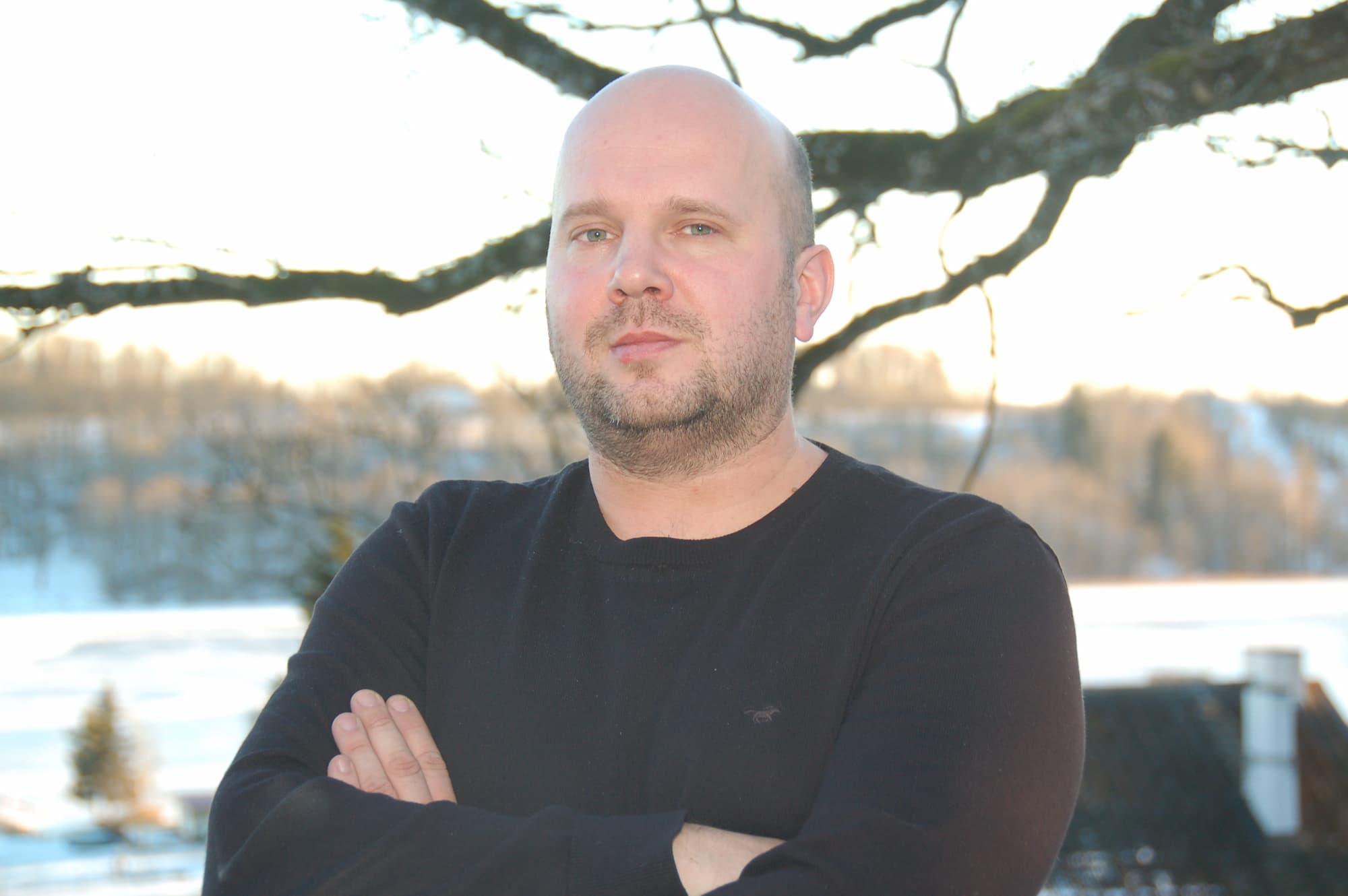
Madis Reinup, a members of the Rural Development Foundation’s three-person management board.

The Estonian Rural Development Foundation was established in 1993 with funds from various donors that became available when the country became independent. Today, the foundation is using these funds to implement programmes that support the economic development of rural Estonia.
The Rural Development Foundation (RDF) is housed in a painstakingly restored old building overlooking the lake in the town of Viljandi, a couple of hours south of Tallinn. The foundation was formed from the merger of two funds, the Agriculture and Rural Life Credit Foundations and the Rural Life Guaranteeing Foundation, and has an equity of EUR39m. This sum is used to support business activities in rural areas and thereby promote the economic development of these areas.
Four main areas of activity
The RDF has different tools to achieve its objectives. Madis Reinup, one of the members of the foundation’s three-person management board, explains that the organisation has four broad areas of activity: issuing guarantees for companies that are taking a credit or other debt obligation; loans; management of the Estonian Agriculture and Rural Economy Advisory Service; support for students of rural economics as well as awards for rural entrepreneurs. The guarantee obligations currently stand at EUR54,4m in different business sector. The agriculture sector has the lion’s share at 40% followed by commerce and storage at 14%. Guarantees for the aquaculture sector are in fact only 0,8%, almost the smallest of all the sectors. The RDF guarantee scheme provides a guarantee to a bank that is issuing a credit to an entrepreneur. Up to 80% of the value of the credit subject to a maximum of EUR2.5m per borrower can be guaranteed by the foundation. In 2013 the guarantee portfolio amounted to EUR53m. There are also other conditions regarding the guarantee, for example, the business (unless it is food processing) has to be based outside Tallinn.
It is in fact the bank which is issuing the credit that evaluates the application and decides whether it requires a guarantee. If the company cannot offer adequate collateral the bank will approach the RDF, where experts will evaluate the project and decide whether a guarantee can be issued. Guarantees are not cheap, says Mr Reinup. The client will pay perhaps 5% on his loan and, on average, an additional 2.8% for the guarantee. However, our guarantee covers projects that, from a financial point of view, are more risky. The best investments are those, where the entrepreneur has capital, and there are no banks involved. The second best are the ones where the entrepreneur borrows from the banks, but has enough collateral. Then in the third category are those who probably do not have enough collateral, and the projects are more risky, which makes the loan a lot more expensive, but still the RDF will guarantee these loans.
The foundation thrives in times of crisis
Once the guarantee is issued RDF will not monitor the company on a day to day basis but perhaps once a quarter… In 2015 things may be worse as a result of the crisis in the agriculture sector brought on by the ban on exports to Russia, which absorbs almost a fifth of Estonia’s agricultural exports. On the other hand the more general economic crisis triggered in 2008 has made banks very much more cautious about lending. As a result the RDF has seen a steep increase in the number of guarantee contracts, which jumped from 82 in 2008 to 340 in 2011, falling slightly to 323 in 2013. Some of these clients are in fact less risky than the average RDF client, which could mean that the quality of the EUR54,4m portfolio increases. It seems sometimes that the fortunes of the companies move in the opposite direction to the fortunes of the foundation. Any kind of crisis which has an impact on the agricultural or other rural sectors, whether financial, economic, or commercial, brings more clients to the foundation as banks react and decide that they can only make loans with a guarantee. Another contradiction that can be seen is that the loans RDF guarantees are often for the purchase of equipment that make companies more efficient, a development that invariably leads to job losses. That is where giving guarantees to new enterprises (a trade-off between risk and new jobs) becomes very important, when developing rural areas.
The foundation also has a lending scheme under which it loans money to banks. For agriculture and aquaculture RDF has a special lending scheme whereby it loans money to the banks for them to lend it further to companies. This is a relatively modest scheme which lends a few million euro a year in long-term loans to SMEs. Here, the limits are EUR1.5m per company and a maximum term of 25 years with a fixed interest rate. Over and above this scheme which goes through banks the foundation also lends directly to distressed companies. This too is a relatively small amount of around EUR2.5m a year and a total portfolio of EUR6.5m in 2013. The maximum amount is half a million euros at a rate of 4-5%. The difference between lending directly and guaranteeing a loan from a bank is profound. A million euro can be used to lend one million euro, but can guarantee loans up to five million, enabling huge multiplier effects. As Madis Reinup says, with an equity of almost EUR40m we could easily have a portfolio of EUR160m instead of today’s EUR55m. However, our high liquidity in the current situation means that banks are more than happy to work with us.
Financial instruments have an important role to play
The foundation manages financial instruments co-funded by the EMFF. This money is used together with funding from a bank to give long term loans to projects such as those in the aquaculture sector, which have a long gestation period. The projects now being funded with these financial instruments include recirculation systems and the processing facility for an aquaculture Producer Organisation. Even with the co-funding banks are sometimes reluctant to lend money – partly a consequence of the Basel III commitments, which force banks to be more conservative. Another reason is that banks are uncertain themselves about the direction of the economy and are therefore reluctant to commit themselves.
| Rural Development Foundation (Maaelu Edendamise Sihtasutus) | |
|
Oru 21 Tel.: +372 648 4064 | Management Board: Raul Rosenberg, Andres Vinni, Madis Reinup Equity capital: EUR38.8m Main activities: Providing SMEs with guarantees for credit/other debt obligations; loans Main business sectors: Agriculture, storage, bioenergy, service sector industry |
The Ministry of Agriculture has completed a study to identify where market failures are preventing the flow of funding. It shows that loans of less than EUR100,000 are of no interest to banks and in sectors, where loans are very long term. The foundation will use EUR10m for fisheries/aquaculture and EUR38m for agriculture from EMFF/EAFRD to remedy these failures. Depending on the financial instruments chosen by policymakers, the foundation will perhaps run a guarantee fund with very low interest rates of, for example, 1% for young entrepreneurs just entering the field or for activities in certain sectors. Mr Reinup is a keen supporter of the financial instruments as it will enable the foundation to be more flexible and creative in lending money, which from a tax payer’s view point is a preferable alternative to financial support. There is always an element of risk in the kind of activity that the RDF specialises in. Despite this the Rural Development Foundation is financially self-sufficient and cover all its expenses. It is therefore very sustainable in contrast to most state foundations, which need periodic injections of capital.