Kristian S. Ottesen (left), director and co-founder of Nordisk Tang, and Heine Max Olesen, co-founder, and the person responsible for marketing. They aim is to offer products that taste good, look appetising, and are healthful to boot.

While algae production and consumption is well established in Asia, in Europe it is less well known. However, as consumers focus increasingly on health and information about the benefits of algae become more widespread, this may be changing.
For centuries seaweed has been consumed in parts of Asia, where it is known for its health benefits. Marine algae are a rich source of minerals, trace elements, healthy fats, and even proteins, and are highly appreciated in Japan, China, and Korea, among other east Asian countries. in Europe, however, in the past algae have been used mainly as cattle fodder, as a fertilizer, or dried as a fuel.
Seaweed has huge potential
As the world shrinks, food habits are establishing themselves far removed from where they originated. Interest in seaweed is growing for a variety of reasons and researchers are investigating local waters to identify and analyse the species of marine algae that grow within them. In Denmark, there are over three hundred species of algae broadly categorised into red, green, and brown algae and research is ongoing to find out how they can profitably be produced and used, as a source of bioactive ingredients, fuel, feed for piglets and cattle, and, of course, for human consumption.

Nordisk Tang is a Danish company based in Grenaa in Jutland that is manufacturing a variety of products based on tang, the Danish word for seaweed. Kristian Ottesen, the director, recalls how, from the merger of two smaller firms, the company was formed in 2015 to develop an industry within gourmet products using seaweed. Although seaweed has been used for many years in Denmark, it has mainly been for the production of carrageenan, a gelling and stabilising agent for foods. Unlike carrageenan, however, seaweed in Nordisk Tang products is not an obscure name featuring at the end of a long list of ingredients, but the unique selling point of the item. Seaweed is highly nutritious with a number of natural benefits, and can be produced sustainably all around the country, says Mr Ottesen. As a smallish country with lots of islands no point in Denmark is more than 50 km from the sea, so a local supply of fresh seaweed should not pose a challenge. At the company the idea behind creating seaweed based products was not only to capitalise on the health aspects but also to exploit some of the other properties of seaweed, including mouth feel, flavour, salt reduction, and preservative. The line of products using seaweed started with pestos, salts, and spices, and today includes also flours, mustards, and oil.
Building a market for seaweed products
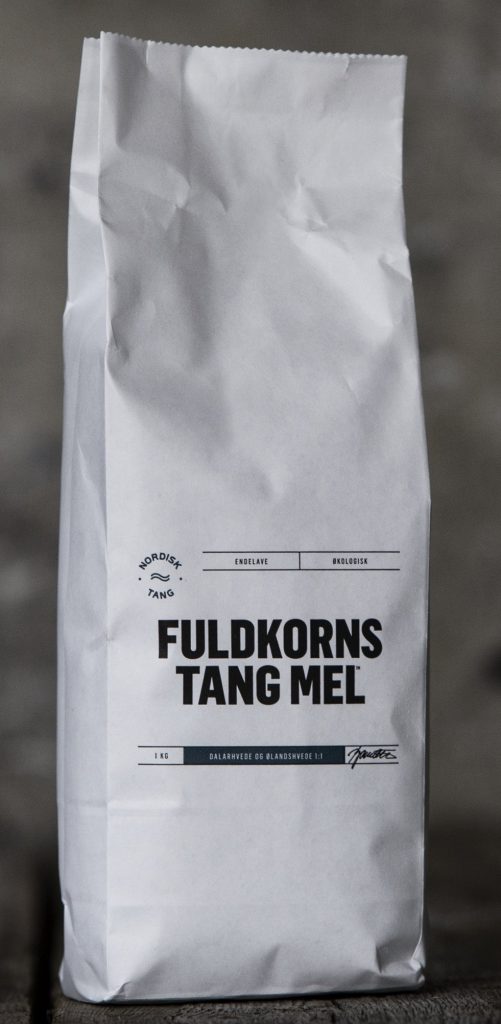
The whole point behind these products is not only that they are healthy, but that they, unlike for example cod liver oil, also taste good, and we are working hard at making it trendy and sexy to eat seaweed, says Mr Ottesen. To build this image the company has eschewed traditional retail chains as outlets for its products concentrating instead on delicatessen food shops, fishmongers, butchers, even interior design studios. For the moment at least, these points of sale harmonise well with the image the company is trying to create, and then there is the not insignificant matter of the price. At DKK50 for a jar of pesto the products are aimed at the upper end of the market, while the vast majority of consumers have not yet reached the stage where they will select a DKK50 jar as opposed to one for DKK15, says Mr Ottesen diplomatically. So far, some 150 shops across the country are selling the company’s wares. The next expansion to the range of items will cater to existing markets for seaweed products such as seaweed salads, seaweed chips, and the thin layers of nori seaweed that are used to produce sushi. The advantage of this range is that they do not have to be created from scratch nor does the market for them have to be developed. The new products will piggyback on similar items that already exist on the market, but will highlight their Scandinavian origin, and the fact that they are organically produced and sustainable to differentiate themselves.
New products demand greater volumes of raw material
The new line of products will demand much greater volumes of raw material than are currently being processed. While the pestos, flours, oils etc. consume about 10 tonnes of seaweed a year, the salad production will call for 1-2 tonnes a week. This means that the seaweed will have to be cultivated locally as opposed to being imported from Norway, which is the case at the moment, as the transport costs will be prohibitive. Seaweed can also be harvested from the wild, but this typically means trawling for it, which can have negative impacts on the environment. Since sustainability is an important selling point farming seaweed is the only answer. The company is collaborating with a local partner as well as one in the Netherlands with regard to the cultivation and harvesting of seaweed. The Dutch company collects the seaweed spores from the water in Grenaa and takes these back to the Netherlands where they are grown in a hatchery. The lifecycle of marine macroalgae is often complex with several stages and different cultivation periods, with some species growing better in winter and others in summer. The product from the hatchery is brought back to the place of origin of the spores on lines and spends the next 3-5 weeks on shore before being introduced into the sea. The lines are attached to ropes that are suspended in the water and the seaweed is allowed to grow for about six months from October to March. From March to May the seaweed is harvested. The first crop is the best and is used for human consumption. If the lines are left in the water it is possible to get a second crop, but the quality is inferior and it can only be used for feed or as a source of bioactive ingredients.
| Nordisk Tang | |
|
Grenaa +45 33 603 603 Director: Kristian S. Ottesen |
Products: Seaweed-containing products including pesto, flour, mustard, and salt Sales: Delicatessen shops in Denmark |
Markets around Europe beckon
Nordisk Tang uses seven different species of seaweed based on their flavour, the ease with which they can be accessed, and the colour. As Mr Ottesen says, the product must appeal to the eye as well as to the palate and so it is important to have different colours of seaweed in, for example, the pesto. Now that it has persuaded people in Denmark to eat its products the company is looking at expanding sales abroad, initially in the neighbouring countries, Sweden, Norway, and Germany, where a shop has just been opened in Berlin, but in time also Italy, Spain, Switzerland, and the Netherlands. In the long term, Kristian Ottesen, who has spent some eight years in China, would like to sell his products there, where he feels an ancient tradition for eating seaweed combined with enthusiasm for European food products will help his case.