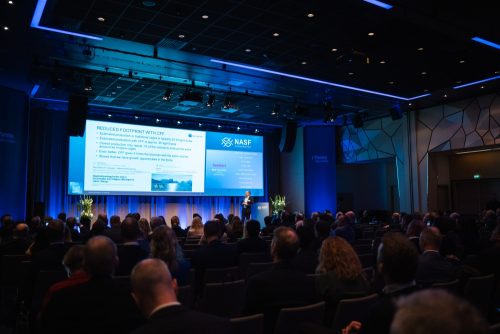
The North Atlantic Seafood Forum (NASF) has become a barometer for the seafood industry. The event has grown rapidly in scale with more than 1,150 seafood executives, experts and investors gathering in Bergen in early March marking it as one of the seafood sector’s principal global meeting points.

Over three days, the forum covered technology, pelagic fisheries, salmon markets, sustainability, whitefish, aquafeed, private equity and infrastructure, new production technologies and artificial intelligence. But since the pandemic, the war in Europe, energy volatility, tighter capital markets and more fragmented trade conditions, resilience has become the language through which food industries now discuss growth. At NASF, technology sessions focused on operational efficiency, fish welfare and data-driven management. Market sessions focused on supply, demand and price volatility. Sustainability sessions focused on reputation and long-term licence to operate. Sessions on risk and growth explicitly addressed cost inflation, supply-chain disruption, regulatory change and changing consumer preferences. What emerged was a sector increasingly aware that competitiveness now depends on resilience across biology, feed, energy, logistics, finance and policy.
Aquaculture has a role to play in food security
Europe’s food-security debate is still dominated by land-based agriculture, but the strategic case for aquatic food is strengthening. The European Commission states plainly that aquaculture contributes to food security noting that aquaculture can produce food and feed with a lower climate and environmental impact than some other forms of farming and can reduce pressure on land. FAO reported in 2024 that aquaculture had, for the first time, surpassed capture fisheries in aquatic animal production, and it projects further growth in aquatic animal production to 2032. Blue proteins are becoming central to the future food equation.
Europe’s own production base remains comparatively modest. EU aquaculture output in 2023 stood at almost 1.1 million tonnes, worth €4.8 billion, according to Eurostat. In contrast EU fish landings in 2024 were estimated at 3.2 million tonnes, worth €5.5 billion. Europe is thus still more dependent on capture fisheries than aquaculture for aquatic food output, even as global development is moving the other way. If Europe wants more resilient food systems, shorter supply chains and a stronger domestic protein base, it cannot avoid the question of how much more aquatic food it is prepared to produce itself. The industry in Bergen was making the case that current regulatory and administrative frameworks often work against the very production growth that public policy says it wants.
Regulation prevents the sector from taking off
The Commission’s own 2024 staff working paper found that 17 member states identified complicated and lengthy licensing processes as specific bottlenecks. A related paper on access to space and water for freshwater and land-based aquaculture notes that multiple authorities may be involved in administrative procedures for land-based systems, creating added challenges for planning and licensing. This is the contradiction at the heart of European aquaculture policy. The sector is expected to contribute to food security, rural and coastal development and environmental transition, yet it often faces permitting structures that are split among different regulatory bodies, are slow, and costly.
Land-based aquaculture illustrates the point particularly well. NASF gave clear prominence to new production technologies, including land-based systems. Recirculating aquaculture systems can offer tighter biosecurity, easier waste capture, more controlled production conditions and, in some cases, production closer to market. But these systems remain a small fraction of Europe’s aquaculture output and they carry high capital costs, high operating costs and high energy consumption. The Commission’s 2024 energy-transition paper further underlines that aquaculture installations require a steady supply of electricity and that many efficiency gains depend on substantial up-front infrastructure choices. Land-based aquaculture is a capital-intensive food industry segment that calls for a significant degree of expertise to run successfully.
A relatively small sector carries a heavy regulatory burden
Using Eurostat’s latest figures, EU aquaculture produced almost 1.1 million tonnes in 2023. By contrast, the EU produced 21.1 million tonnes of pigmeat, 14.1 million tonnes of poultry meat, 6.6 million tonnes of bovine meat and about 0.4 million tonnes of sheep and goat meat in 2024. Combined, that is more than 42 million tonnes of terrestrial meat output. The aquaculture sector remains small in absolute production terms while often carrying a regulatory burden that industry participants argue is disproportionate to its current scale and strategic importance.
Feed was another area where resilience and growth converged. NASF’s aquafeed sessions and adjacent discussions on nutrition made clear that future production gains depend as much on input systems as on farms themselves. Feed innovation, operational efficiency and nutrition are now strategic board-level issues. Without reliable, scalable and sustainable feed ingredients, there is a natural ceiling on how far aquaculture can expand. The discussion on feed showed that seafood’s role in food security depends on the strength of the whole value chain.
Industry is ready to engage, but are the policymakers?
Europe needs more resilient food systems which include blue proteins. But if Europe wants aquaculture to attract more investment and deliver more food, it will need regulatory systems that are faster and less obstructive. NASF 2026 showed an industry ready to discuss sustainability, welfare, and energy use but also one that is increasingly impatient with the disconnect between the ambitions for European aquaculture and the actual policies that regulate the sector. The strategic need for blue proteins has rarely been more obvious, yet the path to producing more of them in Europe remains unnecessarily difficult.
Christian Philip Unmack