The manager (left) of the Zeimena hatchery, where the Fisheries Service has a breeding programme for salmon and sea trout. Ieva Zundiene, Chief Specialist in the Fisheries Policy Division

Lithuania’s inland waters are home to a number of species of which several are of commercial importance. The most important inland fishery takes place on the Curonian Lagoon, a water body separated from the Baltic sea by the Curonian Spit, but several lakes and rivers also have an inland fishery.
The inland waters in Lithuania have an area of some 2,600 sq. km and include lakes, rivers, and most importantly the Curonian Lagoon. The lagoon has a total area of about 1,600 sq. km and is divided into a Lithuanian part in the north and Russian part in the south. The Lithuanian area is about a quarter of the total. These waters are home to a wide variety of species including perch, roach, pike-perch, bream, vimba, smelt, pike, silver bream, crucian carp, burbot, twaite shad, sabrefish, stickleback, European eel, ruffe, asp, and common whitefish, however the main commercial species are pike-perch and bream. About three quarters of the commercial freshwater catch come from the lagoon and amounted to just over 1,000 tonnes in 2014. The other main sites for commercial freshwater fishing are the Kaunas reservoir and the lower Nemunas river.
Several species of fish bred for restocking
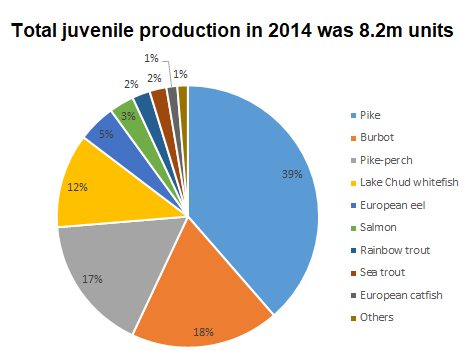
Freshwater angling is a popular pastime in Lithuania with an estimated one in six people practicing it. Accurate figures are hard to come by as data on the number of anglers and their catches is not recorded. In addition to the local angling fraternity,y Lithuania is also a destination for tourists from other parts of Europe interested in pleasure fishing. Freshwater fish stocks in Lithuania are thus important from an environmental and a commercial point of view and the authorities in the form of the Fisheries Service implement a programme to ensure that the stocks are healthy and will remain so also in the future. Breeding and restocking activities are an important part of this programme and the service has a network of six centres that breed different species of fish as well as crayfish. In 2014 juvenile pike (3.1m), pike-perch (1.3m), and burbot (1.5m) accounted for two thirds of the total production. Juveniles of other species that were bred included whitefish, rainbow trout, salmon, European eel, and European catfish.
At the Zeimena hatchery the Fisheries Service maintains a breeding programme for Atlantic salmon and seatrout. About 50 individuals of each species are caught in the wild each year. These will form the broodstock. The seatrout are usually 5-6 kg when they are caught, while the salmon have been known to be up to 20 kg, though around 10 kg is more common. The fish are stripped of the eggs and the milt and then released. The fertilized eggs are stored in incubators for around three months. Once the eggs hatch the alevins are grown to 3 g and in spring the fry, as they are now called, are released into rivers. Approximately, 500,000 eggs are hatched, half each of salmon and seatrout, and about 10% of this number is grown until the following spring, when they reach 50-80 g before they are released. This distribution is an experiment to find out whether survival rates can be improved further.

|
|
Breeding programmes benefit the region
Twenty years ago neither salmon nor seatrout could be found in Lithuanian rivers. A combination of overfishing, damage to their habitats, and pollution were among the factors that decimated the stocks. The breeding programme helps to repopulate the rivers and the Baltic Sea with these species. Both salmon and seatrout are anadromous, that is they breed in freshwater, where they live for one to five years and then travel down to the sea for a long period before returning to the river to breed. In the hatchery the mortality rate among the alevins is 20% while in nature it is 98%. The ministry of environment maintains a red book containing the names of species that are endangered in Lithuania and seatrout was removed from this list in 2013, while salmon was delisted in 2014. Despite the new status of these two species, the breeding programme for both salmon and seatrout will continue as it serves a useful purpose and the hatchery has now built up a significant competence in breeding and releasing the fish which benefits not only Lithuania but several of the countries surrounding the Baltic Sea. Salmon have long migration routes travelling up to 2,000 km away from where they hatched before heading back to spawn in turn. As a result fish hatched in Lithuanian rivers may turn up in any of the countries around the Baltic. Seatrout however does not travel as widely, mostly spending their time in coastal waters a few hundred kilometres from their home rivers. Fish from the hatchery also populate rivers in Lithuania, which benefits anglers. The fish breeding programme is replicated in one way or another in many of the countries bordering the Baltic Sea.
Groundwater reduces the risk of pathogens
| Zeimena Hatchery | |
|
Meskerines vil. Tel.: +370 387 49130 Activities: Breeding fish for restocking | Species: Salmon, seatrout, grayling Capacity: Approximately 500,000 eggs Water supply: Ground water System: Recirculation Number of employees: 19 |
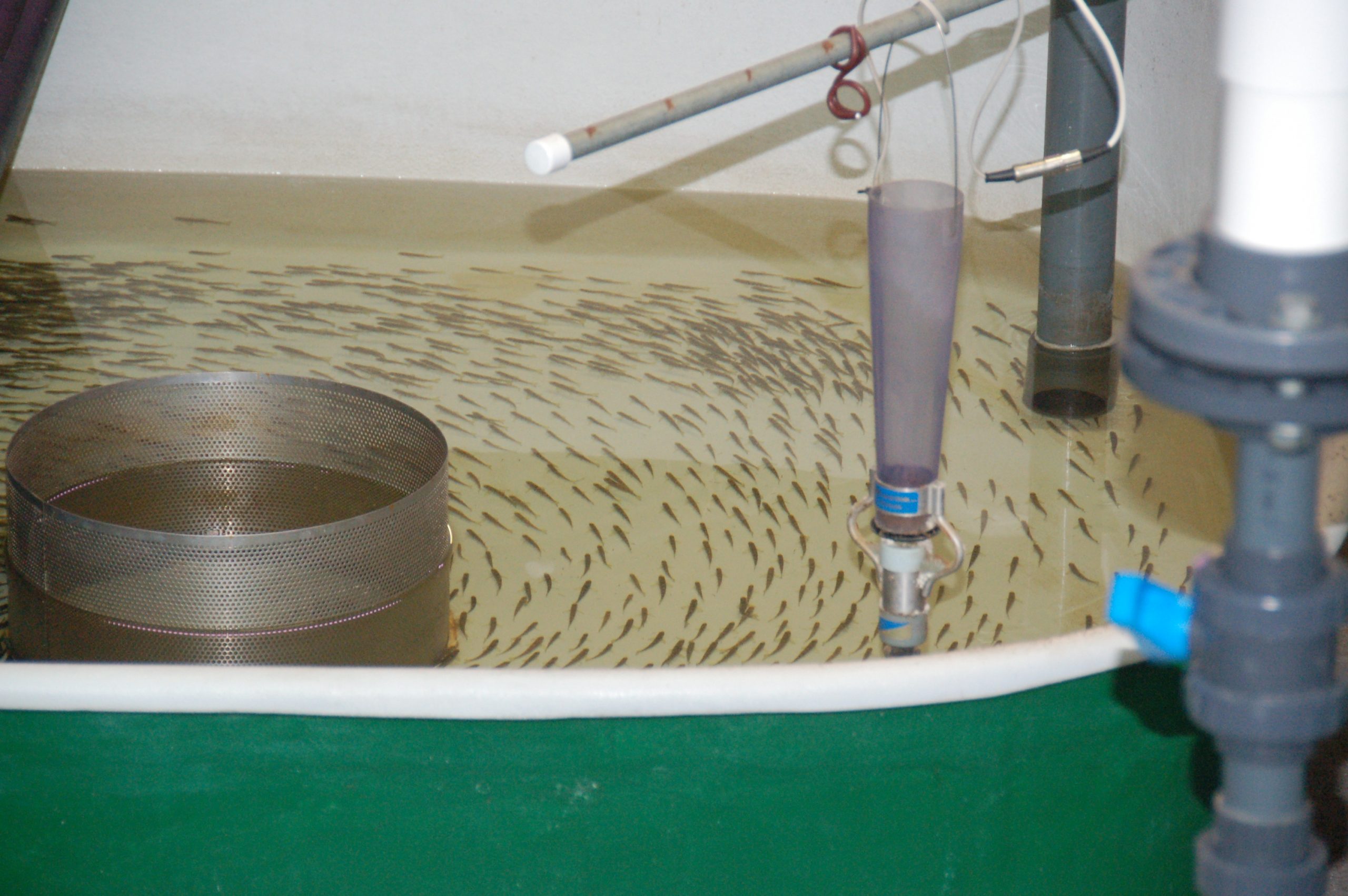
At the hatchery another freshwater fish, grayling, is also being bred as an experiment to see whether it too can be bred and restocked. Today the juveniles are a month old. Grayling is a popular species among local fishermen and the hatchery is breeding it for the third or fourth year, from broodstock harvested from the wild. The entire hatchery runs on water that comes from the ground and is circulated through the system after adding oxygen and filtering. The advantage of using ground water is that there is less risk of pathogens being present in the water, it is free of debris, and it comes at a more or less uniform temperature.
The success of the breeding programme for salmon and seatrout demonstrates that the connections these fish need between the rivers, coastal zones, and the open sea are functioning. While the problems of biology and geography appear to have been solved, for these populations to really thrive in the long run other factors, economic, social, and environmental, will also need to be addressed.