Aivaras Labanauskas, Vice Director of Atlantic

Lithuania’s high seas fishing fleet comprises some 12 vessels, a number which has stayed fairly stable the last few years, but which can also fluctuate depending on fishing opportunities. The fleet has been active in the Northwest and the North East Atlantic, the South Pacific, the EU Western Waters, as well as in the Svalbard fishing area, and the exclusive economic zones (EEZ) of Mauritania, Senegal, Guinea, Morocco, and Greenland.
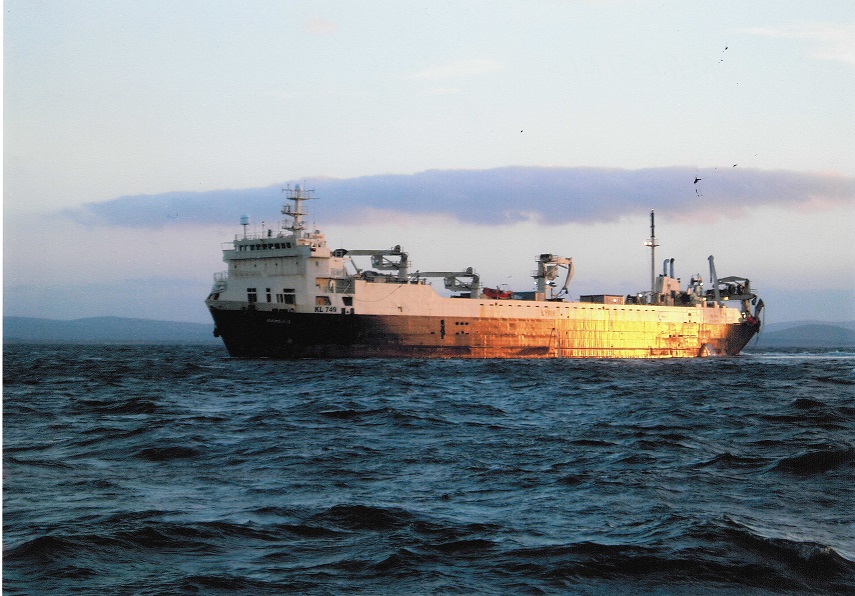
Among the Lithuanian firms that own high seas fishing vessels is the Atlantic High Seas Fishing Company, an enterprise established in 1995, which today is part of the Dutch PP group. Atlantic, one of a handful of Lithuanian high seas fishing companies, has two vessels, one in the northern Atlantic targeting mainly redfish, cod, and other species found in the area. The other is the 143 m pelagic freezer trawler, the Margiris, which is currently fishing in the south Pacific, but which has in the past been active in Mauritanian waters, and in the north Atlantic. The fishery in the south Pacific is for the Chilean jack mackerel, a stock which is managed by the South Pacific Regional Fisheries Management Organisation (SPRFMO).
Atlantic has been fishing in the area for many years, even before the SPRFMO was established in 2009.
Lithuanian high seas quotas vary widely
Total Lithuanian quotas for the high seas fisheries have seen significant fluctuations. Between 2009 and 2014 they fell from about 146,000 tonnes to roughly 137,000 tonnes a drop of only 5%, but this hides substantial variations. For instance, in 2012 the total high seas quota fell by 56% to 54,000 tonnes thanks primarily to a lack of quota in the Moroccan EEZ. In 2014 however, the total quota was boosted by allocations from Morocco and a big increase in the quota in EU Western Waters. The quota in the Mauritanian EEZ has over the last six years on average amounted to two thirds of the total quota from all fishing areas, so the loss of this will be felt keenly by Lithuanian vessels. While Atlantic has two vessels today, it had three in 2009, a development Aivaras Labanauskas, the vice director of Atlantic, explains in terms of the company’s needs, and the quotas available. If another company in the group needs the vessel more than we do then the registration is transferred, he says, but it is not something that is done on a regular basis. For the moment, even with two vessels Atlantic could fish more if the quotas were available.
The quotas from the regional fisheries management organisation are distributed among the contracting parties. Quotas allocated to the EU are then given to the relevant EU countries based on a distribution key. The countries then distribute them among their companies. In Lithuania, for example, quotas are distributed to the companies based on their historical catches and the utilisation of the quota. Mr Labanauskas has no complaints regarding the system of quota distribution, calling it a transparent and objective system that rewards vessels that utilise their quotas and do not engage in any illicit activities, with quotas again the following year. For the fishing companies, he says, the most important thing is stability. We need to know that there will be no sudden changes in the system and that if we fish well we can expect quotas again the next year.
An efficient fishery depends on quota swaps
The high seas fishery is characterised by quota swapping as it allows companies to use their resources most optimally. Quota swapping is a common and very frequently used practice under the Common Fishery Policy. Mr Labanauskas says that Atlantic swaps quotas with other companies, both those within the PP group and those without. Of course it is easier within the group as we cooperate closely with companies and countries that are represented in the group, he adds. Swapping is essentially about making things work. In the case of Lithuania, quotas in the North Atlantic are very small and it is not worth it, for example, to sail to the coast of Canada to fish for a species for which the company has a very small quota. A swap will allow a quota that a company does not intend to fish to be exchanged for a quota for a species or in an area that the company is planning to fish. In this way small quotas can be swapped to accumulate a bigger quota in a single area which it makes sense to fish. While this is a general rule, there are also years, where the company might decide against swapping and choose instead to try and fish the quota it was originally allocated. Naturally, effecting a quota swap calls for two willing parties, and so for highly valued quotas the chances of being able to swap are minimal. But swapping is a common business practice that enables better and more efficient utilisation of the quotas and without them fisheries in certain areas would probably not exist. Among its other advantages quota swapping concentrates scattered quotas on to fewer vessels which has benefits for the environment. Instead of five vessels fishing smaller amounts swaps allow one or two vessels to fish larger volumes, saving on fuel. Swaps that take place between EU-flagged vessels are the easiest to make as the procedures are common to both parties. With third parties it is more complicated, but not impossible and depends also on the regional fisheries management organisation. In NAFO, for example, Mr Labanauskas says swaps are common, but in NEAFC it is still not possible to swap with third countries.
Atlantic catches; leaves sales to others
The fishing vessels also have onboard processing capabilities so fish that is caught can then be sorted, filleted and finally frozen as per the customers’ specification. Fish frozen on board is typically high quality as it is frozen very quickly after being caught. Being part of a large group means that all the sales and marketing is taken care of by other divisions so Atlantic can concentrate on catching the fish. Fishing operations result in a certain amount of collateral damage, bycatch, seabirds etc., but according to Mr Labanauskas neither is really an issue for the company. Both the redfish fishery in the north Atlantic and the jack mackerel fishery in the South Pacific are fairly clean and in other cases the bycatch is usually not of regulated species. To prevent seabird casualties the trawls use seabird mitigating measures as specified by the fisheries management organisation that prevent seabirds from entering the trawl.
| Atlantic High Sea Fishing Company | |
|
(Member of the PP Group) Tel.: +370 464 931 05 | Vice Director: Mr Aivaras Labanauskas Fleet: Two freezer trawlers Operations: Currently in the South Pacific and the North Atlantic Species: Jack mackerel (South Pacific), redfish, cod (North Atlantic) |
The important issue for Atlantic today is neither bycatch nor seabird protection, but the lack of an agreement between the EU and Mauritania. Currently, the protocol with Mauritania is suspended, and so despite a long history of having fished in Mauritanian waters Atlantic cannot send its vessels there, which is a significant setback for the company. Quotas are diminishing all over the world and if yet another region closes, it will be a blow for any fishing company, says Mr Labanauskas. He is therefore hoping that a new protocol will soon be signed with Mauritania. The Lithuanian high seas fishery has a long history and has evolved significantly over the years becoming smaller and more efficient as quotas have trended downwards. The ability to recover from setbacks is one of the characteristics of this sector and in the event of the loss of fishing grounds in the Mauritanian EEZ, this resilience will stand the sector in general, and Atlantic in particular, in good stead.