This article was featured in Eurofish Magazine 6 2026.

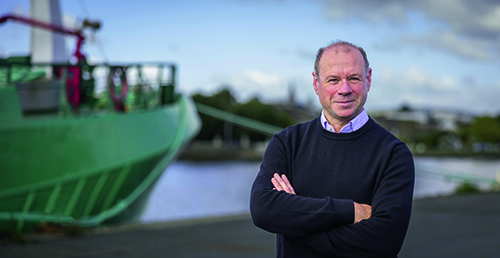
Richard Donnelly took over as chief executive of Ireland’s seafood development agency in May 2026, at a time of shrinking fishing opportunities and growing pressure on coastal businesses. He believes BIM’s next strategy must turn innovation and public investment into measurable commercial results.
As in countries across Europe, the challenge facing Ireland’s seafood sector is increasingly a question of what the industry can earn from the resources available to them. As newish chief executive of Bord Iascaigh Mhara (BIM), Ireland’s seafood development agency, Richard Donnelly oversees an organisation that supports fishing vessels, aquaculture farms, and processors with technical expertise, training, and investment assistance. The task is especially demanding at a time of falling quotas and high costs, and relentless international competition.
Mr Donnelly became permanent CEO in May 2026, having held the position on an interim basis since November 2025. Previously BIM’s director of development and innovation services, he brings more than 30 years’ experience in seafood, including commercial roles in international markets. His appointment coincides with the final year of BIM’s Turning the Tide -strategy 2022–2026, and preparation of its successor, expected in the first quarter of 2027. He credits Turning the Tide with helping BIM and the industry navigate the consequences of Brexit and the disruption from the pandemic. Its emphasis on new markets, innovation, and extracting greater value from catches remains relevant. But he wants the next plan to shape every BIM work programme and funding decision more directly. What we want to do is fundamentally embed the strategy, the new one, into everything that we do, he says. This entails shifting the -focus from volumes produced to one that emphasises extracting the most value from the raw material.
Coping with a smaller catch
Irish vessels landed 184,949 tonnes of seafood worth €346 million in 2025. Landings declined by 11% in volume but increased by 7% in value, helped by strong prices for mackerel and Dublin Bay prawns (Nephrops norvegicus). The outlook for 2026 is less promising. BIM estimates that Ireland’s fishing opportunities fell by approximately 52,200 tonnes, representing €77 million in potential first-sale value, compared with 2025. In the pelagic fleet, numbering roughly 25 vessels, the 2026 quota reductions included cuts of 48% for mackerel and 41% for blue whiting. High prices have softened the immediate effect of lower supplies, but Mr Donnelly warns that this protection is fragile. If that higher price drops, he says, the consequences for vessel economics could be severe. In other fleet segments, for example, vessels targeting demersal fish and Nephrops, BIM is working with Ireland’s food promotion agency, Bord Bia, to develop markets beyond traditional destinations such as Italy and Spain and China has emerged as an increasingly important opportunity growing 62% by value in 2025. Another way to protect margins is through gear modifications to reduce drag which lowers fuel consumption. In the case of inshore vessels, predominantly catching crab, lobster, and whelk, closer links with processors and a better match between landings and market demand should preserve profitability. Improved returns also depend on healthy stocks. BIM’s 2025 lobster v-notching programme involved almost 240 fishers and marked a record 61,000 lobsters to protect breeding females. Ultimately, the aim, says Mr Donnelly, is to secure more value from everything that is landed, rather than simply increasing catches.
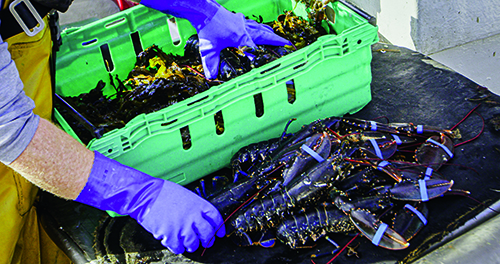
In 2025 BIM’s lobster notching programme involved 240 fishers and marked 61,000 of the creatures to protect breeding females.
Another potential challenge to the fisheries sector is the proposed offshore wind developments, particularly along the east coast, which could overlap with fishing grounds for whelk, crab, Nephrops, and seed mussel fishing. Marine protection measures will also affect how space is allocated. BIM’s response has been to collect data on fishing activity and its wider economic significance. Smaller vessels often lack vessel monitoring systems, leaving important gaps in spatial information. Mr Donnelly points out that a trawler cannot always interrupt a tow at the boundary of a proposed development and resume it on the other side. Displacement can also affect processors and jobs ashore. By mapping fishing patterns and contributing evidence to liaison groups, BIM hopes to ensure these effects are considered before decisions are taken.
Aquaculture value largely stable in 2025
Although expansion has been slow, aquaculture offers a different set of opportunities. Production value from farmed fish and seafood stood at €210 million in 2025. Organic salmon (all salmon farmed in Ireland is organic) accounted for €148 million, while farmed rock oysters contributed €47 million. Salmon exports alone were worth €139 million. However, though salmon volumes rose in 2025, average prices fell by about 20%, limiting value growth. Oyster and mussel growers faced weaker prices too. Access to high-quality seed and spat remains crucial for the shellfish farming industry along with stable conditions in the environment and on markets. Mr Donnelly argues that Ireland must distinguish its products and move higher up the value chain. For oysters, that means promoting Irish brands and premium grades, while developing demand outside the established French market. Domestic oyster consumption and tourism-related sales are also becoming more important.
More generally, the main obstacle to expanding aquaculture production, according to Mr Donnelly, is the system of licensing. BIM has been studying approval systems in countries including Norway, Denmark, and Canada to identify practices that could inform Ireland’s procedures. There’s no silver bullet here, he acknowledges. Producers are therefore concentrating on what they can change within existing farms including rolling oyster bags that reduce labour requirements, improved salmon-farm monitoring, and technologies for collecting mussel seed more reliably.
Research must have practical applications
Translating research into solutions is a key part of BIM’s development role. In October 2026, five aquaculture research projects received a combined €1.25 million through the
BIM-administered Knowledge Gateway Scheme. They address issues ranging from mussel biofouling and salmon health to the environmental contribution of shellfish farming and commercial uses for seaweed. Mr Donnelly offers tube worms on mussel shells as an example of the applied nature of the research that BIM supports. Although the organisms do not harm the mussels, they can impair appearance and increase handling costs. Better knowledge of settlement periods could allow farmers to adjust their operations without relying on chemical treatments. BIM also works with Hatch Blue, an investment firm specialised in aquaculture, through its aquatech innovation programme to help start-ups refine ideas, obtain mentoring, and connect with potential investors.
Processing for international markets
For seafood processors, the main challenge is obtaining sufficient raw material while retaining competitiveness. BIM’s latest processing figures, for 2024, put turnover at €1.05 billion across 99 enterprises. Imports are already integral to the sector reaching €435 million, while seafood exports rose to a record €758 million. Mr Donnelly sees automation and product development as the way forward for the sector. Irish processors cannot expect to be the cheapest suppliers, he argues, so their offer must rest on consistent quality and products that save customers preparation time. He cites a boneless mackerel fillet developed for the Japanese market as an example of converting a traditionally whole-frozen export into a more convenient, higher-value product. At Killybegs, Ireland’s largest port for pelagic fish landings, reduced pelagic quotas have increased interest in attracting landings from foreign vessels to maintain raw material supplies for processors. Mr Donnelly believes that efficient handling and higher-value processing can make such arrangements attractive to vessels and Irish factories alike.
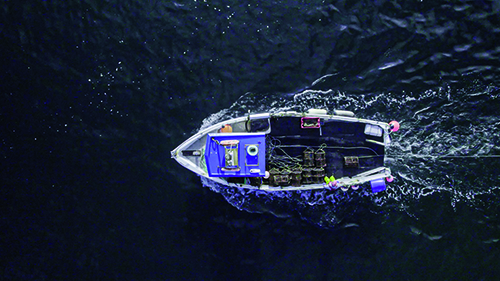
The Irish inshore fleet targets crabs, lobsters, and whelks primarily.
Decarbonisation presents a similar need for commercially feasible innovation. Without a major fleet-renewal funding scheme, BIM has concentrated on measures that can be tested on existing boats. These include less resistant fishing gear, altered mesh configurations, and improved hull coatings. Trials of shorter Nephrops tows have also indicated potential fuel savings without reducing catches. Electric propulsion is a promising longer-term experiment for smaller inshore vessels, where it could strengthen the environmental credentials of crab, lobster, and whelk products. The new strategy due to be released in spring 2027 will offer ideas to increase the sustainability of the fleet, says Mr Donnelly, but he acknowledges that funding for a fleet-wide conversion away from fossil fuels is not available.
New value from marine resources
In the future the blue bioeconomy will becoming another pillar of the Irish seafood sector alongside fishing, processing, and aquaculture. Mr Donnelly points to Marine Health Ingredients in Arklow, which extracts components from oyster meat for health supplements. In the aquatech sector, he highlights SeaQuest Systems in Killybegs, whose fish-handling expertise has been adapted for aquaculture equipment. SeaQuest received BIM’s 2026 Aquatech Business of the Year award at the Blue Ambition conference in Dublin. A BIM-commissioned scoping study of the northwest identifies opportunities to obtain higher-value ingredients from fish by-products and other marine biomass. It also warns that most fishing and processing businesses need help understanding markets and accessing suitable pilot-scale facilities. The report recommends industry collaboration and further examination of shared infrastructure, for example, a biorefinery. Farmed seaweed is another possibility, but Mr Donnelly stresses that it must enter sufficiently valuable markets to compete with lower-cost wild harvesting. Nutraceutical ingredients, cosmetics, and specialised food applications offer possible outlets. If you’re going to grow through aquaculture, you need to sell it into a really high-end value market, he says.
As the agency approaches its 75th anniversary in 2027, Ireland may have less seafood to work with from some fisheries, but BIM is encouraging the industry to increase the value it can extract from the raw material. Moving further up the value chain task would align with BIM’s vision, championed by Mr Donnelly, for a competitive and resilient industry, while ensuring the sustainability of resources.