This article was featured in Eurofish Magazine 6 2026.

From Baltic cod to specialised salmon processing, the Polish family-owned company is successfully adapting to changing raw material supplies and increasingly demanding customers.
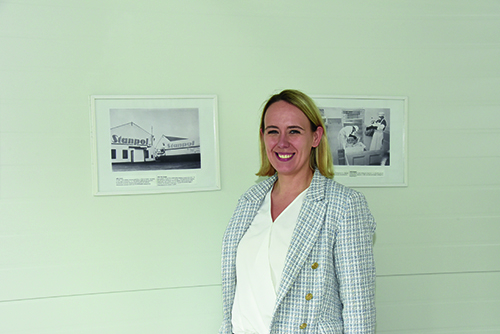
For more than three decades, Stanpol has built its business around processing fish for European markets. However, the company that emerged from the pandemic is markedly different from the one that entered it. Baltic cod, once the foundation of its activities, has virtually disappeared from production, while Atlantic salmon now accounts for approximately 70% of turnover. At the same time, the company has moved increasingly towards contract processing, supplying customised products to other businesses rather than marketing fish under its own name. For Karolina Gach, manager of the trading department and granddaughter of founder Jerzy Safader, the company’s future depends on offering services that larger processors may be unwilling to provide.
Three generations of family ownership
Founded in 1990, Stanpol remains entirely Polish-owned. Three generations of the Safader family have been involved in its development. Jerzy Safader established the business, his daughter Marzena became deputy chairperson, and his granddaughter Karolina now manages its trading activities. Initially, Stanpol concentrated on Baltic fish, particularly cod, alongside flounder and sprat. Due to growing demand for Atlantic salmon, the company started processing this species in 2006. As the business expanded, exports became increasingly important, with Germany, France, and Belgium emerging as principal markets. Although the Polish market has increased in importance for the company, foreign customers still account for most of its business. The decline of Baltic cod fundamentally altered the company’s operations, which had hitherto depended largely on this species. As stocks deteriorated, catches were progressively restricted, culminating in the closure of targeted fisheries.
Stanpol initially responded by switching to Atlantic cod, but subsequent quota reductions and rising prices made this increasingly unattractive. Where the company previously processed 2,000–3,000 tonnes of cod annually, current volumes have diminished significantly. Instead, today, Atlantic salmon dominates the production. Fresh, gutted salmon arrives primarily from Norway and is transformed into fillets, portions, and other products for fresh or frozen distribution. Individually quick-frozen (IQF) portions and fillets represent an important part of the business. The shift towards salmon has coincided with the growing importance of processing services. Rather than purchasing all its raw material, Stanpol increasingly works with customers who buy the fish themselves and send it to the factory for processing according to their specifications. This arrangement reduces Stanpol’s exposure to raw material financing while placing greater emphasis on technical competence, communication, and reliability. Most customers are businesses in Germany, France, Belgium, and Norway. They include companies supplying retailers under their own brands, wholesalers, and other processors requiring semi-finished products.
Transparency underlies long-lasting relationships
Ms Gach says that the company’s position depends on it protecting its customers’ commercial interests. Although Stanpol may know the retailers ultimately receiving its products, it deliberately avoids approaching them directly with offers that would compete with existing partners. Avoiding such potential conflicts of interest has allowed Stanpol to maintain its client relationships, some of which have lasted over two decades.
The European salmon processing industry is going through structural changes, she says. Norwegian companies have expanded their domestic processing capacity, increasingly retaining fish for filleting and portioning before export, which was not the case 15 years ago. Stanpol’s advantage, Ms Gach says, is that it is highly flexible and that it caters to clients who need smaller batches of minimum 5 tonnes, leaving the big orders to processors that achieve economies of scale by processing large volumes of a single product. At our plant we can produce IQF portions one day and then switch to IVP (individually vacuum packed) fillets the next without any trouble, she says. Moreover, some portions must meet precise requirements for weight, thickness, and shape. Such technically fiddly specifications involve considerable handling and may be unattractive to larger factories geared towards huge production volumes.
Ongoing investments in facilities
This flexibility is supported by a workforce of approximately 100 employees. Many have worked for Stanpol for years, including staff who previously filleted Baltic cod and now trim salmon. Their experience remains valuable, says Ms Gach, despite increasing mechanisation. The company has continued investing in its facilities since the pandemic, installing equipment including a new portion cutter and upgrading parts of the production area. Its packaging capabilities include modified-atmosphere packaging, vacuum packing, and equipment for different retail and industrial formats. Quality control is equally important. Customers receive detailed assessments of incoming raw material, including weights, defects, and photographic documentation. Production is monitored throughout, with batch traceability maintained from reception to dispatch. Many of the company’s customers are abroad—in Germany, France, Belgium, and even Norway, and processing to their specifications calls for meticulous attention to detail, as well as very good communications. Stanpol maintains all the certifications its customers need, including IFS, ASC, MSC, and GLOBALG.A.P., which also call for systems that ensure certified products are kept separate from non-certified products.
Diversification provides resilience
Although salmon is central to the business, Stanpol also processes other species to make better use of its capacity throughout the year. Salmon freezing activity is seasonal, generally increasing when raw material prices become more favourable. Outside these periods, the factory can handle whitefish such as saithe, Alaska pollock, and haddock, which can be packaged in different ways, for example, in bags or MAP packages. It also freezes Baltic sprat into blocks for canning companies and processes carp during the Christmas season, when demand on the domestic market is high.
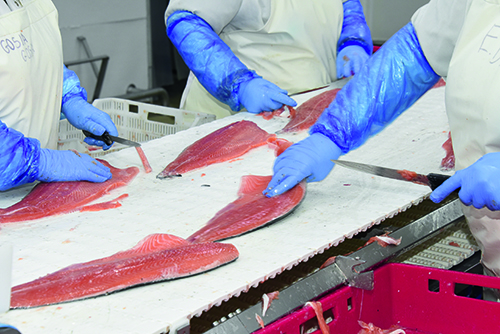
Today, Atlantic salmon imported from Norway is the mainstay of the company’s production.
Stanpol also operates a small smokehouse with a capacity of approximately two tonnes daily, where it smokes salmon trimmings for supply to manufacturers of ready meals and other prepared foods. Again, Ms Gach reiterates the importance of finding a niche rather than competing head on with other smokehouses who all produce smoked salmon fillets. Geography provides the company with another advantage. The processing facility’s location allows deliveries to western European customers within short timeframes. A consignment shipped at 14.00 is, for example, in Boulogne sur Mer on the north Atlantic coast of France at 08.00 the next morning. The company operates two refrigerated trucks, enabling it to combine smaller consignments while maintaining control over transport schedules and the cold chain.
Opportunities in niche products
Looking ahead, Ms Gach sees opportunities in refreshed fish products, which can be thawed, packed, and distributed to destinations relatively close to Poland. As she points out, you cannot defrost a product on one continent for sale on another. Stanpol has also experimented with ready-to-cook fish, reflecting consumers’ growing preference for products that require little preparation. This has been already introduced to retail markets as in-out promotion and the company aims to develop the project further.
Stanpol has successfully adapted to changes in the market and in the resources it processes. Challenges abound in the form of increasing regulatory requirements, new traceability procedures, packaging, and reporting obligations, which all add to operating costs. These pressures come alongside volatile raw material prices, international competition, and geopolitical uncertainty. However, Stanpol has already demonstrated its ability to navigate choppy waters, a quality that will stand it in good stead as it meets the challenges of the next three decades.