This article was featured in Eurofish Magazine 6 2026.

At Seamor’s processing plant in Szczecin, hot-smoked mackerel is still one of the main products. But the assortment now includes halibut, sturgeon, tuna, and prawns. For the family-run Polish business, an extensive catalogue of smoked fish and seafood, quality, and service have kept it at the forefront of the fish processing sector.
Established in 1993, Seamor International Ltd. began as an importer and distributor of frozen fish. Processing followed, initially on a modest scale, before the company opened its own plant in 2004 in Podjuchy, on the eastern side of Szczecin. The original production premises covered just over 200 sq. m. In 2023 the company expanded its processing facility to 3,500 sq m which led to a wider range of products and more customers in Poland and abroad.
Processing soon overtakes trading
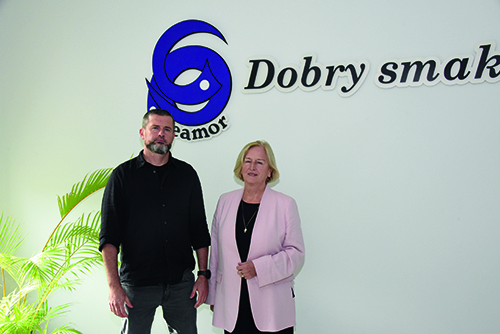
The two activities, processing and trading, remain closely connected. Frozen fish, imported from suppliers around the world, is distributed to Polish wholesalers, other processors, or directly on to the market, while selected species become raw material for Seamor’s smoked products. Małgorzata Pawliszak, the company’s chief executive, estimates that manufacturing now accounts for around 60% of turnover, with trading responsible for the remaining 40%. The trading division is successfully headed by Ania Pawliszak, Małgorzata Pawliszak’s daughter. The company’s product range extends to some 30 species and multiple presentations, from whole smoked fish to fillets, steaks, portions, and premium loins. Mackerel and herring retain an important place, but their dominance has diminished. In the case of mackerel, this is due to the price of the raw material which went up enormously a few years ago due to a lack of agreement on quotas among the main European players (the EU, Iceland, Faroe Islands, Norway, and the UK). Rafał Pawliszak, Małgorzata Pawliszak’s son and the director responsible for production, recalls that mackerel once accounted for about 60% of smoked output but is now nearer 40%. Instead, the company has added several high value smoked products using halibut, sturgeon and shrimp to its product range. The shift has been deliberate as margins on the new species are higher than those on mackerel, which all smokehouses in Poland compete to produce.
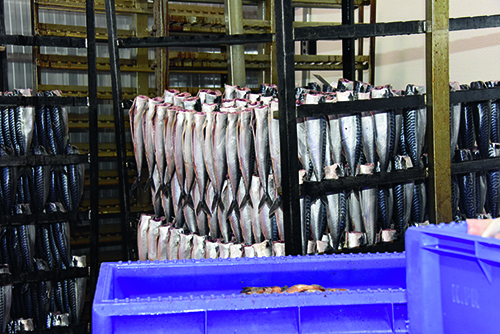
Despite a steep rise in the price of Atlantic mackerel, the fish remains popular in Poland.
Here it is prepared for smoking.
Halibut, sturgeon, whitefish, and smoked prawns have become particularly important. Seamor also produces smoked tuna and salmon loins, giving consumers an extensive range to choose from in terms of species, tastes, and prices. The wider assortment makes planning and production more complicated, but it gives the company scope to offer retailers distinctive products and to respond to changing tastes. An example is sturgeon, which Seamor obtains from a Polish aquaculture company that farms the fish principally for caviar. By processing the meat into smoked cuts, Seamor creates a market for another part of the farmed fish. The relationship has allowed the processor to develop a product that was relatively unfamiliar to many Polish shoppers when it was introduced. Prawns provide another example of how Seamor experiments with its assortment. The company has developed a hot-smoked product made mainly from farmed vannamei prawns sourced in Asia. The product is a strong seller, says Rafał Pawliszak, despite its premium price. Its appeal lies in the simplicity of the product which is just salted, and the texture produced by a smoking process that the company has refined through experience. Seamor has also tested wild Argentine prawns, although vannamei remains the focus of its smoked-prawn business. Raw materials for the production are sourced from countries around the world. Mackerel and herring originate mainly in the North Atlantic, hake from South America, Greenland halibut is purchased principally from Canada, and other whitefish arrives from several regions. The purchasing team manages these relationships while seeking materials suitable for the particular cuts and smoking methods demanded by customers.
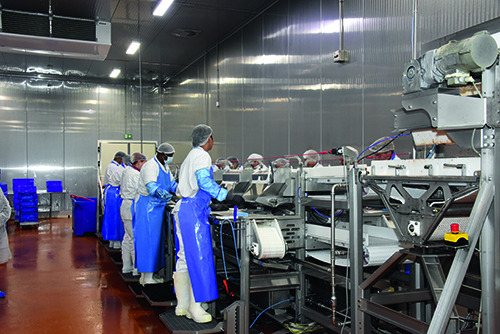
Polish processors are compelled to look further and further afield to find the labour they need to work in production.
Superior raw material and careful handling contribute to final product quality
Despite considerable changes to the company’s scale, the basic processing technique has remained the same. Fish is traditionally brined before being hot or cold-smoked with natural beechwood chips. The only ingredient is salt—liquid smoke, artificial preservatives, or flavour enhancers are banned from the production. Careful handling along the processing chain is equally important. Frozen raw materials must thaw under controlled conditions. Temperature and humidity are monitored during defrosting to protect the texture and appearance of the fish. Seamor operates food-safety procedures based on HACCP and a management system aligned with the IFS standard. The quality of the raw material combined with careful handling contribute to the quality of the final product—as well as the length of its shelf life.
Since the expansion of the Szczecin factory in 2023, a new project commenced in 2025 that will add a further 1,000 sq m of floor space bringing the total to around 4,500 sq m, says
Mr Pawliszak. The development will conclude in 2026 and includes cold-storage facilities with a capacity for approximately 1,000 pallets. The space will also allow additional production and storage areas, new smoking chambers, upgraded packing equipment, and a 50 kW rooftop photovoltaic installation. More space will mean larger production volumes, says Rafał Pawliszak, but it also makes the flow of materials easier to organise, supports larger customer orders, and improves working conditions. The earlier expansion, for example, enabled the company to dispense with night shifts. Last year the factory produced some 300 tonnes a month of finished products, he adds. The company is automating parts of the production process. A Danish-made system handles part of the mackerel preparation, while further investment covers smoking chambers and packaging. Yet the many species, sizes, and cuts prevent complete automation. Skilled employees, therefore, remain essential to preparing the fish, getting the highest yields, and achieving consistent results. Seamor has a workforce of between 150 and 200 people, some of whom are employed through agencies, of whom around 100–150 work in production.
Packaging forms to satisfy any customer
How the products reach consumers has changed significantly since Seamor first developed its smoking activities. Historically, much of the output was sold loose in cartons to wholesalers. Individual packs have opened doors to retail chains and overseas customers. The company now offers modified-atmosphere, vacuum, and skin packaging, alongside bulk formats. These systems help protect freshness, facilitate distribution, and allow the Seamor name to appear prominently on packs. Large retailers account for most sales of smoked products. In Poland, Seamor supplies Lidl, including mackerel under the retailer’s own label and higher-value items under the Seamor brand. Auchan is another customer, purchasing some products in traditional bulk formats. Frozen fish, however, is typically sold to wholesalers who distribute it to smaller retailers and the food-service sector. Seamor also supplies retail-ready frozen packs and thawed products intended for chilled sale. The company also sells through its own shops in Szczecin, where customers can choose smoked, fresh, and frozen fish. These outlets provide a direct connection with consumers and offer insights into preferences and trends. Furthermore, exports are becoming an increasingly important part of the business. Germany is a substantial market for Seamor’s smoked products, and deliveries have begun to supermarket chains in Latvia and Estonia.
In another phase of the company’s development, Rafał and Ania Pawliszak both joined the management board in 2023. After more than 30 years building the company, Małgorzata Pawliszak is gradually reducing her day-to-day involvement, confident that her offspring can continue the work she began. I am fortunate, she says, in that there is a younger generation to take over from me. Many of my peers in the business do not have that luxury. What Seamor will look like in 30 years’ time is difficult to foresee, but it has a solid foundation on which to build thanks to Ms Pawliszak’s efforts.