This article was featured in Eurofish Magazine 6 2026.

Arvydai combines the organic production of multiple species of fish with environmental services and recreational fishing. This diversification could be a model for other pond fish farms.
Founded in 1958, Arvydai operates 583 hectares of ponds. The company produces and trades live fish, provides stocking material for water bodies, and offers recreational fishing activities. Over the past decade, with support from the European Maritime and Fisheries Fund (EMFF, 2014-2020) and the European Maritime, Fisheries and Aquaculture Fund (EMFAF, 2021-2027), Adomas Banikonis the owner has modernised the farm investing in innovative technologies, environmental protection, and service diversification.
Reconciling environmental with economic sustainability
Aquaculture increasingly faces the challenge of balancing production demands with environmental responsibility. Arvydai is certified for organic production and must comply with strict environmental standards yet must also ensure commercial viability. Over the years, the company has invested heavily in technologies that improve resource efficiency. One of the most significant objectives has been reducing water use and improving water quality across the pond system. Modern equipment for cleaning ponds and canals has helped optimise water management, reducing water consumption by as much as 50% while improving dissolved oxygen levels and overall pond conditions. These improvements are expected to contribute to higher fish productivity and better product quality.
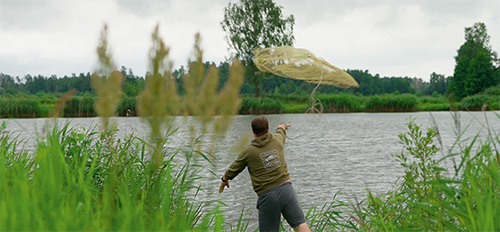
Recreational fishing offers an additional source of income to a pond farm.
Many of the farm’s older vehicles and other machinery had become inefficient, costly to repair, and increasingly difficult to operate safely. Through targeted investments, Arvydai has renewed its equipment, improving working conditions and enabling more effective management of its extensive pond infrastructure. In 2020–2022, EMFF support enabled the purchase of an excavator equipped with a high-capacity pump specifically designed for canal and pond cleaning. Subsequent investments introduced automated fish feeding systems and digital equipment for machinery management.
Protecting biodiversity through aquaculture
For Mr Banikonis biodiversity conservation ranks as important as fish production. The farm’s extensive shallow-water pond system provides ideal feeding and nesting habitats for numerous bird species. Some of these species are listed in the Lithuanian Red Book and face declining populations across Europe. Recognising the environmental value of its landscape, the company has committed to implementing nature management measures aimed at preserving and restoring critical habitats. A flagship initiative has been the Krykštė-1 project, which focuses on restoring open landscape habitats for waterfowl and wading birds. The project supports species conservation by improving habitat quality, maintaining suitable breeding areas, and ensuring long-term protection of ecologically valuable wetlands. Nature management activities have included habitat restoration work and compensation measures associated with bird conservation. Maintaining healthy wetland ecosystems contributes to biodiversity, landscape quality, and environmental resilience. Mr Banikonis says that carefully managed aquaculture can actively contribute to biodiversity objectives while remaining commercially successful. Supported by the EMFF and EMFAF programmes Arvydai has also invested in preventive fish health measures such as improving pond sanitation and strengthening biosecurity to reduce the likelihood of parasites and disease outbreaks.
Diversifying income streams for economic resilience
Like many aquaculture businesses, Arvydai faced the challenge of dependence on a limited number of income streams leaving the company vulnerable to seasonal fluctuations and market uncertainties. To strengthen resilience, the company expanded beyond fish production by developing recreational fishing and leisure services creating additional value from existing assets. The company launched a dedicated online shop, making high-quality fish stocking material available to customers across Lithuania. Public authorities use these larvae and juvenile fish to repopulate public waters, while clients who rent lakes from the government can also draw on this material to restock the waters under their management. Recognising that successful stocking requires specialised knowledge, Arvydai also provides expert aquaculture consultations to these customers. By sharing its decades of operational experience, the farm ensures that both private and public restocking efforts thrive.
Recent investments in the farm have enabled the creation of comprehensive family fishing experience. New facilities will include a two-story container-style building equipped with a café area, mini-shop, workspace with Wi-Fi access, and facilities suitable for families with children. Visitors will also be able to make use of electric bicycles and digital booking of the different services the farm offers. Beyond its commercial and environmental achievements, Arvydai has cultivated a thriving community of aquaculture and fishing enthusiasts. Recreational fishing infrastructure caters to all skill levels—from families introducing children to the sport to seasoned anglers practicing catch-and-release. Visitors are drawn not only by the prospect of catching large carp, pike, tench, and perch, among other species, but also by modern amenities such as equipped gazebos and family-friendly environments. To further engage the public, Mr Banikonis also offers hands-on educational activities for both children and adults, exploring topics such as pond ecosystems, sustainable aquaculture, and the importance of healthy nutrition.
The value of European support
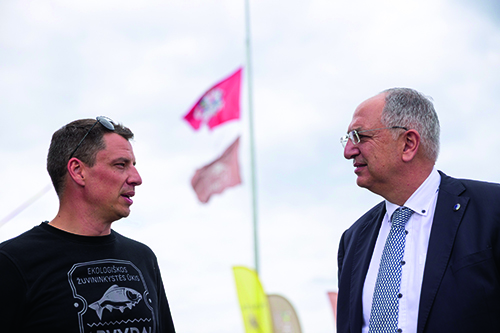
The speed with which Arvydai was transformed, Mr Banikonis says, would not have been possible without European funding instruments. Since 2015, the farm has implemented a series of projects supported through EMFF and EMFAF which, according to him, would have been delayed for years or remained unattainable using their own resources alone. In June 2026, European Commissioner for Fisheries and Oceans had the opportunity to experience Arvydai’s achievements firsthand. Mr Banikonis, guided the Commissioner and his delegation through the extensive pond system, showcasing what had been developed over the decades. The visit offered a vivid illustration of the farm’s multifunctional approach. Several groups of visitors were enjoying recreational fishing, while the Commissioner explored the ponds and birdwatching facilities, witnessing how aquaculture, biodiversity conservation, and income diversification come together in practice.
As European aquaculture continues towards greater sustainability and climate resilience, examples such as Arvydai illustrate what the sector can achieve when long-term vision is combined with targeted investment. The farm’s approach demonstrates that aquaculture, in addition to producing fish, can protect wildlife, restore habitats, support rural economies, and provide recreational opportunities, while remaining commercially competitive. From its inception in 1958 to its current role as a modern organic aquaculture enterprise, Arvydai has shown that sustainable growth is possible when innovation and environmental stewardship go hand in hand. In doing so, it offers a compelling model not only for Lithuania but for aquaculture producers across Europe.