This article was featured in Eurofish Magazine 6 2026.

The annual Aquaculture Europe conference featured a comprehensive programme of sessions, workshops and events which drew a large and very international audience.
Climate change, technological innovation, and the need for more resilient production systems took centre stage at Aquaculture Europe 2026 in Ljubljana, Slovenia. The conference brought together the international aquaculture community to discuss how the sector can adapt to changing environmental conditions while maintaining its competitiveness. Eurofish contributed to the discussions through presentations, scientific session organisation, and the promotion of European research and innovation projects.
Fifty years of bringing the aquaculture community together
From 28 September to 1 October 2026, Ljubljana hosted Aquaculture Europe 2026, the annual conference of the European Aquaculture Society (EAS). Under the theme Aquaculture in Global Change, the event attracted 2,522 participants from 80 countries, demonstrating the importance of international cooperation in addressing the challenges facing aquaculture. The conference also marked the 50th anniversary of EAS, providing an opportunity to reflect on the development of European aquaculture over the past five decades and consider its future direction.
With 54 scientific sessions, more than 500 oral presentations, and a trade exhibition with 169 booths, the event covered a broad range of subjects, from aquatic animal health and nutrition to production technologies, environmental sustainability, and digitalisation. Beyond presenting scientific advances, the conference emphasised the importance of translating research into practical solutions.
From sustainability to resilience
Climate change impacts—rising water temperatures, changing precipitation patterns, extreme weather events, and increasing pressure on water resources are already affecting aquaculture production in different parts of Europe. The opening plenary presentation, Aquaculture: From Sustainability to Resilience, delivered by Jurica Jug-Dujaković, explored why aquaculture must look beyond reducing its environmental impact and strengthen its ability to withstand changing conditions. While sustainability remains essential, resilience requires production systems that can respond to environmental uncertainty without compromising economic viability. This may involve adapting husbandry practices, introducing more resilient species, or investing in technologies that improve the management of production conditions.
Other plenary discussions addressed the importance of communicating aquaculture’s achievements beyond the scientific and industry community, as well as the challenges of achieving net-zero greenhouse gas emissions in European aquaculture by 2050. A recurring message was that solutions must reflect the diversity of European aquaculture. The risks facing intensive marine farms differ considerably from those experienced by freshwater pond producers or land-based recirculating aquaculture systems (RAS).
Climate action requires regional solutions
A dedicated Climate Action in Aquaculture workshop, held on 28 September, provided an opportunity to examine the practical implications of climate change for European aquaculture. Organised with contributions from international researchers, industry representatives, and policymakers, the workshop explored climate impacts, adaptation and mitigation opportunities, and the actions needed to strengthen the sector’s resilience. An important element was the presentation of regional perspectives from the Atlantic, Mediterranean, Central European, and Baltic regions. These situation reports highlighted the importance of understanding how climate-related challenges differ across Europe’s aquatic environments. Eva Kovacs, Senior Project Manager, Eurofish presented the situation report Aquaculture and Climate Change – Impact, Adaptation and Mitigation in Central Europe.
Central European freshwater aquaculture is particularly exposed to changes in temperature and water availability. Traditional pond farming systems depend on reliable water supplies and seasonal conditions, making them vulnerable to prolonged droughts and increasingly unpredictable precipitation. Higher summer temperatures can also affect dissolved oxygen levels and fish welfare, requiring adjustments to production practices and water management. These challenges highlight the importance of adaptation measures suited to the specific characteristics of freshwater aquaculture, including improved water management, climate-resilient production practices, and technologies that help farmers respond to changing environmental conditions.
Eurofish promotes innovation for sustainable freshwater aquaculture
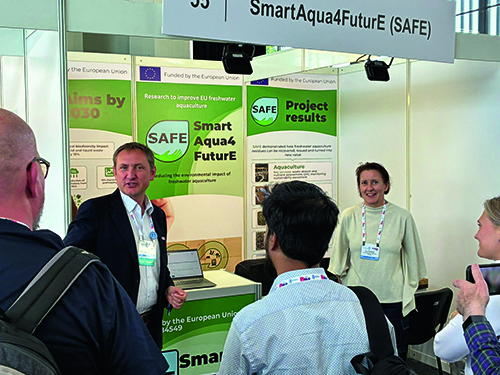
Alongside its contribution to the climate workshop, Eurofish participated in discussions on technological innovation and the future of freshwater aquaculture. Tamas Bardocz represented Eurofish at the workshop organised by the EU-funded RootLinks project, where he introduced the newly launched DANUBEAQUA project (read more about DANUBEAQUA on page 21). The RootLinks workshop, Blue Innovation Bites, focused on connecting primary producers with practical circular and bio-based innovations. Eurofish together with many project partners was also present in the trade exhibition with a booth dedicated to the EU-funded SmartAqua4FuturE (SAFE) project (read more about SAFE on page XX) which offered an opportunity to share lessons from SAFE with conference participants and discuss how circular technologies could be taken forward by the industry.
Eurofish also contributed to the scientific programme by organising the session Light and Aquatic Organisms, chaired by Bela Urbanyi and Tamas Bardocz. Light is an important environmental factor affecting the behaviour, development, and physiology of aquatic organisms. Light intensity, photoperiod, and spectral composition can influence growth, reproduction, and welfare, making light management relevant to aquaculture production. The subject is particularly important for hatcheries and controlled production environments, where artificial lighting can be adjusted to meet the biological requirements of farmed species. Understanding these interactions can help producers optimise husbandry conditions while considering the energy requirements of lighting systems.
Turning knowledge into practical improvements
Aquaculture Europe 2026 demonstrated the breadth of scientific knowledge and technological innovation available to support the sector’s development. However, it also highlighted the importance of ensuring that new solutions are accessible and economically viable for producers. It also reinforced the value of cooperation between research organisations and industry, particularly through European projects that test innovative approaches under practical conditions.
Eva Kovacs, Eurofish, eva@eurofish.dk