This article was featured in Eurofish Magazine 5 2026.

The summer of 2026 has given Europe’s pond fish farmers a sharp warning about the speed at which climate pressure can become a production emergency. In mid-August, drought conditions remained critical across much of Europe, with alert conditions extending through large parts of the Danube basin, including Hungary, Czechia, and Romania.
As temperatures rose across Europe this summer and precipitation dwindled, exceptionally low river flows were reported on several major European rivers. For pond farms, however, the crisis was often visible even earlier: feeder streams weakened or stopped, canals ran low, evaporation accelerated, and shallow ponds became progressively warmer.
Pond aquaculture is especially exposed to such conditions because the production environment is directly connected to the weather and the surrounding catchment. Traditional Central and Eastern European carp ponds are generally shallow, and many depend on precipitation, small watercourses, canals, or reservoirs for replenishment. In Hungary, for example, valley-dammed ponds can be particularly vulnerable when the streams draining their relatively small catchments lose flow. Unlike a closed or highly controlled system, a pond farm cannot simply compensate for a prolonged regional water deficit. Once the supplying catchment runs short of water, the farmer’s room for manoeuvre rapidly narrows.
Shallow waters offer narrower safety margins
Temperature is one of the main factors controlling fish physiology. Common carp grows best in warm water, with an optimum growth range commonly cited at 23–30 °C. Moderate warming can therefore lengthen the growing season and increase feeding activity. But there is a limit to the benefit. As water warms, its capacity to hold dissolved oxygen falls, while fish metabolism and oxygen demand generally increase. The result can be a physiological squeeze precisely when ponds are also losing water through evaporation. Low water levels exacerbate the problem. A smaller water volume heats more quickly, while organic matter, nutrients, and fish biomass become more concentrated. Algal blooms can intensify, and when algae or other organic material decompose, additional oxygen is consumed. In shallow Central European ponds, hypoxia is already a recurring late-summer risk. Research has shown that low oxygen can restrict carp to better-oxygenated parts of the water column and interfere with normal bottom feeding. Under extreme heat and drought, this risk becomes more acute. Lower water levels also make fish more visible and accessible to fish-eating vertebrate predators, including birds and mammals. As ponds shrink, fish are crowded into fewer and shallower refuges, escape distances are reduced, and predation pressure can increase just when fish are already weakened by heat and oxygen stress.
As a result, feeding can decline, and fish may concentrate close to the surface or around inflows where conditions are more favourable. Prolonged oxygen stress reduces growth and feed utilisation and, in severe cases, causes mortality. Heat and deteriorating water quality also raise animal-welfare concerns. Fish subjected to chronic high temperature, low oxygen, crowding in shrinking water volumes, or repeated handling face additional stress. Disease risks may also change, although the relationship is not straightforward: warming favours some pathogens while suppressing others, and the outcome depends on the fish species, pathogen, and environmental conditions.
Weather changes the technology
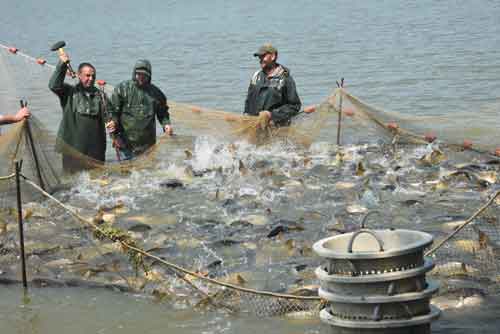
Extreme weather therefore changes not only the pond environment, but also day-to-day farming technology. Feeding regimes have to be adjusted to fish appetite, oxygen levels, and water temperature. Harvesting, grading, and transport may need to be organised differently, with particular attention to oxygen supply and handling stress in warm water. Warmer transport water, for example, increases oxygen demand and reduces the number of fish that can safely be carried. In an emergency, farmers may have to choose between maintaining growth and simply keeping fish alive. This was clearly visible in Czechia during August. Fish farmers reduced or suspended supplementary feeding to lower oxygen consumption and aerated ponds more intensively. Some ponds were harvested earlier than planned. In the Třeboň area, part of the 200-hectare Koclířov pond was drained and fish were transferred to holding facilities. Reports indicated that more than a third of the water was missing from the region’s famous pond network, while the water level in Lake Svět had fallen by 98 cm.
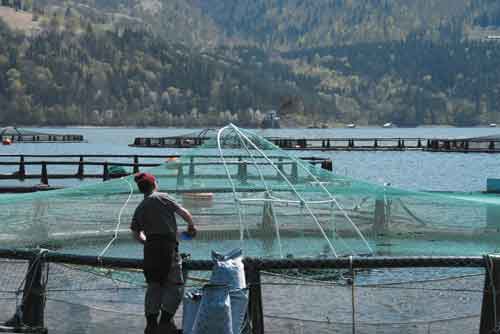
Higher water temperatures also threaten farms such as this one
in Romania growing trout in cages in a dam lake.
Hungarian producers used similar emergency measures. The Hungarian Aquaculture and Fisheries Inter-branch Organisation (MA-HAL) reported round-the-clock monitoring, continuous oxygen measurements, careful rationing of the limited incoming water, aeration where possible, and emergency harvesting. In some cases, water from a pond being emptied was transferred or pumped to another pond that could still be kept operational. The production objective changed from maximising yield to avoiding a disaster.
Losses continue for years
The economic effects of fish mortality are not confined to the summer in which it occurs. This is particularly important in carp farming, where the production cycle commonly lasts three or four years. Losing a cohort of fry, juveniles, or market fish changes the farm’s production structure for subsequent seasons. A mortality event in 2026 can therefore mean lower availability in 2027 or 2028, in addition to the immediate loss of fish, feed, labour, and income. Romanian producers know this cumulative effect well. Cătălin Platon, the ROMFISH president noted this summer that the sector was still feeling the consequences of severe droughts in 2023 and 2024. Losses at one stage of a carp cycle pass through the production chain. Rebuilding stocks takes time, and repeated drought can prevent farms from returning to a normal age structure before the next shock arrives.
In Hungary, figures reported in late August indicated that around 1,588 hectares of fishponds had dried out and nearly 280 tonnes of fish had died at 20 farms. Severe incidents such as that at the Rétimajor–Rétszilas pond system also demonstrated how production losses and ecological damage can overlap. The system is not only a fish farm, but also part of a Natura 2000 site and a Ramsar wetland supporting important bird and amphibian habitats. Extensive and semi-intensive fishponds support biodiversity, retain water in the landscape, regulate water flows, cycle nutrients, and preserve traditional cultural practices. A European Commission study published in January 2026 highlighted biodiversity enhancement, water-quality regulation, nutrient cycling, and sediment stabilisation among the ecosystem services associated with fish farming in ponds and wetlands. The Hungarian organisation MA-HAL estimates that around 27,000 hectares of fishponds can, under favourable conditions, retain up to 350 million cubic metres of water. When such ponds dry, the loss is therefore not measured only in tonnes of fish but also in the impact on habitat, local water storage, and the resilience of the surrounding landscape.
Drought brings co-related risks
The summer of 2026 also showed that climate risks rarely arrive in isolation. Extreme heat and dryness contributed to an exceptional European wildfire season. By 5 August, more than 500,000 hectares had burned in the EU, according to the European Commission’s Joint Research Centre. Even where fire does not directly reach a fish farm, a burned catchment can later create a water-quality problem. Rain falling on fire-damaged land can deposit ash, sediment, nutrients, metals, and other contaminants into streams, reservoirs, and ponds.
A similar principle applies to erosion and landslides following intense rainfall. Heavy precipitation can trigger floods, landslides, and erosion, and can rapidly move soil and pollutants into watercourses. For a pond farm this may mean increased turbidity and sediment loads, damaged feeder channels, or abrupt changes in incoming water quality. Climate adaptation therefore needs to take the condition and management of the entire catchment into account as they can influence both the quantity and quality of water reaching the farm.
Perhaps the most important lesson of 2026 is that individual farms cannot solve water scarcity alone. Aquaculture shares water resources with crop irrigation, drinking-water supply, nature conservation, industry, energy production, and navigation. The exceptionally low Danube was a textbook illustration of how the same drought affected agriculture, transport, power generation, ecosystems, and communities. Farmers can improve monitoring, install aerators, deepen refuge areas, manage sediments, or move fish between ponds. These measures are valuable, but decisions about storage, allocation, and drought priorities must be made at catchment and national level and, where river basins cross borders, through international cooperation.
Prevention before the next summer
Europe’s response must consequently shift from being reactive to becoming proactive. Water needs to be retained when and where it is available. Improving the ability of soils and landscapes to absorb rainfall also helps replenish groundwater rather than allowing precipitation to leave the catchment rapidly as surface runoff. Managers of the different water consumption systems—agriculture, aquaculture, municipalities etc.—need to collaborate from the outset rather than competing after scarcity has already become critical.
At the European level the European Water Resilience Strategy calls for restoration and protection of the water cycle from source to sea, greater use of green infrastructure, and measures that increase water retention in the landscape. It specifically recognises the need to restore the landscape’s natural “sponge” function and strengthen water resilience across economic sectors. For pond aquaculture, this should translate into clearer drought-management and water-allocation rules, investment in water-retention infrastructure, stronger catchment monitoring, and formal recognition of the water-storage and biodiversity services provided by well-managed ponds. At farm level, adaptation will also require the implementation of measures such as reliable monitoring, suitable emergency holding areas, pond maintenance and sediment management and, where feasible, deeper areas that provide fish with refuge during extreme conditions. In this context, smart systems become increasingly important. Sensors for dissolved oxygen, temperature, water level, pH, and turbidity can warn farmers of potential threats and, when connected to pond management software, can support faster decisions, reduce unnecessary energy and feed use, and help prioritise intervention before a pond reaches a critical threshold.
Policies need to adapt to a new reality
Public support should recognise the public goods delivered by extensive and semi-intensive pond systems. Policymakers should therefore encourage the uptake of smart monitoring and decision-support tools to enable farmers to react quickly when a drought looms or temperatures spike. Summer 2026 is showed that the future of pond farming depends on producers planning for low water levels and high temperatures in conjunction with other users of water. Retaining more water during wetter periods, protecting catchments, and agreeing how scarce water will be shared are no longer peripheral environmental issues but imperatives to enable European pond aquaculture to thrive under adverse conditions.
Eva Kovacs, Eurofish,
eva@eurofish.dk;
Prof. Bela Urbanyi,
Széchenyi István University