This article was featured in Eurofish Magazine 5 2026.

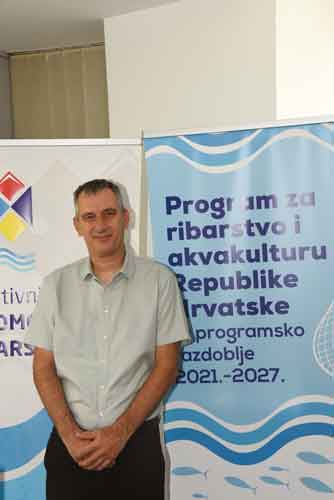
For Ante Mišura, director of fisheries in the Croatian Ministry of Agriculture, Forestry and Fisheries, the main challenge he faces regarding the fisheries and aquaculture sector is to protect the biological basis of fishing while ensuring that fishing and aquaculture remain viable activities in coastal and island communities.
Due to its semi-enclosed geography, climate, and hydrological features the Mediterranean is critically affected by global warming. Among the countries affected is Croatia which has 5,835 km of coastline (mainland + islands) in the Adriatic Sea. Fisheries and mariculture play an important socioeconomic role in coastal economies, so the threat from the impacts of global warming has potentially severe consequences. Ante Misura, fisheries director in the Ministry of Agriculture, Forestry, and Fisheries, says that the negative impacts of climate change on aquaculture production can already be seen both at sea and on land. For example, unusually heavy precipitation can cause declines in salinity particularly in sheltered and semi-enclosed farming areas. Inland aquaculture production faces the consequences of decreased precipitation and drought periods that affect the availability of fresh water necessary for terrestrial ponds. In its National plan for aquaculture development for the period until 2027 (NPAD), the administration seeks to mitigate climate change by encouraging the sector to invest in technologies that foster sustainability by, for example, using less water, or generating fewer emissions, as well as by striking a balance between aquaculture expansion and nature protection. In the sea, rising water temperatures negatively affect growing conditions for some valuable finfish and shellfish production, while ocean acidification has a negative impact on shellfish growth. Shellfish farms are also affected by predation, with species such as gilthead seabream causing considerable damage to cultured bivalves.
Raft of measures to increase bivalve farming
The latter are grown mainly on small, family-owned farms producing relatively small quantities. Their products are mainly sold on local markets, with demand strongly influenced by the tourism season. This relatively small-scale structure, together with limited production capacity and market dependence, can constrain the competitiveness and economic resilience of the sector. Another increasingly important constraint is the reduced availability of naturally occurring seed. Since the collection of wild spat has traditionally been the main source of seed for Croatian shellfish farms, the decline in natural spat availability reported by producers in recent years represents a significant threat to the continuity and further development of production. The administration is therefore promoting measures including the development of shellfish hatcheries, diversification of species farmed, and the development and implementation of more effective measures to protect farms from predators. Moreover, fragmentation in the sector is being countered by encouraging farmers to establish and join producer organizations to consolidate production, and develop joint branding and marketing activities. This has resulted in the establishment of two producer organizations in the shellfish farming sector, one for mussel producers and one for oyster producers, the two main bivalve species.
To encourage the expansion of aquaculture production the government is further harmonising administrative procedures and strengthening cooperation between the competent authorities. For example, the Directorate of Fisheries has created a webpage to inform the public about administrative procedures. This improves transparency and provides potential investors and producers with clear information on requirements, procedures, and competent authorities. The digital system “FishNet” has been established, the goal of which is to accelerate and simplify the process for applying Fisheries and Aquaculture Fund (EMFAF) measures and to enable the submission of applications for grants and payments to all fishers and fish farmers. Spatial planning plays an important role in reducing uncertainty for investors, as the suitability and availability of areas for aquaculture can be established before licensing and concession procedures begin. Further digitalisation and harmonisation of procedures should also help reduce the administrative time and costs faced by producers and, all else being equal, should encourage growth in the aquaculture sector.
Smoother permitting procedures in some counties
In Croatia spatial planning for the aquaculture sector is largely the responsibility of regional governments primarily at the county level. As each county has its own development strategy and their own spatial plans, the approach to identifying and designating areas for aquaculture varies considerably between counties. Consequently, the planning of areas suitable for aquaculture has not been developed to the same extent throughout the country. For marine aquaculture spatial plans aim to identify the most suitable areas and classify them into three categories: A1, where aquaculture has priority; A2, where aquaculture has priority, but other activities are also permitted; and A3, where only limited forms of aquaculture are permitted alongside other dominant activities. Zadar and Dubrovnik-Neretva, the counties with the most farming activity, have recognised aquaculture as an important contributor to regional economic development and have incorporated the necessary environmental and other requirements into the planning process to simplify and shorten subsequent concession procedures.
While Croatia has a long history of farming seabass and seabream, production, though growing significantly, is still relatively small and fragmented. This makes it difficult to provide a continuous and standardised supply, increases production costs and thus leaves smaller producers in a weaker negotiating position compared with the largest domestic and foreign producers of these species. However, despite these challenges, Croatian producers of marine finfish have several very strong competitive advantages including quality, freshness, proximity to the market, recognisable origin, and the possibility to diversify income streams by combining tourism, gastronomy, and aquaculture. This is particularly important for Croatia due to its large domestic tourist market. Around 30–35% of total production remains on the domestic market, while the majority is exported. The export orientation is particularly pronounced for white fish, around 70% of which is exported, and for tuna, where exports account for approximately 90% of production. Domestic consumers’ perception of farmed marine fish is generally positive, although some still consider aquaculture products to be less valuable than products from commercial fishing. This could, however, be seen as an opportunity to further improve the perception and increase consumption.
Farmed fish and seafood output touches a new high
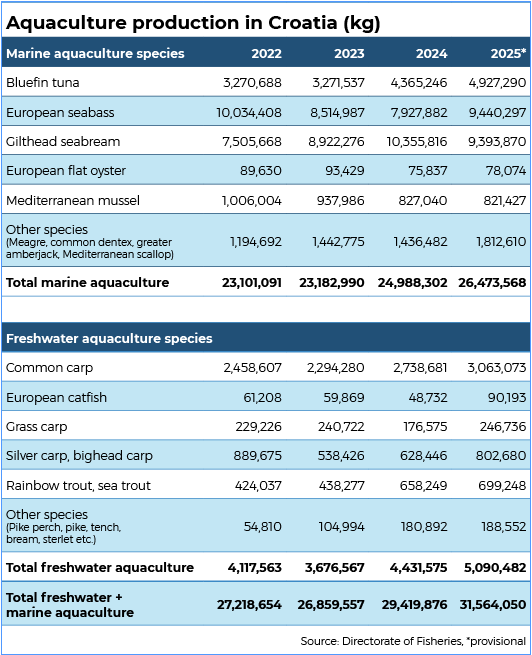
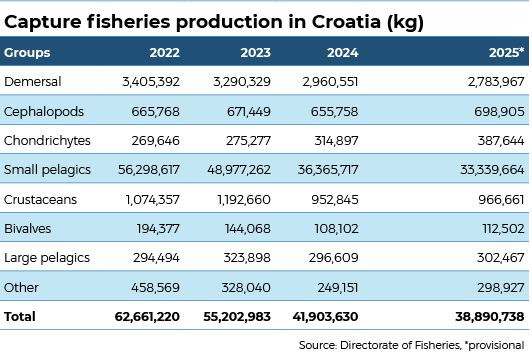
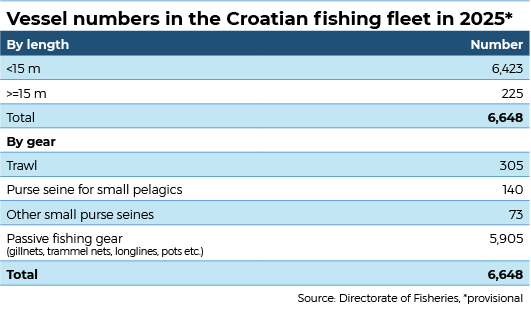
Despite the impacts of climate change, aquaculture production reached a record 31,564 tonnes in 2025 in contrast to capture fisheries sector production which, compared to 2024, declined 8% to 38,891 tonnes. Capture fisheries is dominated by small-scale vessels up to 15 m in length. According to preliminary data from the fisheries directorate, in 2025 these accounted for 97% of the fleet or 6,423 vessels. Small-scale coastal fishing represents an important source of income and employment for coastal and island communities, contributes to the supply of fresh fishery products to local markets, and is crucial for preserving traditional knowledge, skills and cultural heritage. It is particularly important for maintaining economic activity on islands and in smaller coastal areas, where alternative employment opportunities are often limited. For its multifaceted contribution to society this segment is acknowledged at the European level too as evidenced by an aid intensity of 100% of eligible expenditure for certain support measures directed at this group of fishers. The idea of the measures is to modernise and improve the safety and sustainability of small-scale fisheries to ensure its long-term viability. For the economic success of this fleet is tied to the future of coastal and island communities whose livelihoods and identities have been shaped by fisheries for centuries. In the context of generational renewal Mr Misura points to the success of community-led local development (CCLD) initiatives that have strengthened the competitiveness of the sector, created employment opportunities and, by demonstrating that fishing can be a promising career opportunity, helped attract and retain young people in small-scale fisheries.
Commercial fishers have suffered from fuel prices that have risen in particular since the hostilities in the Middle East. Further increases will have a direct and substantial impact on operating costs, profitability and ultimately the economic viability and sustainability of fishing activities. The government has therefore implemented two crisis support measures for fisheries, aquaculture, and fish processing companies that extend in the first instance to the end of the year. The administration is also trying to reduce the sector’s dependence on fossil fuels in part by ensuring that information on available financing opportunities and new technologies reaches the operatives in the sector, for example, through the ETP (Energy Transition Partnership) Pilot Ambassador Programme 2026 which aims to bring energy transition-related issues closer to stakeholders at both national and local levels. The ministry is also keen to modernise the legislative framework to allow support for the modernisation of the fleet through the purchase of new vessels and the modernisation of existing ones, something that is either not permitted or highly restricted in the current programming period. Mr Misura also believes that investments in innovative technologies that improve, for example, energy efficiency, may help attract younger generations to fisheries contributing thereby to the renewal of the sector.
Short-term pain can lead to long-term gain
More important perhaps for potential young fishers is for them to know that they are joining a thriving sector, not one that is in decline. To secure fish stocks, Croatia has taken an active role in shaping the management framework for fisheries in the Adriatic as described in the GFCM 2030 strategy. Mr Misura acknowledges that such measures may create operational and economic pressures for fishers in the short term but firmly believes that effective management is essential for rebuilding stocks. The Jabuka/Pomo Pit fisheries restricted area illustrates this approach. Its special management regime, first developed through bilateral cooperation and subsequently established at GFCM level, has been in place for more than a decade now. Protecting one of the main spawning and nursery areas for demersal species, together with the GFCM multiannual management plan for demersal fisheries, has helped to stop and reverse long-standing negative trends as regards stock status. Recent scientific assessments indicate a substantial improvement in the status of several important demersal stocks, including common sole, red mullet, Norway lobster in the central Adriatic and hake. The recently established no-take zone in the Kvarnerić channel area will contribute to the recovery of Norway lobster in the eastern Adriatic, as scientific evidence identifies this area as an important spawning and nursery ground for this and other key demersal species in this part of the Adriatic.
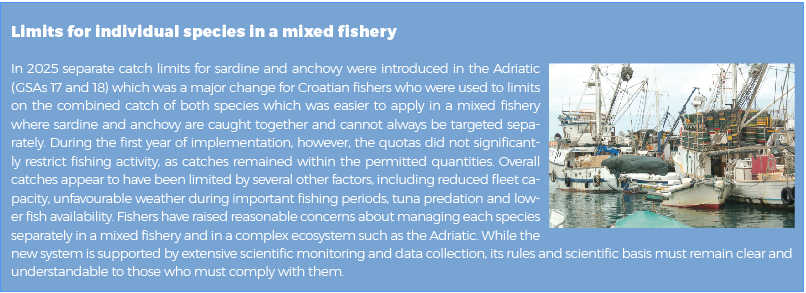
Since 2025, catches of sardine and anchovy have been regulated through a quota system under a multiannual plan for small pelagics adopted in 2021. However, the stocks are still not within safe biological limits, particularly sardine. Croatia considers that this situation is not necessarily a result of fishing pressure alone as other types of human pressure cannot be ignored. Moreover, climate can be seen as an important driver affecting recruitment and changes in food-web dynamics including interactions between species. Climate and ecosystem considerations must therefore become a standard part of stock assessments, scientific advice and management decisions. At present, these pressures are still not sufficiently understood or consistently reflected in fisheries management. Mr Misura adds that stronger compliance and enforcement are important for Croatia because management measures can only work if they are applied equally throughout the region.
Digitalisation will contribute to more efficient fisheries
Another tool for improving the efficiency, competitiveness and sustainability of the Croatian fisheries and aquaculture sector is digitalisation. The administration is therefore supporting the gradual introduction of digital solutions for data collection, reporting, monitoring, traceability and production management. Aquaculture producers already use the Commercial Fisheries Portal to submit production and statistical data electronically, reducing administrative work and facilitating data management. The further development of the Fisheries Information System is also expected to improve the integration and use of digital data across the sector. The uptake of more advanced technologies in production process, such as sensors, automated monitoring systems, farm management software and artificial intelligence, is still developing among Croatian producers. The administration’s role is to create favourable conditions for their introduction, including financing mechanisms through EU and national funding programmes. Within the European Maritime, Fisheries and Aquaculture Fund (EMFAF), support for innovation, modernisation, improved environmental performance and competitiveness provide opportunities for producers to invest in new technologies and equipment.
Seafood consumption on the right track
The consumption of fisheries and aquaculture products in Croatia has stabilised in the last few years at over 20 kg/per capita with a peak of almost 23 kg/per capita in 2023. Fresh/chilled fish is consumed the most, and among marine species, pelagic species, cephalopods, demersal species, and finfish play an important role. The share of products from capture fisheries in 2024 was 81%, while aquaculture accounted for the remainder. Of the total consumption of 21.59 kg per capita, 17.47 kg came from capture fisheries and 4.12 kg from aquaculture. Fish consumption varies by socio-demographic groups with women, the elderly, the more educated, non-smokers, and the more physically active consuming more fish than other groups, a 2022 study by researchers from the Teaching Institute of Public Health in Rijeka and the University of Rijeka showed.
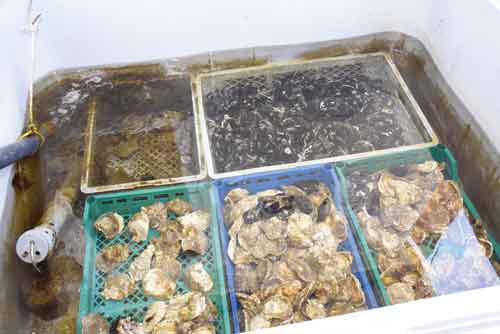
Farmed oysters and mussels placed in tanks ready for sale to consumers.
To improve customer perception and increase the level of trust in aquaculture products, the ministry in cooperation with HGK (Croatian Chamber of Economy) conducts regular campaigns in which both fisheries and aquaculture products are promoted on TV, radio, and through social networks. Among the actions foreseen for increasing consumption is to encourage partnerships between aquaculture producers and institutional buyers, such as schools and kindergartens, as new forms of cooperation that would encourage public consumption and thus create healthy eating habits among the youngest population. The application of new innovative technologies in diversification of aquaculture products and the value added, as well as directing production and linking it with processing activities are also recognized as the interventions which will contribute to increasing consumption and strengthening the competitiveness of the aquaculture sector.
Expectations of the budgetary allocations for 2028 to 2034 are high
EU budget negotiations for the 2028-2034 programming period are ongoing. While hoping for greater emphasis on the conservation and sustainable management of fisheries resources, Mr Misura would also like to see more flexibility regarding the modernisation and gradual renewal of the fishing fleet. He feels this should include the purchase of new vessels (vessel replacement), the modernisation of existing ones, and the removal of bottlenecks in capacity management. Stronger support for the energy transition of the fleet, including investments in more energy-efficient engines, new propulsion technologies and the development and deployment of low-emission alternative fuels are also Croatian priorities. In the aquaculture sector the administration would like to see stronger financial backing for investments that increase the resilience of the sector, strengthen biosecurity, and facilitate climate change adaptation. Assistance is also needed to combat emerging threats, including invasive species and other organisms that may negatively affect farmed species and production. Above all, the means to ensure generational renewal should continue, enabling young people to enter the sector more easily, access investment and modern technologies, and benefit from conditions that make fisheries and aquaculture an attractive professional opportunity. In this regard Mr Misura highlights again the role of CLLD and the work of fisheries local action groups (FLAGs) in connecting local stakeholders, strengthening the resilience and competitiveness of local fisheries sectors, and creating new development and employment opportunities for coastal areas.