This article was featured in Eurofish Magazine 5 2026.

On the central Dalmatian islands of Hvar, Vis, and Šolta, FLAG Škoji is using community-led development to strengthen fisheries contribution to the wider island economy. Working with the Vis Archipelago UNESCO Global Geopark, the FLAG shows how investment in fishing can also support research, heritage, education, and the marketing of local seafood.
The fisheries local action group (FLAG) Škoji was founded in 2016 by the cities of Hvar, Vis, Stari Grad, and Komiža, the municipalities of Jelsa, Sućuraj, and Šolta, fisheries businesses, and local civil-society organisations. FLAGs bring public authorities together with representatives of business and civil society to apply the EU’s community-led local development approach, under which local partnerships decide how development funding should respond to local needs. FLAG Škoji’s territory covers 475 sq. km, and alongside the three larger inhabited islands includes 117 islands, islets, and rocks, and has almost 16,000 inhabitants. For the 2021–2027 programme period, close to EUR2.3 million has been allocated to its local fisheries development strategy.
Longlining study shows importance of fishing to Komiža
According to the available national data the area’s fishing sector includes 231 fishing licences of which 209 represent small-scale vessels, i.e. those measuring less than 12 m. On the island of Vis, the towns of Komiža and Vis demonstrate why fisheries remain so important. A 2022 study of open-sea bottom longlining in the central Adriatic identified 84 vessels that could be regarded as predominantly engaged in this fishery. Of these, 43 were based in Komiža and another four in Vis. Komiža vessels accounted for 71% of the open-sea bottom-longline catch recorded in the study. The fishery is highly selective and generates relatively little discard, but it catches mainly mature fish, particularly hake and tub gurnard. The study warned against increasing fishing effort or fleet capacity and noted that rising fuel and bait costs were placing profitability under pressure. It consequently recommended exploring diversification and adding value through measures such as branding, traceability, and improved marketing rather than relying on increased catches.
Developed from the existing rural Local Action Group, the FLAG Škoji is registered as a non-profit association. Its work revolves around connecting fishermen with municipalities, associations, scientists, educators, artists, and tourism businesses. Ms Antičević describes “connecting” as an imperative and argues that each project should create value for the wider community. In 2019 the archipelago, which includes Vis and surrounding islands such as Biševo, Sveti Andrija, Brusnik, Jabuka, and Palagruža, became a UNESCO Global Geopark. The designation explicitly connects geological heritage with the area’s other natural and cultural values and with sustainable development.
Sustainable economic activity is permissible in a geopark
Lana Schmidt, Expert Associate Biologist at the Vis Archipelago Geopark, argues that geology provides the physical foundation on which the island’s biodiversity, settlement, food production, tools, stories, and fishing traditions developed. The geopark is therefore not conceived as a protected area intended to exclude economic activity. People are considered part of the territory, and sustainable development depends on finding a workable relationship between human activity, including fisheries, and the environment. The archipelago’s geopark status remains subject to external scrutiny. The Vis Archipelago Geopark underwent its latest UNESCO revalidation mission from 22 to 26 June 2026. The process examined its management, international cooperation, local involvement, educational work, heritage interpretation, and contribution to sustainable development. As of September 2026, UNESCO continues to list Vis Archipelago among Croatia’s UNESCO Global Geoparks.
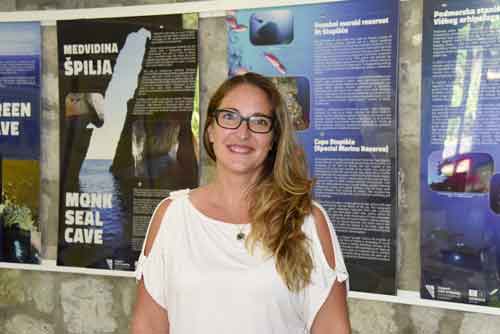
Lana Schmidt, Expert Associate Biologist at the Vis Archipelago Geopark
GEOfood offers one mechanism for turning the connection between territory and food into economic value. GEOfood is not a UNESCO certification but an independent initiative used by participating UNESCO Global Geoparks. Its criteria require products to have a defined geographical connection to the geopark and place considerable emphasis on communicating origin and geological context. Fishery products must originate within the geopark area or an approved buffer zone. In Ms Schmidt’s words food cannot be separated from the place where it is produced. Climate, sea, geology, and local knowledge influence both available ingredients and the way communities use them. GEOfood is an attempt to tell the story behind the product rather than a quality label. Today the Vis Archipelago Geopark works with 17 local GEOfood partners.
GEOFish inspires the Komiža swordfish project
Among the projects supported through the FLAG Škoji for adding value to fisheries and aquaculture products was one called GEOfish. Led by the Vis Archipelago Geopark, the project combined fisheries research with culinary workshops, promotional work, and a conference that brought together scientists, civil-society organisations, educational institutions, fishers, hospitality businesses, and artists. Researchers examined local fish resources and their potential for commercial use and gastronomy, while workshops explored how local seafood could be incorporated into contemporary cooking. Its wider purpose was to connect fisheries with tourism while encouraging sustainable management of marine resources. GEOfish also became a demonstration of how a non-profit initiative could lead to a commercial fisheries investment. Ms Antičević recalls that, after fishermen and the Komiža fishing cooperative had seen the potential of GEOfood, the cooperative decided to apply the concept to swordfish leading to the Komiža swordfish (Komiška sabljarka) project.
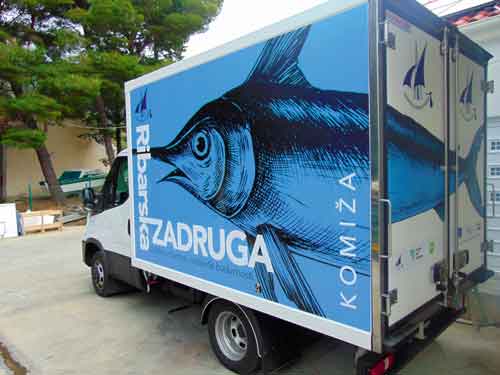
The truck for the delivery of fish to the mainland is also used to promote the story of Komiža swordfish.
The cooperative received EUR74,000 in support for a specialised refrigerated vehicle, a solar installation at its premises, handling and cleaning equipment, and educational activities. The project also placed Komiža swordfish under the GEOfood brand. In December 2023 the cooperative and the geopark formalised their cooperation, with the geopark identifying swordfish caught in the Vis Archipelago as the first Croatian fishery product to carry GEOfood branding. Ms Antičević points to the refrigerated vehicle as an example of product promotion. Its graphics communicate messages about Komiža, fisheries, and GEOfood while the vehicle transports fish to the mainland. FLAG-supported work has included Komiža’s fishing collection, the mapping of maritime heritage, illustrated publications, and activities for children. The organisation’s Naši su Škoji – tvoji i moji campaign linked schools on Hvar, Vis, and Šolta and reused knowledge generated by earlier FLAG projects. Ten smart screens were supplied to schools, while online events involving 140 pupils addressed marine life, island heritage, and responsible relationships with the sea.
Fisheries development has many facets
Ms Antičević makes a case for relatively small projects that can help make island life more attractive, particularly for younger people and families. A thriving local community is critical to maintaining fisheries which in turn contribute to the economic wellbeing of the community. FLAG Škoji supports locally selected priorities and bring sectors together enabling fishers and fishing cooperatives to develop products and services. Under its 2014–2020 strategy the FLAG implemented 14 projects. Its 2021–2027 programme has five priority measures covering the recognition and availability of local fisheries products, services for the sector, environmental resources, the social and cultural valorisation of fisheries and maritime heritage, and development of fisheries and processing businesses. Projects that preserve product quality, expand markets, transfer knowledge, or keep more economic value within the community all count as fisheries development. The cooperation between FLAG Škoji and the Vis Archipelago Geopark shows how it is not necessarily about increasing catch volumes.