This article was featured in Eurofish Magazine 5 2026.

An attempt to establish an auction 12 years ago by the Adria fishing cooperative in Tribunj has given way to activities that achieve the same goal but through other means.
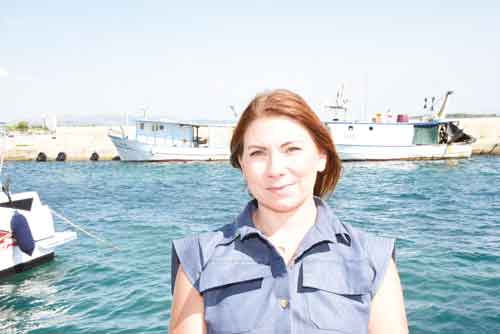
Twelve years ago, the Adria fishing cooperative in Tribunj was trying to strengthen the position of local fishers by creating a wholesale fish auction. The idea was to bring catches together, increase transparency, reduce the influence of intermediaries, and improve first-sale prices. Unfortunately, the auction never took off, partly because of resistance from vested interests along the supply chain, partly due to the generally conservative nature of fishers. Today, however, the organisation is pursuing the same underlying goal but by different means. Under Matea Lovrić, the manager, Adria combines port management and first sale with processing, product development, environmental work, and an effort to put locally caught Adriatic fish on Croatian plates.
EU fisheries funds support many developments
The cooperative was founded in 2007, following an earlier fishermen’s association created to secure a safe harbour for the local fleet. It now has 12 active members, comprising purse seiners and trawlers, whose landings are about a third of the total landings at the port. Adria manages the fishing port under a concession running to 2035, and this base is one of the strongest incentives for membership. Members have berths, ice, electricity, water, and access to the cooperative’s fish handling and marketing infrastructure. When a fisher has no buyer, the cooperative can take the catch and find a market for it. Moreover, through projects managed by the cooperative and funded by the EU’s fisheries fund, fishers have been supplied with clothing, weighing machines for their boats, and thermal boxes for fish storage. The cooperative has installed solar panels on its building and is working on a proposal to install them on each vessel.
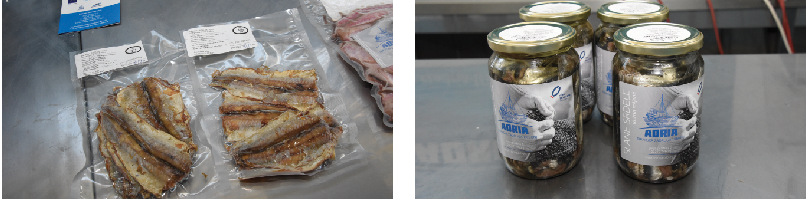
Some of the value-added products that are manufactured by Adria and sold to local restaurants and
to specialised delicatessen shops in Zagreb and along the coast.
However, cooperation among fishers is not always simple. Membership of the cooperative places some constraints on the fishers. In addition, because they are not all fishing the same species, some target demersal fish, others pelagics, their interests are not always aligned. Ante Sladoljev has been working with the fishing sector for years, including at the Cooperative Adria, and now leads Galeb, a Fisheries Local Action Group (FLAG). He says fishers are reluctant to work together if it means compromising their independence. Ms Lovrić explains that a fisher may prefer to sell to an external buyer offering slightly more on the day, even though the cooperative has provided infrastructure and can offer a stable price for the fish. Adria does not oblige members to sell their catches through it. Instead, it tries to make membership valuable enough that fishers choose to do so.
Processing the landed fish boosts prices and has created a market
Ms Lovrić says the cooperative normally adjusts the prices it pays fishers only once or twice a year, rather than following every short-term movement in the market. But the model comes under pressure from imports. She gives squid as an example: last year the cooperative was paying its fishers EUR15/kg while restaurants could find imported squid for around EUR12/kg. Depending on availability, Adria might then sell its local squid for EUR20-25/kg. Competing on price alone is therefore difficult; the cooperative must compete on the fish’s origin and freshness. Processing the raw material is also a way to add value to the catch and has become central to the cooperative’s strategy. It started in 2017, and Ms Lovrić says demand for Adria’s processed products has risen strongly over roughly the last four years as Croatian consumers have become more interested in Adriatic seafood. The cooperative sells fresh and processed fish through its markets in Tribunj and Tisno, supplies Metro, and works with specialist food shops in Zagreb and along the coast. Fresh and processed products are sold within Croatia, while some fresh fish has been exported to Italy and, in smaller quantities, to Slovenia.
The range reflects the mixed catches of the local fleet: hake, red mullet, squid, shrimp, sardines, anchovies, and other permitted species from the Adriatic. Some products are cleaned and frozen, while sardines and anchovies are salted. Capacity remains a constraint. Two women carry out much of the processing manually. Therefore, when the volumes of small pelagic fish landed are high, some of the catches go to factories equipped for high-volume processing.
Adding value to lesser-known species
Smoking is a newer way of extracting more value from fish that otherwise struggle to find a market. With support through Mr Sladoljev’s FLAG, Galeb, and the EU’s fisheries fund, Adria obtained a purpose-built smoking chamber and other processing equipment. The European Commission has highlighted the initiative as an example of combining traditional preservation techniques with modern food-safety requirements and applying them to lesser-known species. The idea, Ms Lovrić explains, is that when species are landed for which there is little demand as fresh fish, smoking can turn them into a distinctive and often unique product. She knows because she does some of the smoking herself and has learnt that consistency is not automatic. Fillet thickness and humidity affect the result, and on some occasions a batch has had to be discarded, because of unsuitable conditions in the chamber. You cannot get the same result every time, she says, as individuals of even the same species are not the same.
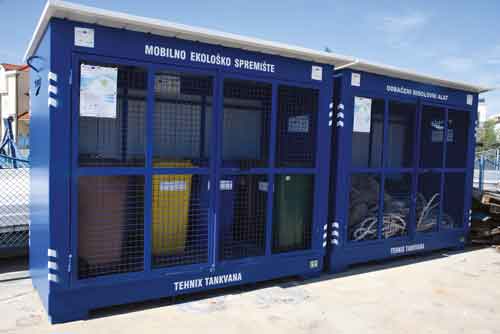
These bins from the Interreg project FishNoWaste are used to store waste generated
by fishers or collected from the sea. Ultimately the waste will be disposed of by the municipality.
Adria has begun supplying smoked fish to several of the local restaurants. Smoked seafood is still unfamiliar to many consumers in Dalmatia, where smoking is much more strongly associated with meat. The cooperative therefore also uses tastings and dishes such as red mullet pâté to show what can be done with species people may otherwise overlook. The Commission reports that the processing initiative has created employment, strengthened demand for local catches, and helped women enter parts of the fisheries value chain where they have traditionally been less visible. Adria’s activities also extend beyond commercial sales. Three years ago, it began working with kindergartens to introduce more Adriatic fish into meals for young children. Ms Lovrić says the cooperative now works with five or six kindergartens, reaching more than 1,000 children who eat Adriatic fish twice a week. The effort is linked to FLAG-supported projects that help kitchens obtain equipment and train staff to prepare seafood. Familiarising children with local seafood will hopefully foster an interest in consuming fish, shellfish, and cephalopods that will stay with them for the rest of their lives.
Socially-useful initiatives for the environment and for promoting fish consumption
Environmental work has become another part of Adria’s role. Since 2014 it has cooperated with the Institute of Oceanography and Fisheries in Split on marine litter brought up in fishing gear. Fishers are encouraged to bring waste ashore rather than return it to the sea, and the material is analysed by the scientists to understand its composition. The cooperative also organises annual clean-ups in and around the port, involving divers, children, schools, and local organisations. Old fishing nets are collected and passed to partners for recycling. Under the Interreg FishNoWaste project, which seeks better ways to manage waste in Adriatic fishing ports, containers were installed in the port where fishers could deposit their own waste as well as material they pick up from the sea. For disposal of waste from the port Ms Lovrić says the cooperative pays the municipality about EUR800 a month, including material fishers have recovered from the sea rather than generated themselves.
The organisation itself is small. Adria currently has seven staff, and Ms Lovrić estimates that it is short of at least three more. Recruiting for fish processing is difficult despite wages that she says compare well with jobs in other sectors. The work is physically demanding, and Croatia is facing labour shortages more generally. With a small team, office staff must be prepared to sometimes help with the fish processing when colleagues are absent. Since 2007 Adria has proven adept at reinventing itself, a skill that will no doubt stand it in good stead in the future as well.