This article was featured in Eurofish Magazine 5 2026.

Consumers have access to more information about sustainable food than ever before. But more information does not necessarily make choosing seafood easier. Labels, environmental claims, seasonality, origin, fishing methods, and production systems can leave even informed consumers unsure about what to buy. Enter Mr.Goodfish3.0, a project that aims to facilitate informed decision-making among consumers.
This gap between awareness and action is at the centre of Mr.Goodfish3.0, the latest iteration of an initiative that has promoted responsible seafood consumption since 2010. The project is expanding its approach across European sea basins and inland waters, while broadening its scope to include freshwater and aquaculture products. But the change is not only geographical. Mr.Goodfish3.0 is also moving away from a model in which experts simply provide information to consumers. Instead, citizens, seafood professionals, educators and other stakeholders are being involved in shaping how that information is presented and how responsible consumption can fit into everyday life.
Listening before designing
In Mr.Goodfish3.0, while scientific institutions and experts remain responsible for the evidence underpinning seafood recommendations, citizens contribute through interviews, surveys, workshops, consultations and co-creation activities that explore how people actually choose, buy and prepare seafood. At the beginning of the project, stakeholder mapping, interviews, consumer surveys and contextual analyses were conducted in three pilot regions in France, Norway and Cyprus. Consumers were joined by educators, researchers, fishers, producers, retailers, restaurants, policymakers and other actors from the seafood value chain. Their input has subsequently fed into the development of the new Mr.Goodfish app, website, educational materials and engagement activities. For example, consumers were recently invited to submit their favourite seafood recipes for possible inclusion in the website and app. Beyond generating content, the initiative gives people an opportunity to bring their own culinary traditions into the project.
Other feedback has resulted in more substantial changes. The previous Mr.Goodfish platform displayed recommended species that were in season. Consumer feedback showed that this could cause confusion, with users potentially interpreting the absence of other species as meaning that they were unavailable or should never be consumed. The new version therefore also displays out-of-season species while making the distinction clearer.
Cases reveal different approaches to the same goal
Perhaps the more difficult challenge comes after consumers understand the recommendation. Seafood purchases are influenced by price, convenience, availability, taste, tradition and cooking skills alongside environmental considerations. Mr.Goodfish3.0 therefore tries to connect sustainability information with the factors that determine what people eventually put in their shopping basket or order in a restaurant.
In Norway, work with young consumers revealed reluctance to purchase unfamiliar fish partly because people did not know how to prepare it and were concerned about wasting food. A workshop was developed around monkfish, presented by the project as a locally abundant but underused species. Participants learned how to prepare the fish, turning an unfamiliar species into something they could cook. In Cyprus, the challenge was different. Activities around lionfish connected seafood consumption with the presence of an invasive species affecting local ecosystems. Instead of relying primarily on messages about environmental responsibility, the project approached consumers through culinary curiosity and local identity. The principle behind both examples is similar: telling consumers that they should make a different choice may be less effective than removing the practical or cultural barriers preventing them from making it.
Nudging people to make sustainable choices
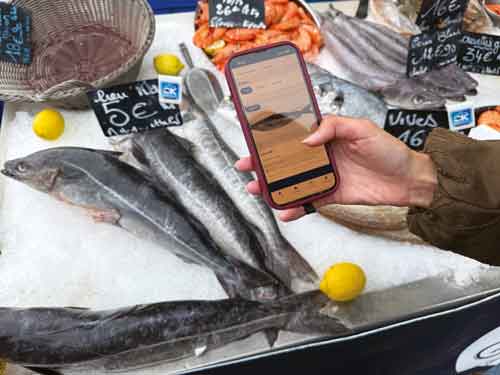
The digital tools being developed follow the same reasoning. The Mr.Goodfish app translates scientific information into species profiles and recommendations intended for everyday use. An interactive map provides information about species origins and fishing areas, while recipes connect recommended species with practical ways of preparing them. Users can save favourites and receive information related to seasonal species, recipes and nearby committed restaurants, fishmongers or producers. The project’s resources also include so-called Nudging Toolkits designed to encourage sustainable choices without relying on prescriptive messages.
Digital communication is only one part of the system. Chefs, restaurants, fishmongers and retailers can be particularly influential because they encounter consumers at the moment when choices are being made. A recommendation from a trusted fishmonger or chef can make somebody more willing to try a species they would otherwise overlook.
Schools, aquariums, museums and science centres have a different but complementary role. Mr.Goodfish3.0 is working with teachers and students to develop educational resources including learning scenarios, workshops, a board game and a Nudging Toolkit for Educators. The emphasis is again on participation and practical experience rather than simply delivering information.
The difficult question of influencing behaviour
Whether these activities produce lasting changes in seafood consumption is harder to establish. The project acknowledges this challenge. Website visits, app downloads, social media interactions and participation figures can show that people have been reached, but they do not demonstrate that consumers have changed their buying habits. Mr.Goodfish3.0 will use feedback, surveys and engagement data to evaluate its activities. However, whether awareness develops into a sustained behavioural change remains a more complex question. After years of sustainability communication, the challenge is increasingly not simply how to provide consumers with more information, but how to encourage them to make responsible choices.
Mr.Goodfish3.0 is testing whether presenting the information in a way that enables responsible consumption to become a part of daily life can help close the distance between knowing what a responsible seafood choice is and actually making one.
Ixai Salvo, Eurofish, ixai@eurofish.dk