This article was featured in Eurofish Magazine 4 2026.

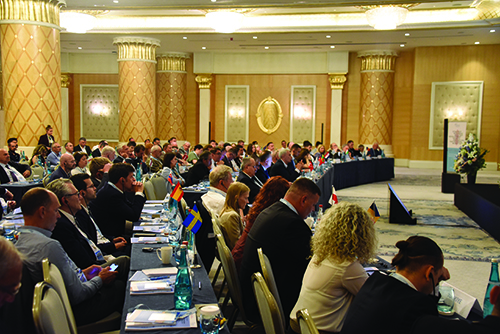
Organised by Eurofish International Organisation in cooperation with the Turkish Ministry of Agriculture and Forestry, the Eurofish international conference on processing, certification, and trade held in Istanbul on 9–10 June 2026 brought together around 200 participants from 28 countries, as well as FAO, for two days of presentations, discussion, networking, and a field visit.
The conference addressed some of the central questions facing fisheries and aquaculture businesses including how to secure raw materials, add value, and exploit digital technologies. In their opening interventions speakers from Eurofish and the Turkish authorities welcomed participants to a programme that moved from trade and online sales to processing, robotics, artificial intelligence, and certification.
A changing trade environment
The first session addressed trade and online sales in the seafood business. For seafood, e-commerce depends on cold chain discipline, product standardisation, and the processing capacity needed to regularly supply convenient products. Fresh fish is a demanding product category for online retail because quality must be maintained from order to delivery. Moreover, the consumer needs clear information on origin, species, and shelf life. The discussions therefore linked online trade directly to processing and traceability.
The wider trade picture was addressed in the presentation by Roberto Alonso from ANFACO-CYTMA, who described the European seafood processing sector as a strategic pillar for food security, employment, coastal cohesion, and industrial resilience. Europe is a major seafood consumer and processor, but its industry depends heavily on imported raw materials. This creates opportunities for international trade but also exposes processors to geopolitical instability and freight disruptions. Securing raw materials through diversified sourcing, free trade agreements, cooperation with producers, and aquaculture development was essential to competitiveness, in his view.
The sector also faces demands for a level playing field. Traceability, catch documentation, food safety, and labour requirements for companies outside the EU need to be comparable to those within, if competition is to be fair.
Processing aims for ever-greater added value
Several presentations showed how processing is evolving to create greater added value products. In the Adriatic Sea basin, Ivana Kuzman from Pelagos Net Farma described the structure and trends in sardine, anchovy, and bluefin tuna processing. Sardine remains Croatia’s most important commercial species, accounting for more than 60% of the country’s total fish catch, followed by anchovy, while farmed bluefin tuna is a high-value export. Across these species, a common trend of less volume and more value is emerging. Rising production costs, resource fluctuations, demand for premium products, and the growth of ready-to-eat and convenience seafood are pushing processors towards higher-value formats.
For sardine and anchovy, frozen, salted, canned, marinated, and filleted products all have a role. For bluefin tuna, strict regulation, traceability, and careful harvesting techniques support access to high-value export markets. The presentation also reminded participants that modernisation does not remove the importance of people. Skilled workers remain critical to quality, especially in species and product categories where their experience is an invaluable asset.
The Nutaaq project from Western Greenland offered another strong example of value creation through process innovation. Summer inshore cod traditionally suffered from quality problems, including soft texture. Inspired by aquaculture practices, the project introduced live holding in pens where they were kept without feeding for 8-14 days. Planning and collection are vital because the fish must be moved from traps to holding pens and then processed at the right time. The system has improved raw material quality and enabled higher-value production, including pre-rigor processing and freezing. The lesson from Greenland showed that improving value does not always require a new species or a new market but can come from redesigning the way an existing fishery is handled.
Technology reaches the farm and factory
The conference also looked at the role of artificial intelligence and digital tools. Umitron, a Japanese company, presented smart aquaculture technologies designed for different farming environments, including locations with limited electricity, connectivity, or capital. The company’s approach combines satellite data, software, and artificial intelligence to support site selection and farm management. Feed is one of the main cost drivers in aquaculture. Poor feeding practice contributes to waste and environmental impact. AI-supported appetite analysis and remote feeding can help farmers feed when fish are ready to eat, reduce waste, and use operational data to improve decision-making.
A particularly important point was that smart aquaculture should not be understood as a single pathway based only on large, highly centralised farms. Decentralised technologies may support smaller cages, inland ponds, and regions where infrastructure is limited. By making digital tools more accessible, such systems can strengthen local production, improve resilience, and support sustainable growth in different regions. This is especially relevant at a time when food supply chains are vulnerable to disruptions from climate events to geopolitical crises that influence energy prices or logistics.
Certification makes sustainability claims credible
The second day focused strongly on certification and corporate sustainability. Jacob Færgemand introduced the relationship between accredited certification, and corporate sustainability, including the relevance of the UN Sustainable Development Goals and the ISO/UNDP work on management systems for the SDGs. Companies are under growing pressure to report on sustainability. However, reporting is useful only when it is connected to management, implementation, and measurable improvement. Certification and standards can help companies move from intentions to structured action.
Jacobo de Novoa from Bureau Veritas presented fisheries certification as a portfolio of tools rather than a single route to market. The Marine Stewardship Council standard, chain of custody certification, Certified Seafood International, and emerging approaches such as Community Catch all serve different needs. Certification can support market access, reduce the risk of mislabelling, strengthen traceability, and help consumers identify products from responsibly managed fisheries. However, cost and complexity remain barriers, especially for small-scale fisheries.
FAO’s presentation on the WTO Agreement on Fisheries Subsidies showed that fisheries and aquaculture production reached record levels in 2022. Aquatic products are among the world’s most traded foods, and millions of people depend on the sector for employment. At the same time, overfishing, IUU fishing, climate change, pollution, and biodiversity loss remain serious challenges. The WTO agreement, which entered into force in 2025, disciplines certain harmful fisheries subsidies, including those linked to IUU fishing and overfished stocks. Its implementation will depend on transparency, fisheries management, technical assistance, and cooperation with organisations such as FAO.
From conference room to processing floor
The field visit to the Sağdıçlar Group production plant in Istanbul gave participants a practical view of seafood processing in Türkiye. The company processes different species producing smoked, marinated, salted, frozen, and ready-to-cook items. For participants, the visit connected many of the conference themes including raw material quality, hygiene, product development, and the importance of convenience in modern seafood markets.
Overall, participants considered the presentations and the organisation to be of a high level, and the programme was intense but rich in new information. The conference confirmed that the future of fisheries and aquaculture business will not be shaped by one factor alone. Processing, certification, trade, sustainability, and technology are becoming increasingly interdependent. In Istanbul, the sector’s challenges were clear, but so too were the tools and examples that can help turn them into opportunities.
Eva Kovacs, Eurofish, eva@eurofish.dk