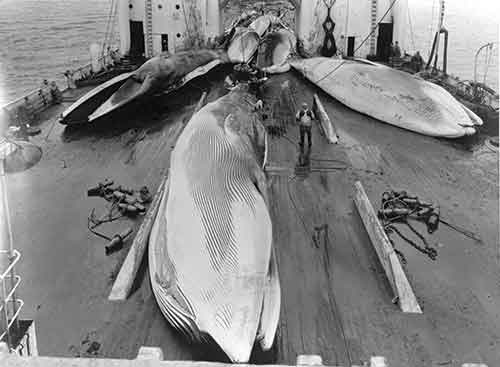
This article was featured in Eurofish Magazine 4 2026.

Whaling has been part of human coastal life for a very long time. Early hunts were typically local and seasonal, supplying meat for food and blubber for oil, while baleen and other tissues were used in tools and household items. Today the pressures on whales are more from the environment than from hunting which is carried out by just a handful of nations.
In the North Atlantic and the North Pacific, including Arctic regions, whaling became embedded in community practices and, in some places, ceremonial life. From the late medieval period onwards, European ventures expanded the scale of whaling, with Basque crews often highlighted as among the pioneers of organised commercial operations in the Atlantic. As the centuries progressed, whaling shifted from nearshore activity into longer voyages, driven by trade in oil and baleen products.
By the eighteenth and nineteenth centuries, whaling had become a global enterprise. Sailing ships from Europe and North America pursued sperm whales and right whales across the Atlantic and into the Pacific. The pattern that emerged was one of expansion followed by scarcity: as whales became less common near familiar grounds, fleets travelled farther and stayed longer at sea. This “search and move on” dynamic laid the groundwork for the most damaging period of whaling, which arrived with industrialisation. In the twentieth century, technological change transformed whaling’s impact on whale populations. Steam power and explosive harpoon technology increased the speed and success rate of hunts. Factory ships and at-sea processing reduced the need to return to port, allowing fleets to exploit remote waters for extended periods, including the Southern Ocean. These developments enabled intensive harvesting of large whale species, which reproduce slowly and recover over long timeframes. Scientific understanding of population dynamics improved during this period, but governance struggled to keep pace with industrial capacity. As a result, several stocks were heavily reduced, and the industry often shifted pressure from one species to another as scarcity increased.
The International Whaling Commission
The principal attempt to create a durable international framework came after the Second World War. In 1946, fifteen governments signed the International Convention for the Regulation of Whaling, establishing the International Whaling Commission (IWC). The Convention framed whaling as an international matter requiring common rules, and it set out a dual purpose: conserving whale stocks and, by doing so, enabling the orderly development of the whaling industry. That founding balance continues to shape how different parties interpret the Commission’s role.
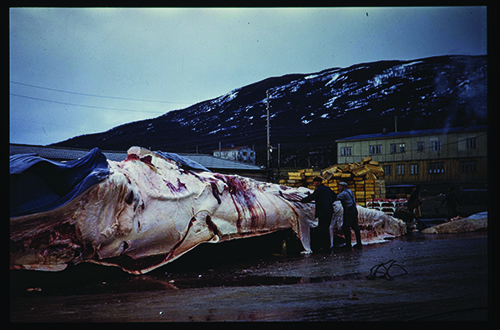
A whale being skinned manually at the Skjelnan whaling station, Norway in 1952.
The IWC’s authority rests on the Convention and its legally binding Schedule. The Schedule is the practical rulebook: it sets catch limits and defines where, and how, whaling may take place. It can be amended without reopening the Convention, which allows rules to evolve as scientific assessments change. Each member government appoints a Commissioner with a vote. Routine decisions can be taken by majority, while amendments to the Schedule require a higher threshold, which was intended to encourage broad agreement on the most consequential measures. The Convention also contains an “objection” procedure, under which a government may formally object to a Schedule amendment within a defined period, thereby limiting the amendment’s applicability to that government.
Science is central to the IWC’s functioning. The Scientific Committee assesses whale stocks and advises on management approaches, including sustainable catch calculations, where relevant. Over time, the Commission’s agenda has also widened beyond direct catch regulation to include conservation questions affecting whales more generally, reflecting changing public priorities and the growth of non-consumptive uses such as whale watching.
A moratorium with derogations
The IWC’s most consequential decision was the adoption of a pause in commercial whaling, agreed in 1982 and taking effect from the 1985/1986 season. Often referred to as the commercial whaling moratorium, it set commercial catch limits at zero under the IWC Schedule. The moratorium did not eliminate all whaling. Under the IWC framework, aboriginal subsistence whaling is permitted for certain indigenous communities under conditions intended to meet nutritional and cultural needs while maintaining sustainability. The Convention also provides for “special permit” whaling, where national authorities issue permits for research purposes, with the IWC’s Scientific Committee providing scrutiny.
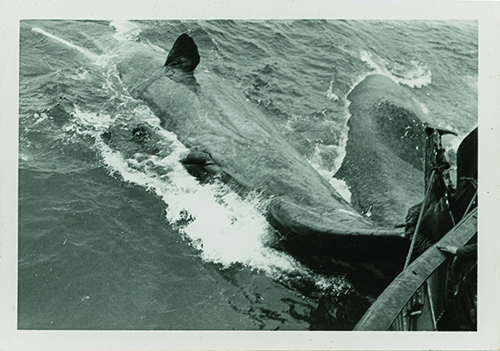
Whale hunting today is governed by the International Whaling Commission and
only a small number of counties actually hunt these cetaceans.
As debates intensified, the Commission also adopted sanctuary measures in certain regions, reflecting a stronger protection-oriented current within the membership. At the same time, some whaling nations argued for a return to regulated commercial whaling under updated scientific tools and strict compliance measures. In that context, the IWC adopted the Revised Management Procedure in the 1990s as a method for setting catch limits designed to be precautionary in the face of uncertainty. However, reaching agreement on the broader package of monitoring and inspection proved difficult, and the moratorium remained the default position within the IWC framework.
Today commercial whaling is limited and shows divergent approaches
Commercial whaling today is conducted by a small number of states, and in uneven ways. Norway conducts whaling under an objection to the moratorium, setting national quotas for common minke whales. Actual catches have often been below quotas, which is commonly linked to market demand and fleet economics. Iceland has issued licences for fin whales, and, at times, minke whales, yet hunting activity has fluctuated, and recent seasons have been marked by uncertainty, including decisions by major operators not to hunt in consecutive summers despite holding permits.
Japan’s position changed fundamentally after its withdrawal from the IWC. Japan announced its intention to leave in December 2018, and the withdrawal took effect on 30 June 2019. Japan resumed commercial whaling from July 2019 under national regulation, focusing hunting in its territorial waters and exclusive economic zone. Supporters of Japan’s approach argue that it reflects the Convention’s original premise of sustainable use within a science-based framework. Critics argue that withdrawal reduces the scope for international oversight and weakens cooperative management, even if national regulation remains in place.
Japan has also invested in operational capacity, including a new factory ship introduced in 2024, intended to process and freeze catches at sea. This has prompted further debate about the future scale of Japan’s programme, including how far vessels might range, and which species are targeted. In 2024, Japan also moved to expand commercial hunting to include fin whales, a large whale species whose historical depletion is central to modern conservation narratives. The policy debate around this decision illustrates a broader pattern: discussions tend to focus on stock status and the robustness of scientific assessments, alongside the welfare implications of hunting methods.
Whale meat is consumed by humans as well as used for petfood
Where whale meat is sold, it is generally a niche product. In Japan, it is often discussed as a small part of overall meat consumption, with demand supported by limited retail channels and some restaurants, alongside public messaging that frames whaling as culturally significant. In Norway, consumer surveys cited in the background material indicate low levels of frequent consumption, and the economics of the sector appear sensitive to price and demand shifts. When supply exceeds demand for direct human consumption, whale meat can be diverted into other outlets, including pet food. Iceland’s experience, where the viability of hunting has been linked to export conditions, underlines how dependent commercial whaling can be on a small number of buyers and on price movements within those outlets. This economic fragility is one reason some analysts expect commercial whaling to remain limited, even where it is legally permitted.
The niche character of whale meat markets has not prevented fraud. Reported cases include mislabelling of species, including substitution with protected cetaceans, as well as smuggling across borders where trade is restricted. Fraud can also involve marketing whale meat as other products, exploiting the fact that processing can remove visible identifiers. Because of these challenges, enforcement increasingly relies on DNA-based species identification, supported by documentation and traceability requirements.
Certain cetacean tissues can contain contaminants such as mercury and persistent organic pollutants. When products are mislabelled, consumers may not receive appropriate guidance, and authorities may struggle to assess risk, especially if the species and origin are unclear. These concerns apply to human consumption, and they may also be relevant where whale meat is used in animal feed.
Whale watching is displacing whaling
Looking ahead, several pressures are likely to shape whaling’s trajectory. The first is governance. The IWC remains the central forum for international discussion, and it continues to regulate aboriginal subsistence whaling and to provide scientific assessment. However, the use of objections and differing interpretations of the Convention’s purpose have made consensus on commercial whaling difficult, and withdrawals have added to this challenge. The second pressure is economics. Evidence of limited demand in some markets, alongside reports of unsold meat and reliance on subsidies, suggests that commercial whaling may face long-term constraints, even without new legal restrictions. Investment in capacity, as in Japan, points to the opposite possibility, namely that a state may seek to stabilise or expand its programme where it believes there is a domestic rationale and an acceptable scientific basis.
A further pressure is welfare and public acceptance. Concerns about time-to-death and the practical challenges of monitoring hunts at sea have become more prominent in policy discussions. At the same time, whale watching and broader marine conservation agendas have strengthened the non-consumptive value attached to whales, influencing public opinion and tourism policy in many coastal regions. Even as whaling -declines, whales remain exposed to serious human-driven pressures: entanglement in lost or abandoned fishing gear, plastic ingestion, toxic chemicals accumulating in blubber that can affect immunity and reproduction, and underwater noise that disrupts communication, feeding, and navigation. These impacts can be intensified by climate-driven changes in prey availability, alongside vessel strikes and habitat degradation.
In practice, the most plausible near-term outlook is continued divergence: strong protection policies within the IWC framework, limited commercial whaling under a small number of national regimes, with ongoing scrutiny of market demand and welfare, alongside trade integrity. Neutral analysis depends on transparent data and clear traceability, because these are the foundations for evaluating sustainability claims, enforcing rules, and enabling informed public debate.
Eva Kovacs, Eurofish, eva@eurofish.dk