This article was featured in Eurofish Magazine 4 2026.

Aquaculture has become a strategically important component of Ireland’s “blue economy,” producing seafood such as salmon, mussels, and oysters while supporting rural coastal livelihoods. By 2024, the sector produced almost 38,500 tonnes of farmed seafood annually, generating over €200 million in value and supporting more than 1,800 jobs.
Like other food production systems, aquaculture in Ireland is under increasing pressure to address its environmental footprint—particularly energy use and greenhouse gas (GHG) emissions. EU and Irish climate policy frameworks, including the European Green Deal and Ireland’s Climate Action Plan, are accelerating the need for decarbonisation and energy transition across marine industries.
Moving to alternative energy sources is challenging in many ways
The energy transition in Irish aquaculture therefore refers to the shift from fossil-fuel-dependent operations toward more energy-efficient practices and the adoption of renewable and low-carbon energy systems. This transition is complex, involving technological, economic, and governance challenges. Aquaculture operations require energy for feeding systems, aeration, pumping, monitoring, processing, and transport. Offshore and intensive aquaculture installations tend to be particularly energy intensive. Across the EU, fisheries and aquaculture remain heavily dependent on fossil fuels, especially diesel, which exposes the sector to fuel price volatility and contributes to emissions.
Although Irish aquaculture is often described as a relatively low-carbon food production system compared to livestock or crop agriculture, emissions still occur across the full value chain—from feed production and farm operations to processing and distribution. Ireland has begun to quantify emissions through studies such as the Bord Iascaigh Mhara (BIM) carbon footprint report. This work identifies energy use as a key component of emissions and highlights “hotspots” across aquaculture and seafood supply chains. While the overall seafood sector contributes only a small share of global emissions (around 4% of food-related emissions), decarbonisation is essential to reach Ireland’s national target of reducing emissions by 51% by 2030 and achieving net-zero by 2050.
Policy frameworks for more sustainable aquaculture abound
Ireland’s National Strategic Plan for Sustainable Aquaculture Development 2030 emphasises reducing environmental impact and minimising carbon footprint while enabling sector growth. The plan aligns with wider marine and climate policies, including: the Climate Action Plan (net-zero target by 2050) and the National Marine Planning Framework and Maritime Area Planning Act (MAPA). However, research suggests that regulatory frameworks governing aquaculture may not yet fully integrate sustainability and energy transition goals, limiting progress. At European level, the energy transition is guided by the European Green Deal and aquaculture strategy for 2021–2030, which emphasise decarbonisation of food systems, transition to renewable energy, improved energy efficiency and climate resilience. In addition, the EU’s Energy Transition Initiative proposes to reduce fuel intensity (e.g. 15% reduction target by 2030), adopt alternative fuels such as electricity, biofuels, and hydrogen and invest in innovation, skills, and financing mechanisms.
One of the most significant areas of progress is in innovation-driven energy solutions. Projects in Ireland and across Europe are exploring how renewable energy systems can power aquaculture operations, particularly offshore farms. A notable Irish example is the WEC4FISH project, which investigates the use of wave energy converters to supply electricity to offshore aquaculture systems. This approach aims to replace diesel generators and integrate energy generation with aquaculture infrastructure. Other emerging technologies include solar-powered monitoring systems, hybrid energy solutions combining batteries and renewables, and electrification of equipment and feeding systems. Such innovations demonstrate the feasibility of low-carbon aquaculture, particularly in offshore locations where grid access is limited. In the short to medium term, the most widespread progress lies in energy efficiency improvements, including optimisation of feeding regimes, improved equipment efficiency, digital monitoring systems for energy use and reduced fuel consumption in transport and logistics. EU policy emphasises these measures as the most immediate pathway to reducing energy demand and emissions.
Support to decarbonise is available from EU and national sources
The European Maritime, Fisheries and Aquaculture Fund (EMFAF) plays a central role in supporting the energy transition. In Ireland, schemes such as the Aquaculture Capital Investment Scheme provide funding for renewable energy systems, energy efficiency upgrades and low-carbon technologies. These funding streams are critical for enabling small and medium aquaculture enterprises to invest in decarbonisation. BIM has developed sustainability frameworks and reporting tools that help companies measure and improve environmental performance. The Irish aquaculture sector has shown strong uptake of innovation, with high levels of engagement in process improvements and new technologies. There is also increasing adoption of certification schemes, organic aquaculture practices and circular economy approaches (e.g. waste recycling).
Despite progress, several structural and operational challenges continue to slow the transition. Energy transition technologies often involve high upfront costs. Many Irish aquaculture enterprises are small-scale and operate in remote coastal areas, limiting access to capital and infrastructure. This makes decentralised renewable energy solutions (e.g. wave, solar, hybrid systems) necessary but technically challenging. Rising energy costs also increase operational pressure, especially where reliance on diesel remains high. During the recent energy crisis energy costs became a major share of expenses, exacerbating vulnerability to price fluctuations.
Technical and administrative barriers slow progress
In addition, many low-carbon energy technologies are still in early development or not yet commercially viable for aquaculture. For example, hydrogen systems and advanced batteries are not widely deployed, offshore renewable integration requires complex engineering, and electrification is limited by grid connectivity issues. This creates uncertainty for businesses considering investments. Ireland’s aquaculture sector is often criticised for complex and slow licensing processes. In addition, policy frameworks for aquaculture and renewable energy are not always fully aligned. Aquaculture has not been fully integrated into marine spatial planning systems. Therefore, legal and administrative barriers can delay new projects. These governance issues can hinder both sector expansion and the implementation of energy transition projects.
While energy transition focuses on carbon reduction, aquaculture must also address broader environmental issues, including water pollution and eutrophication, biodiversity impacts and disease and chemical use. These issues can complicate sustainability strategies, as reducing energy use alone does not ensure overall environmental performance. The aquaculture energy transition requires new technical skills in renewable energy systems, data analytics and digital monitoring and engineering and maintenance. There is a recognised need to develop workforce capacity to support these changes, which is being addressed through EU and national initiatives but remains a constraint.
More efficient use of energy also contributes to decarbonisation
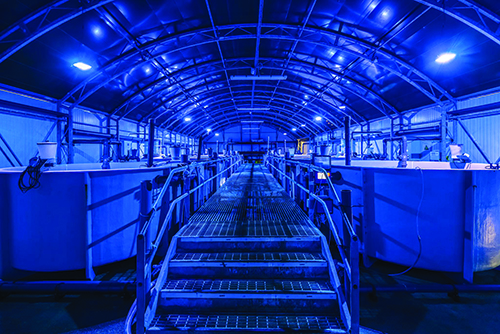
In general, the trajectory of energy transition in Irish aquaculture is broadly positive but gradual. Several trends are likely to shape the future, for example, Ireland’s growing offshore wind and marine energy sectors present opportunities for co-location and shared infrastructure with aquaculture. This could significantly reduce energy costs and emissions while enhancing spatial efficiency. In addition, land-based and recirculating aquaculture systems (RAS) are emerging as alternatives that allow greater control over energy use and emissions. Although energy-intensive, they can be powered by renewable electricity and integrated into circular systems. Furthermore, smart farming technologies will improve energy efficiency through real-time monitoring, automation and predictive analytics. These tools will help optimise resource use and reduce emissions across operations. However, continued EU support, particularly through the Energy Transition Partnership (ETP) initiative combined with national strategies, is required to accelerate investment in clean technologies, improve regulatory frameworks and enhance coordination between stakeholders.
Overall, Irish aquaculture benefits from relatively low baseline emissions compared to other food systems, strong policy support, and growing innovation capacity. Significant progress is being made through, energy efficiency improvements, renewable energy pilot projects and funding mechanisms and sustainability initiatives. However, major challenges remain, including high costs and limited access to finance, technological and infrastructure barriers and governance complexity and policy gaps. To achieve a fully decarbonised aquaculture sector, Ireland will need to scale up innovation, improve integration with renewable energy systems and streamline regulatory frameworks. The transition is not only essential for climate targets but also for enhancing the long-term resilience and competitiveness of the Irish seafood industry in a low-carbon global economy.
Julie Maguire, Research Director,
Bantry Marine Research Station Ltd, julie.maguire@bmrs.ie