This article was featured in Eurofish Magazine 4 2026.

A project by the Port of Copenhagen, WWF, and organisations housed in buildings along the quays is bringing more biodiversity to the water in the channels around the port by installing safe spaces for juvenile fish.
The EU’s biodiversity strategy seeks to undo some of the damage to the environment inflicted by human activity as well as to create greater resilience to the impacts of climate change. Biodiversity restoration and protection have immense economic, health, and nutritional benefits. According to the strategy, at a global scale half of the world’s GDP relies on nature including industries such as agriculture, forestry, tourism, and fisheries, and over half the world’s drugs can be traced to compounds found in nature.
Increasing biodiversity benefits vital industries
Agriculture is heavily reliant on insects to pollinate crops, while genetic diversity results in more resilient and adaptable crops and livestock ensuring food security around the world. The strategy aims to place biodiversity on the road to recovery by 2030 en route to restored ecosystems by 2050. Implementation of the strategy is funded by various EU funding mechanisms, EU Member States, and the private sector. Efforts to restore biodiversity are being implemented at EU, national, and local levels to counter the impacts of unsustainable human activities such as intensive farming and forestry, as well as of pollution.
In a local Copenhagen biodiversity initiative, WWF and By & Havn, the company responsible for the Port of Copenhagen, have joined forces in a project to bring more life to the water in the port and the surrounding channels. “Life” here refers to animal life; of human life there is no lack. The Port of Copenhagen attracts some two million people each year including bathers, swimmers, boating, kayaking, and rowing enthusiasts, users of the public harbour buses, as well as large numbers of anglers who fish along the 42 km of quays. Among the partners in the project is Ecocean, an ecological engineering firm based in Montpellier, France that creates solutions to encourage biodiversity in ports and urban environments. Since 2021, the company has installed 200 Biohuts in Copenhagen. A Biohut is an artificial nursery comprising a steel cage itself made of recycled material. Of the 200 installations, 80 were part of a collaboration between WWF and By & Havn to improve fish habitats and biodiversity in the port.
Cages replace natural habitats
The cages comprise an inner chamber containing oyster shells which provide a substrate that helps establish a food chain, and an outer area where the young fish (less than 3 cm) are protected from predators. The Biohuts are available in different models, but the ones used in Copenhagen were Dock Biohuts, a variant that can be tethered to a quay. The cages are placed 20-50 cm under the water surface in areas undisturbed by vessels or swimmers. Ecocean reports that the survival rate among pre-juvenile animals in an undisturbed coastal ecosystem is less than 10%. In an environment subject to anthropomorphic pressure, such as a port, this drops to near zero, due in part to the absence of natural nursery habitats where the pre-juvenile fish can find feed and protection from predators. The Biohuts replace these natural habitats and contribute thereby to maintaining populations of fish and other marine organisms in these areas. Since the time they were installed in the port more species have been seen including wrasse, varieties of kelp, and even the threatened European eel. According to WWF, the presence of a wider range of marine organisms contributes to a balanced ecosystem that is also more resistant, for example, to invasive species.
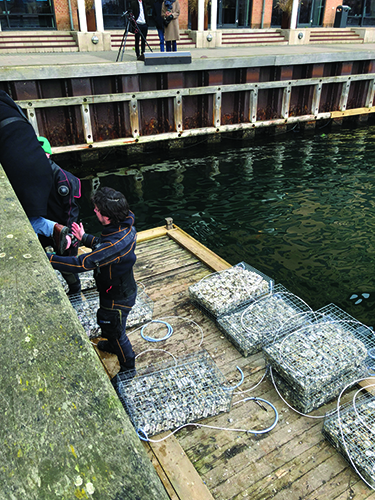
The Biohuts being installed at the quay behind the IDA building.
Installing the Biohuts is a process that includes an initial assessment of the area to identify environmental conditions and the existing level of biodiversity. Once the cages are installed the area is monitored to assess the impacts of the Biohuts and during the lifespan of the project the structures are maintained to preserve the ecological functioning and prolong their life. Finally, when the project concludes the structures are removed and recycled. In addition to the Biohuts, Ecocean also installed three floating ecosystems, platforms that provide safe spaces for fish and invertebrates and which also attract birds and insects. The roots of the plants growing on the platform are submerged in the water from where they absorb nutrients—nitrogen and phosphorus—thus filtering the water as they grow.
IDA’s sustainability work makes it an obvious project partner
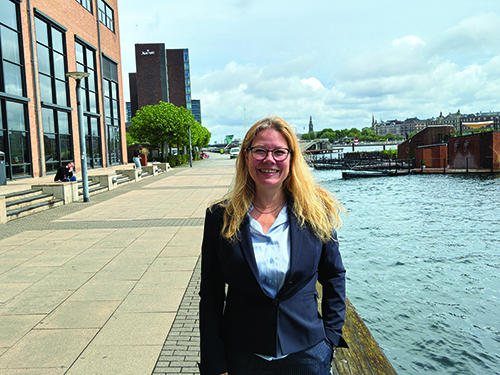
The Biohuts were installed in cooperation with organisations occupying buildings along the quay. Among them, IDA, the union for those working at a high level in technology, natural sciences, and IT. Lone Daugaard Jepsen, the head of sustainability, says IDA provided the space where 25 Biohuts could be suspended, and contributed to the installation and maintenance costs. The initiative fits in with IDA’s broader sustainability work. The organisation believes that combining knowledge of technology and people can help create a better future and, as an institution representing engineers, having an office that embodies this belief helps to promote it as well. IDA is certified to the ISO 14001 standard for creating and maintaining an environmental management system. In the building, which houses some 500 people, this includes recycling wherever possible, collecting rainwater for use in the toilets, and ongoing operational measures to reduce environmental impact. The UN sustainable development goals have been part of IDA’s vision since 2017, says Ms Jepsen, with the organisation examining its operations to see how it could contribute to the UN SDG targets and indicators. The green transition is one of several areas where IDA is active, and within this area it focuses on climate, circular economy, and biodiversity, among others, convening experts, organising events, producing reports, and lobbying the Danish parliament.
Copenhagen’s example may inspire other port cities to establish Biohuts and thereby contribute to a better environment in their waters. And while these fish nurseries in practice may only be a small, if innovative, step towards improved ecosystems, they carry weight as a proof of concept and deserve to be replicated far and wide.