This article was featured in Eurofish Magazine 3 2026.

Estonia has been at the vanguard in developing and implementing measures to defend its fish stocks and coastal fisheries from cormorants and grey seals.
Estonia restarted active management of great cormorants in 2023 after several years during which control was limited resulting in increasing pressure on fish resources. In coastal waters the species has expanded strongly and in some areas its feeding now overlaps with fisheries and with restoration priorities. The challenge is not only the quantity of fish consumed but the timing and location of predation. In spring, when fish concentrate near river mouths and in other spawning grounds, the impact can be disproportionate, particularly for migratory species gathering for spawning.
Culling cormorants as well as deterring them
The policy response in Estonia has been a structured approach that combines long-term population management with targeted action in high-risk locations. The backbone of cormorant control is egg oiling which aims to reduce breeding success and slow recruitment into the population. This is supplemented, where justified, by deterrence measures designed to protect vulnerable fish aggregations during narrow seasonal windows. In parallel, Estonia is increasingly active in the European policy debate, arguing that the issue is transboundary and that the current legal framework makes it -unnecessarily difficult to apply coherent management measures at Baltic scale.
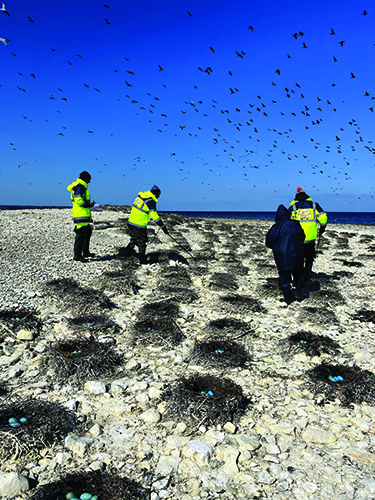
Egg oiling is the main nationwide instrument. Estonia’s working target is to oil at least 30% of the breeding population each year to achieve a sustained reduction in breeding success. Unlike short-term scaring that may simply move birds to nearby areas, reducing recruitment is intended to moderate pressure in the medium and long term. The scale of effort has increased accordingly. In 2025, Estonia estimated the population at 47,500 breeding pairs and carried out management on 19 islets, where 12,623 nests were treated. With clutch sizes typically in the range of three to five eggs, the operational footprint is significant and reflects a commitment to treat egg oiling as a continuing programme rather than an occasional intervention. This approximately 50,000 unborn birds left around 2,700 tonnes of fish in the sea showing the huge effect of oiling on fish populations.
Restoration projects can sometimes facilitate predation
At the same time, Estonia has recognised that some situations require additional, highly targeted tools. The Pärnu River has become the clearest example. The removal of the Sindi dam in 2018 is one of the country’s most important river restoration measures. This is precisely the kind of restoration investment expected to translate into stronger returns of migratory fish, more resilient stocks, and improved ecological status.
However, restoration also concentrates fish movement in predictable corridors. In the sea area near the Pärnu river mouth, cormorant numbers have risen sharply, and nearby coastal islets host some of Estonia’s largest colonies. This combination creates a management dilemma—as the river becomes more accessible to fish, it can also become a more efficient feeding zone for birds during the spring migration. Estonia’s concern is that predation pressure in the river and near the river mouth can reduce spawning success and weaken the benefits that restoration is meant to deliver. The species most often cited in the local context include European smelt, salmonids, vimba, river lamprey, and other fish that migrate from sea to river and vice versa.
To protect the river during this sensitive period, Estonia’s Environmental Board has issued permits since 2024 to deter cormorants from feeding along the Pärnu River corridor. The permits allow both non-lethal and lethal deterrence, and they are timed to cover the spring, including the period before breeding and the peak spawning migration and spawning season for smelt. The rationale is to focus action where and when the ecological return is highest—at a migration bottleneck and during the weeks when fish are most exposed. This activity continues in 2026 to maintain pressure on the birds and safeguard the restored migration route.
Tackling inland cormorant colonies calls for new approaches
While coastal colonies remain prominent, an emerging concern is the growth of inland breeding colonies. Experience from other countries suggests that inland lakes and smaller water bodies can be especially vulnerable, as predation pressure can translate quickly into visible changes in fish communities. Estonia’s practical difficulty is that the main method, egg oiling, while feasible on accessible islets on the ground is much more challenging in colonies nesting high in trees. A scalable and safe approach for treating eggs in tree nests is still lacking. Estonia is therefore researching technological developments, including improved drone capability, both for monitoring and for potential future use in those colonies. At the same time, there is awareness that deterrence alone displaces birds rather than reducing overall impacts, underlining the importance of planning at the appropriate spatial scale.
Finally, Estonia places increasing emphasis on the European dimension. Cormorants and fish stocks present across borders and in the Baltic Sea is a shared problem. Estonia argues that the cormorant’s current status in EU legislation limits Member States’ ability to establish general management frameworks and forces reliance on case-by-case derogations and permits. Together with Sweden, Estonia has raised the issue with other Member States, calling for changes that would enable a more coherent approach across the region. From Estonia’s perspective, adding the species to Annex II of the Birds Directive would allow countries to set clearer rules on cormorant hunting, consequently reduce administrative burden, and align management more closely with the scale and speed of current population developments. Only a holistic approach including a Baltic Sea-wide hunt (preferably before the breeding season) and massive egg-oiling will help to challenge the cormorant issue. Let us hope that there is enough political will to save our fisheries.
Seals have multiple baleful effects on coastal fisheries
Seal hunting and management in Estonia has also entered a new phase, driven by strong pressure on the coastal fishery. Grey seals are native to the Baltic, their population has recovered strongly, and their interaction with small-scale fisheries is increasingly visible both through direct consumption of fish and through damage to fishing gears and catch. For many coastal operators the economic impact is amplified because attacks are repeated and concentrated in specific areas. This has increased demands for a management response that goes beyond ad hoc mitigation and provides tools that fishers find effective in practice.
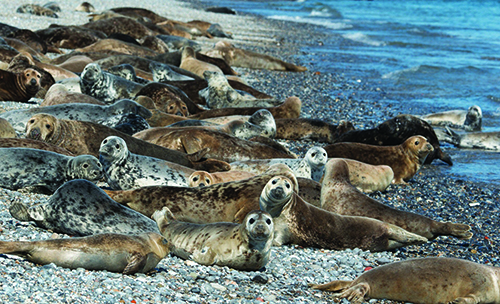
Seals are a threat to Estonian fisheries due to the fishing gears they damage, the fish
they consume from fishing gears, and more generally due to their impact on fish stocks.
Since 2025, Estonia has established seal hunt quota of three percent of the grey seal population, an increase from the previous one percent. The limit applies to the entire Estonian coastal sea. In the 2025 hunting year, 119 grey seals were hunted in Estonia, the first time the country has recorded such a level within a single season. Even though the absolute number is small the change is significant because in earlier years the quota was typically 50–60 animals and the actual number hunted remained around 20–30. The higher quota has been retained for 2026, when up to 176 grey seals may be hunted. For the authorities, this marks a clear recalibration of policy, aligning permitted take more closely with reported interactions and population dynamics. For fishers, it widens the possibility of responding to repeated gear damage, particularly in locations where seals learn to associate fishing operations with an easy meal. The concern is not only the fish consumed, but also the damaged catch and the costs of repairing and replacing gear.
Protected areas cannot shelter malign individuals
A further indication of this shift is that last year Estonia issued, for the first time, a permit to hunt a problem individual in a protected area. Protected areas require higher thresholds for intervention, and the permit was granted because the evidence was considered sufficient to demonstrate that seal abundance and associated damage to fishing gear in the area were substantial. Fishermen are not necessarily hunters themselves therefore projects should be considered to hire specialists to deal with those seals and some additional motivation is needed to compensate the costs for such hunters. Estonia is also maintaining pressure on the European Commission to lift the seal product trade ban in the European Union to fully utilise hunted seals.
Estonia’s strategy for dealing with these two predators is therefore to maintain long-term population measures, such as egg oiling for cormorants, while using targeted deterrence and hunting permits where acute pressure threatens fish stock recovery or the viability of coastal fisheries. Whether consistent implementation, improved tools for inland cormorant colonies, and higher seal hunting quotas translate into measurable reductions in damage and stronger returns from investments in restoration remains to be seen.
Kerli Pettai
Ministry of Regional Affairs and Agriculture