This article was featured in Eurofish Magazine 3 2026.

The proposal by the European Commission not to renew the authorisation of eight smoke flavourings has been accepted by the member states. The decision is based on the scientific assessment by the European Food Safety Authority (EFSA) from November 2023, which was unable to rule out with certainty that the smoke flavourings may have genotoxic effects. Transitional periods will, however, still apply before the measure is implemented.
For a long time, alongside salting and drying, smoking was regarded as a safe method of preservation before the advent of refrigeration. A welcome “side effect” of this method was that smoking also gave foods such as fish or meat a pleasantly smoky aroma. In addition, the treatment was very simple. The product only had to be exposed for a certain period to the smoke of a wood fire, which significantly reduced its water content. At the same time, substances from the smoke with antibacterial and antioxidant properties penetrated the product and contributed to the formation of flavour compounds. Hot smoke also hardens the surface of the product, making it more difficult for microorganisms to penetrate. The high-quality protein, the heart-healthy omega-3 fatty acids, the vitamins, and the minerals remain almost unchanged during smoking. That is why smoked fish is fundamentally healthy, apart from its often somewhat high salt content. The fact that smoking can also transfer some harmful substances to the products, including small amounts of carcinogenic compounds, above all so-called polycyclic aromatic hydrocarbons (PAHs), has only become much more widely recognised by the public in recent decades. Although strict legal provisions exist to protect consumers, a residual risk cannot be excluded entirely. As so often, however, the “poison” here too lies in the quantity: smoked fish should be eaten in moderation.
The concentration and composition of the smoking smoke, which is produced by the incomplete combustion of wood, has a decisive influence on the later flavour of the smoked product, its antibacterial effect, and, ultimately, the preservative effect. Considerable experience is needed to influence these processes in a targeted way and guide them in the desired direction, because smoking smoke is a complex mixture that can contain up to 5,000 substances. These are chiefly gaseous components and aerosols with flavouring, preservative, and colouring properties, but, unfortunately, also small quantities of substances harmful to health. During incomplete combustion, temperature and oxygen supply affect the composition of the smoke, and each type of wood delivers slightly different aromas. As a result, cold smoking produces compounds different from those formed during hot smoking. Modern processes often use purified smoking smoke, which contains proportionately fewer harmful substances.
Complex mixture of different substances
A large proportion of the smoke consists of water vapour. In addition, there are numerous organic compounds such as phenols and carbonyls, as well as organic acids, which lower the pH value on the surface of the smoked product and inhibit microbial growth. Tar substances are also part of the mixture; some of them settle on the product and intensify the characteristic brown colouring of smoked fish. Among the undesirable components in smoke, which arise particularly at higher temperatures, are the health-damaging PAHs, including benzo[a]pyrene, which is suspected of being carcinogenic. Benzo[a]pyrene is only one of around 250 potentially dangerous compounds from the PAH group that can arise during the incomplete combustion of organic material such as wood. These substances are not formed only during smoking, but also enter the atmosphere through grilling, as well as from the exhaust fumes of countless cars. They are ubiquitous environmental contaminants, the concentration of which in the air we breathe must be strictly monitored and limited. The scientific committee on food of the European Commission (SCF) has listed a total of 15 PAH substances suspected of being carcinogenic. Alongside benzo[a]pyrene, these include benz[a]anthracene, benzo[b]fluoranthene,
and chrysene.
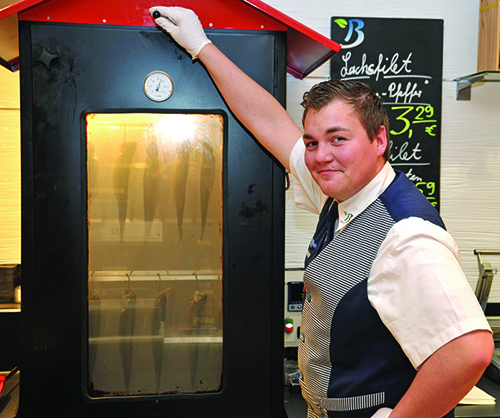
In the fish departments of some supermarkets, smoking is even carried out
behind the fish counter, which always attracts special interest and draws customers in.
This is a major reason why smokehouses and smoked products, and now also some other food manufacturers, are subject to rigid regulations and official controls. Today, the typical smoky taste, which is popular with many consumers, is created not only by traditional smoking but also by adding “smoke flavourings”. In this way, foods that were never previously smoked, and in fact cannot really be smoked, such as soups, BBQ sauces, or baked goods, can be given a subtle smoky flavour. Such smoke flavourings can be produced by purely chemical means, although this is done only rarely. As a rule, they are isolated from “real” smoke, which is cleaned in several stages and freed from undesirable substances as far as technically possible.
EFSA questions the safety of smoke flavourings
The starting point of the manufacturing process for “natural” smoke flavourings is pyrolysis, in which wood, chiefly beech or other hardwood, is heated strongly in steel reactors under conditions of very limited air supply. This produces a great deal of smoke, which then condenses on cooling into a “smoky liquid”. The smoke flavouring is obtained from this concentrate. The conditions under which pyrolysis occurs influence the composition of the liquid and the concentration of the substances it contains. The longer and more intensely the wood is heated, the more concentrated and oily the liquid becomes. At lower temperatures, by contrast, a relatively thin liquid is produced, with aromas that tend more towards acetic acid and vanilla notes. However, both one and the other concentrate contain substances that should ideally not come into contact with food, and which are therefore removed by elaborate filtration and purification procedures. All processes are strictly monitored and documented in order to ensure that smoke flavourings produced in this way pose no health risks to consumers.
In November 2023, however, the European Food Safety Authority, EFSA, published a new scientific opinion that questioned the safety of eight smoke flavourings. These had previously been authorised on the EU market, but, under the applicable legal provisions, their authorisation was due for renewal. On the basis of the scientific evidence available, the experts concluded that, for none of the eight smoke flavourings, could concerns be ruled out with the required degree of certainty that these substances might be carcinogenic or genotoxic, that is, capable of altering genetic material.
Following the EFSA recommendation, the European Commission decided not to renew the authorisation for industrially produced smoke flavourings, which in practice amounts to a ban on these substances. This far-reaching step was justified by the potential health risks posed by these substances. They must be withdrawn from the market gradually. Transitional periods do, however, apply. The sale of sauces, soups, and snacks is permitted until 1 July 2026. For fish, meat, and cheese products, the authorisation expires on 1 July 2029.
Strict maximum limits apply to smoked products
The polycyclic aromatic hydrocarbons and furans that may be present in smoke flavourings are chiefly responsible for the expiry of the authorisation. To protect public health, the European contaminants regulation laid down maximum levels for benzo[a]pyrene, as well as for the sum of benzo[a]pyrene, chrysene, benz[a]anthracene, and benzo[b]fluoranthene (4 PAHs), in certain food groups. Muscle meat of smoked fish and fishery products must therefore not exceed a content of 2 µg/kg of benzo[a]pyrene and a total content of 12 µg/kg for the 4 PAHs. Any fish products exceeding these values may not be placed on the market, in accordance with the said regulation. In addition, fish smokehouses must comply with the food hygiene regulation and the regulation on hygiene rules for food of animal origin, including with regard to the cleanliness of smoking facilities and the quality of the smoke used.
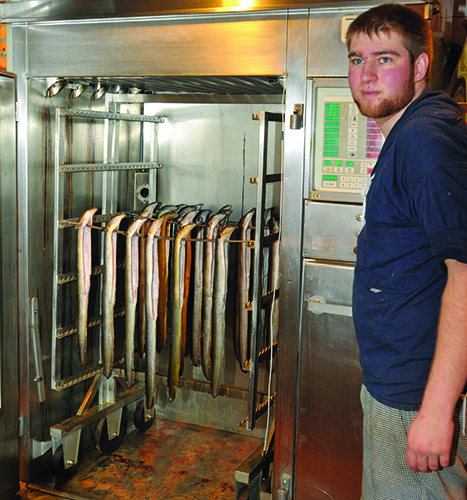
Although smoked salmon is probably the most popular smoked product, mackerel, trout,
eel, and other species are also in strong demand.
Critics warn that the European Commission’s decision could mean the end of product-friendly and environmentally friendly smoking. Apart from the economic damage, they fear a return to conventional smoking processes, which pose at least the same health risks. In fact, the “quasi-ban” relates only to the use of smoke flavourings, because traditional smoking with wood smoke remains permitted, as it is regarded as safer. Although, naturally, this smoke is not free from harmful substances such as PAHs either. Maximum levels must be observed, but the permitted limits for PAHs may vary depending on the food. Smoked fish is subject to different values from smoked ham. The EU allows particularly high PAH concentrations, for example, in sprat and Baltic herring. The permitted maximum level is significantly lower for mackerel. One of the reasons for these curious provisions is the assumed “frequency of consumption”: the more often consumers are thought to eat a product, the lower the limit generally tends to be.
Soon flavourings instead of smoke flavourings?
Regular laboratory analyses in EU countries, in which smoked fish is tested for its PAH content, have in recent years almost without exception given the all-clear regarding breaches of the maximum levels. In Germany, for example, the state laboratories responsible for this have not detected any infringements for a long time. Yet the end may not have come even for smoke flavourings, and thus for smoky flavour notes in potato crisps and barbecue sauces. Manufacturers of smoke flavourings are already working on the development of “clean”, PAH-free, or at least extremely low-PAH production processes. The key to solving the problem lies in lowering the temperature during the heating of the wood in the reactors. Below 250 °C, the tar content in the condensate is significantly lower, and therefore so too is the PAH concentration. The resulting liquids would probably comply with the EU flavourings regulation. They would no longer be smoke flavourings, but “flavourings with a smoky note”. They will therefore in future be listed in the ingredients declaration as “flavouring” and not as “smoke flavouring”. Numerous food manufacturers are already showing interest in these new products. As a clean alternative, fish products smoked using the “Clean Smoke” process are already available. This clean smoking process, which uses primary smoke products, remains permitted and is even authorised in organic
production.
Manfred Klinkhardt