This article was featured in Eurofish Magazine 2 2026.

The ingenious idea of using electric current to stun and temporarily remove fish from water bodies has become a routine method in fisheries research. Electrofishing allows for the non-selective capture of fish with minimal harm, enabling species identification, examination, tagging, and release. Thus, the method contributes to answering many scientific and practical questions.
Reportedly, coincidence sparked the development of this groundbreaking fishing technology. In 1910 Germany, when a 110-volt power line broke and both cable ends fell into the water below, masses of fish suddenly floated motionless at the site—only to miraculously revive when the power was switched off. This gave birth to the idea of using electricity for fishing, or ‚electrofishing.‘ It took several more years before the first practical electrofishing devices came to market, but by the 1950s and 60s they had become the preferred method for many fisheries routines, conservation studies, and fish research applications. Since then, the technology has been continuously refined and made more user-friendly through modern electronics. Compared to mechanical netting methods, it is gentler on fish and—when all regulations are followed—safe for operators. Today, electrofishing is a standard fisheries biology technique, primarily used for qualitative and quantitative analysis of fish populations.
The basic principle of electrofishing is quite simple: An electric field is created in the water between two electrodes—a positive anode and a negative cathode. Within its effective range (averaging about 5 meters depending on current strength and waterbody type), fish are temporarily stunned, allowing them to be netted for examination or used for tagging and relocation purposes. When applied correctly, electrofishing causes no irreversible harm to fish; they recover fully after the ‘galvanonarcosis’ wears off, remaining lively and healthy. The advantages of this method are compelling. It yields viable catch results even in highly structured waterbodies with dense submerged vegetation and hiding spots that are largely inaccessible to traditional fishing gear. Fish of all locally present species and age groups can be captured and examined on-site for attributes like species, weight, length, and general health and nutritional condition. The captured specimens can be tagged, relocated to other waterbodies, or used for breeding purposes. The proportions of native versus non-native (potentially invasive) species provide insights into their habitat preferences and changes in aquatic ecosystems. Such data significantly contribute to a better understanding of the ecology of local fish communities. Results from electrofishing analyses are highly informative, particularly when they involve “time series” conducted regularly at the same time in the same water section. This allows immediate detection of changes in species composition or the absence of offspring.
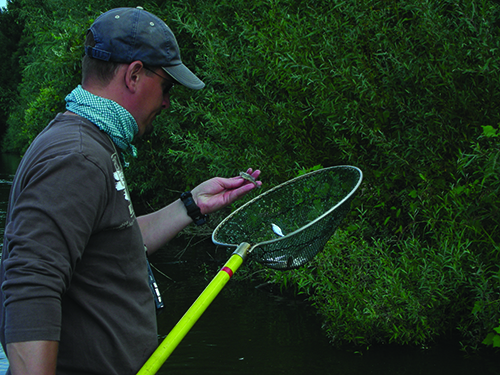
ecology of local fish communities and to relocate fish to other water bodies.
Known fish reaction patterns
The effects of the electric field generated in water between the two electrodes are now well understood. Once the voltage gradient along the fish’s body from head to tail reaches a critical threshold, the fish becomes immobilized and enters a state of “electro-narcosis.” Determining this exact critical value requires knowledge and experience, as it is influenced not only by the species and size of the fish but also by water conditions, particularly conductivity. While the stunning zone of the field should ideally be as large as possible, excessively high voltages can kill the fish, while voltages too low may trigger a fright response and scare them away. The catch efficiency for larger fish is often higher because their greater body length typically results in a stronger voltage gradient. This can introduce a degree of size selectivity, especially since different fish species vary in their “internal conductivity” and escape behavior. Particularly “electrosensitive” species often flee upon merely sensing the electric field from a distance. However, once they enter the field, they too exhibit typical reactions. In the electric field, they are directed purposefully toward the anode (“anode taxis”) and become anesthetized upon approach (“galvano-narcosis”). They swim erratically toward the anode (“oscillotaxis”—a disoriented, twitching motion), occasionally losing balance and gradually becoming immobile. This electrically induced paralysis caused by overstimulation of nerves and muscles is termed “tetanus.” Despite their unconscious state, the fish are drawn almost magnetically toward the anode (“pseudo-taxis,” forced swimming), often even belly-up. In this condition, they can be easily netted and transferred to a holding tank, where they “awaken”
within minutes.
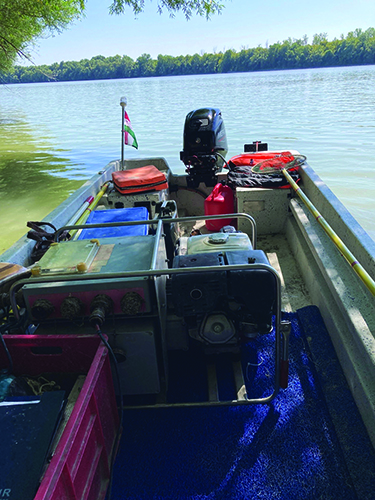
In electrofishing, direct current (DC) is generally preferred over alternating current (AC) because it creates a strong “attraction zone” that draws fish both actively and passively toward the anode (galvanotaxis). Additionally, DC is less harmful to fish and poses fewer risks to the operator. Direct current is typically applied in pulses, meaning it cycles on and off at high frequency, conserving power and extending battery life in portable devices. While AC produces a larger anesthesia zone, it frequently injures or even kills fish and is therefore used primarily when catch efficiency takes precedence over avoiding harm. AC devices are typically operated from boats when harvesting lakes and larger rivers.
Catch efficiency depends on many factors
Catch efficiency depends on temperature but primarily on water conductivity, which measures a waterbody’s ion content and determines how effectively electricity is conducted through the water as well as the electric field’s strength. In water bodies with high electrical conductivity, the electric charge disperses more widely, reducing electrofishing efficiency. For optimal catch results, conductivity should therefore be neither too high nor too low. This is why electrofishing in seawater—with its high salt and ion content—is possible but requires highly powerful equipment. The same applies to very hard water, though the power requirements here are significantly lower compared to marine environments. The best catch results in electrofishing are achieved in water bodies with conductivities around 70 to 75 µS/cm, typical of small streams and oligotrophic freshwater lakes. Here, small generators or backpack-mounted batteries often provide enough energy to generate sufficiently strong voltages for electrofishing. Here, small generators or backpack-mounted batteries often provide enough energy to generate sufficiently strong voltages for electrofishing. However, conductivity must not be too low, as this would result in insufficient charge carriers for current conduction and a stable electric field.
In addition to water conductivity and temperature, factors such as turbidity, aquatic vegetation, and the complexity of waterbody structures—like the width and depth of the sampled area—also influence electrofishing efficiency. The composition and texture of the substrate can also alter the electric field. Soft substrates reduce catch efficiency more than coarse ones. To achieve comparable results, the current must be adjusted to local conditions, typically by fine-tuning the voltage. The current must not be too low, as some fish may escape, nor too high, as it could harm the fish. Experienced electrofishers recognize the optimal setting by observing fish behavior in the electric field.
Electrofishing requires specialized qualifications
Electrofishing equipment consists of three main components: the power source (either a generator, typically producing alternating current, or a battery/accumulator), the transformer (which converts AC to DC and regulates voltage), and the electrodes (anode and cathode), which conduct current into the water and generate the electric field. Typically, the cathode is a simple probe passively suspended from the device. In backpack units, this can be a simple trailing cable, colloquially called a “rat-tail cathode.” In larger setups operated from boats or rafts, the cathodes are often
fixed. For boats with metal hulls, the hull itself can serve as the cathode. Since stunned fish are drawn to the anode
(a phenomenon called “galvanotaxis”), this electrode is often integrated into the metal hoop of the dip net for easier
fish retrieval.
The reliability of scientific studies using electrofishing naturally depends on the type of waterbody and other factors. In flowing waters, for example, it hinges on the length of the selected river or stream section, which should ideally be representative and encompass diverse habitats—pools, riparian zones, sediments, rapids, and flowing stretches. While specific conditions vary based on study objectives, sampling typically covers a minimum of 100–150 m and a maximum of 300–1,000 m of flowing water. A common rule of thumb for electrofishing in streams suggests that the sampled stretch should equal roughly 30–35 times the average stream width to reliably estimate population sizes. Sometimes, multiple fishing passes may be necessary for this purpose.
Electrofishing is an effective and relatively harmless sampling technique, but it may only be conducted by trained professionals and is prohibited for unqualified individuals. When all regulations are followed, no serious harm to fish populations is expected. A U.S. study found that while fish experience stress from the electric current, they rarely sustain injuries that fail to heal or prove fatal. Fatalities mostly occur due to convulsive muscle spasms caused by sudden voltage changes, which can result in severe spinal injuries. Salmonids are considered particularly susceptible in this regard, whereas cyprinids are less so. However, when low-frequency pulsed DC (<30 Hz) is used, spinal injuries occur significantly less frequently. Whether electrofishing immediately before spawning adversely affects reproductive success is still disputed. However, it is suspected that electric currents may harm embryos. Therefore, electrofishing should be avoided in spawning areas.
Manfred Klinkhardt