Net cages for aquaculture are being made fit for the future

This article was featured in Eurofish Magazine 2 2026.
In almost all areas of aquaculture there have recently been remarkable -advances. These concern, for example, feed, disease prevention, and the technical equipment on farms. All this has made aquaculture more -sustainable and environmentally compatible. Some improvements to floating net cages, which have been more closely adapted to their surroundings and the fish species kept in them, have also contributed to this.
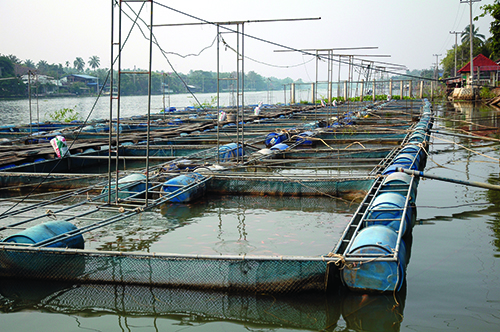
In recent years, interest in net pens and cages has increased noticeably, because they offer opportunities for rapid increases in production in waters that have so far remained largely unused. Net cages are an inexpensive technology. With relatively little effort they make it possible to offer fish good living conditions, because the circulating water supplies the animals held in them, among other things, with a continuous supply of oxygen. The technology represents a sensible compromise between economic efficiency, and ecological and social responsibility. Net cages can make use of “idle” water resources such as lakes, reservoirs, pits, streams, and rivers, as well as extensive marine areas. Keeping fish in net cages is not an entirely new practice, because the method was already widespread in some regions of the world, especially in Asia, for many centuries. Norway, however, was the first country to prove that net-cage aquaculture can be used commercially on an industrial scale. The “professionalisation” of this sector of aquaculture included the development of practical net cages made of robust materials such as high-density polyethylene (HDPE) or steel mesh that can withstand the forces of nature and prevent the escape of fish. Based on this basic model, which has proved its worth over many years of practice, such cages are now in use, often in modified designs, both in fresh water and in marine environments.
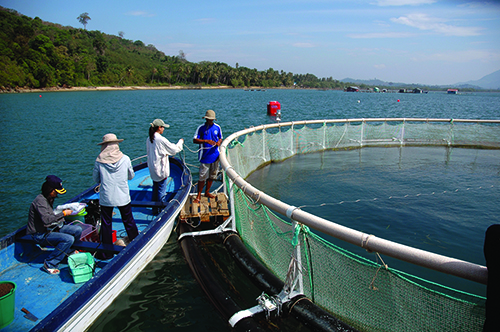
and optimised for the rearing of cobia.
However, this development alone does not explain the steadily growing worldwide interest in fish production in net cages. An equally important motive is the possibility of expanding aquaculture further than before into coastal and offshore areas at sea. This opens up enormous growth potential for the aquaculture sector, because the greatest part of its global production, in 2022 almost two thirds (62.2%) of the total volume, is produced in fresh water.
Using net cages to open up unused waters
In principle, attitudes towards aquaculture in the Asia-Pacific region are much more positive than in western industrialised nations. For this reason, the expansion of fish farming through the use of net cages encounters hardly any reservations. People tend to perceive the advantages of this technology, the growth opportunities in production, and the enormous potential of fish farming in marine areas. However, this important option for increasing fish production is still in its infancy in most Asian coastal countries. In India, whose coastline measures more than 7,500 km, the number of net cages of various sizes is currently estimated at just about 1,500 units. Even if only 1% of the coast were used for net-cage farming, however, the ICAR-Central Marine Fisheries Research Institute (CMFRI) estimates that around 820,000 cages would be possible, with a production potential of 3.2 million tonnes. The Institute therefore recommends expanding cage farming at sea, and the Indian parliament has already cleared some legal hurdles in order to reduce the bureaucratic burden involved in expanding marine aquaculture.
The Indonesian government has recently decided to strengthen the country’s aquaculture industry and in particular to promote tuna farming in several bays along the coast. The intention is not only to counteract the overfishing of these popular fish, which are in demand internationally, but also to improve the economic and social situation of the local population, which has suffered severely from the restrictions imposed during the corona pandemic. The Indonesian government aims to establish a network of dozens of villages with aquaculture farms and downstream processing plants that will be able to hold their own on the world market with tuna products.
Fresh ideas are driving development forward
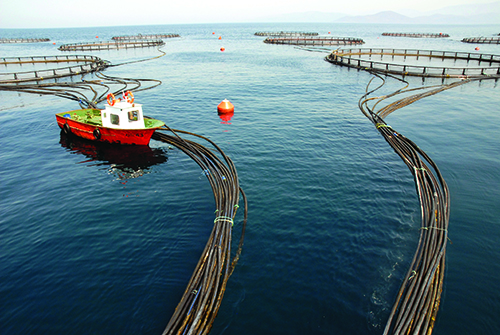
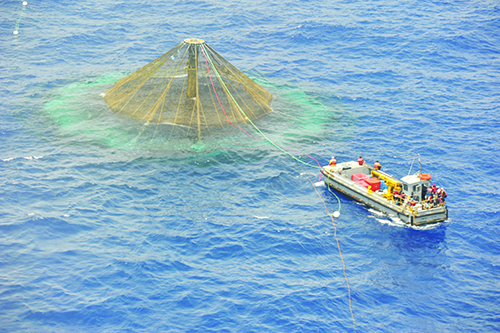
Depending on local interests and economic conditions, net cages are a source of both hopes and fears. While critics emphasise above all the negative aspects of these “open” systems, such as escapes, nutrient inputs, and risks from parasites and diseases, advocates place greater emphasis on the economic opportunities and social benefits of this technology. In the heated debate it is often ignored that numerous variants of net cages have been developed for very different purposes, which have made considerable progress both in their construction and in the way they function. In aquaculture sustainability strategies, improvements to animal husbandry systems play an equally important role as the optimisation of feeding strategies, disease prevention, or animal welfare. Other drivers of these developments include both changing environmental conditions as a result of climate change, which is leading to an increase in extreme weather events, and the wish to give aquaculture a more sustainable orientation with better living conditions for fish and less environmental impact. Interactions with parasites, jellyfish, and toxic algae, and conflicts with other user groups of coastal waters, also play a part. However, the relocation of surface-based net cages to more distant offshore areas has once again increased the pressure to improve equipment design. Far out at sea, where conditions are dictated by wind, waves, and currents, what is needed are not only materials that are as robust as possible, but also new farm designs that can withstand the immense energy of these waters. Offshore, on stormy days, net cages are difficult or even impossible to reach, which calls for completely new technologies for monitoring, feeding, and managing the fish stocks.
Offshore farms must, if necessary, be able to operate for longer periods autonomously, that is, without direct intervention by personnel.
Researchers and developers are faced therefore with enormous challenges. How, for example, can floating cages be anchored in place offshore. For normal mooring systems the sites are usually far too deep. Anchor lines of the necessary length would probably exceed the carrying capacity of the structures. What net materials are stable enough to prevent deformation of the cage, or even tearing, in strong currents. There is also the question of which farm design is most likely to withstand possible wave heights of 10 metres and more in stormy areas. Designers must take into account that the harsh conditions cause considerable wear and tear on the structures. It also remains unclear how offshore conditions affect the fish.
Offshore farms need completely new technologies
Despite the unresolved issues, the first offshore fish farms have already been planned and tested in practice. Such projects are realised mainly in countries where aquaculture is of great importance and where investors with strong financial resources are available. Norway, for example, can draw on its experience with technologies from the offshore oil and gas industry in developing offshore fish farms. With the two offshore fish farms Ocean Farm 1 and Havfarm, which have been in full operation off the Norwegian coast since 2017 and 2020 respectively, two different design concepts for offshore sites are being tested. Ocean Farm 1 resembles the familiar circular cages that have so far been used for salmon farming at nearshore sites, but on closer inspection shows significant differences. Unlike collar cages, Ocean Farm 1 is a dodecagonal, semi-submersible unit with a rigid frame structure designed to withstand rough sea conditions and significant wave heights of around 5 metres. The stiff netting material is -attached to the frame structure to prevent deformation of the cage. With a diameter of 110 metres and a volume of 250,000 m³, the unit offers space for more than one million salmon.
Havfarm, by contrast, has a ship-like shape. The 385-metre-long steel structure consists of six separate net cages, which are attached at the top to the stable frame structure. Their total volume amounts to 414,000 m³ and provides space for 10,000 tonnes of salmon. The farm is designed to withstand significant wave heights of up to 10 metres. Work is also focusing intensively on the development of net cages that can operate underwater, either when required or permanently. The development of such technologies has received further impetus from the rapid advances in artificial intelligence and modern sensor technology. The progress towards a more -sustainable orientation of cage aquaculture
is unmistakable…
Manfred Klinkhardt