This article was featured in Eurofish Magazine 2 2026.

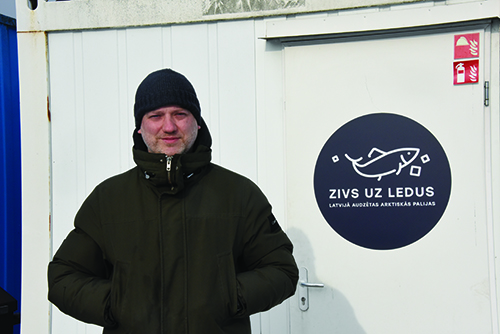
Blue Circle is a Latvian land-based aquaculture business producing premium, cold-water fish close to market, in a tightly controlled environment. The company farms Arctic char in a recirculation aquaculture system (RAS) and sells it in the Baltic region under the name Zivs uz ledus (Fish on Ice).
The farm was conceived and executed as a pilot project with construction completed in December 2019, and operations beginning immediately afterwards, just ahead of the covid-19 disruption that closed hospitality channels across Europe. Lauris Apsis, the founder of the company, describes the pandemic in retrospect as a concentrated lesson in timing, risk, and resilience: pandemic shocks, energy price volatility, and a market shaped by low salmon prices all arrived before the business had fully stabilised. Despite the rough start, by 2025 the company was producing just over 100 tonnes of head-on, gutted fish annually, while running the site with a team of four people, including harvest and dispatch. These achievements may be modest by global salmon standards but are substantial in Latvian terms, and Mr Apsis has now started to design a much larger second phase.
A salmonid that is not salmon
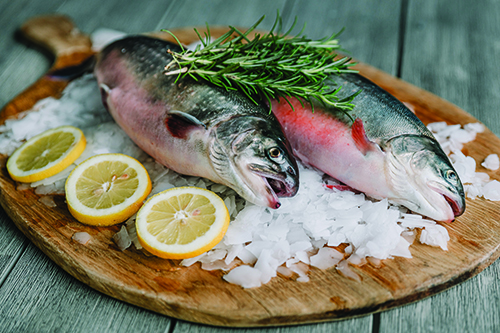
Mr Apsis feels that competing head-to-head with mainstream salmon or trout producers, particularly those supplying large volumes from sea-cage systems, was a “guaranteed loss”. Instead, the company selected Arctic char as a niche salmonid with a milder flavour, a tender texture, and a story that retailers and chefs can use to distinguish the fish from salmon and trout. The decision was also shaped by place. The farm is located in the Ropaži area, where groundwater is around 7°C, naturally steering the decision towards cold-water species. Mr Apsis describes the facility as the largest and most advanced recirculation fish farm in the Baltic States, built on family land, and designed around high standards of fish care, and environmental responsibility. That the fish is a high quality product is not in question. Low-density stocking and high levels of tank hygiene mean that the fish suffer none of the damage to fins and heads that is visible in fish in more densely packed enclosures. My job, Mr Apsis avers, is to persuade people to try it, the fish will do the rest.
In its daily operations the farm manager attempts to reduce variability, because small deviations in feeding, cleaning, or water management can show up months later as uneven growth, welfare, or quality issues. Disease-free eggs are sourced from Canada; the eggs are disinfected before shipment to reduce biosecurity risk, and batches of about 50,000 eggs arrive four times a year. Larval stages are treated as the most sensitive, when the fish are kept in cooler water to support slower, steadier organ formation. Juvenile fish are moved into warmer grow-out conditions. As the fish develop, Mr Apsis aims for year-round deliveries by structuring production into multiple batches. In the current pilot, weekly deliveries amount to around three tonnes. Harvesting is tied closely to confirmed orders, so that fish can stay in the system if demand softens. The company’s focuses heavily on freshness and speed: harvest starts early, and product can reach retail distribution the same day, with a conservatively set shelf life of ten days.
Creating value from waste
The farm’s freshwater intake reaches about 5.5 litres per second at peak, with the expectation that it can be reduced further as additional treatment steps, such as denitrification, are introduced in future designs. Stocking density is described at around 50–60 kg per cubic metre, notably below the upper range often seen in high-intensity cage systems. The fish are housed in large circular tanks where they must constantly fight the current and this combination of sustained swimming and lower crowding supports fish health and reduces reliance on medicines. While energy is treated as a strategic issue, Mr Apsis is keen to stabilise production and sales first before embarking on an energy plan that will include solar power. He also sketches a circular model in which sludge and processing by-products could be used to generate biogas. If the carbon dioxide could be stripped from the gas it would contribute to making the operation carbon neutral. Other ideas in play are to sell excess energy back to the grid or to add value to the processing waste by using it as a source of ingredients such as collagen, fish oil, and calcium or other minerals.
If production discipline is one pillar, market education is the other key factor to sell a species that many consumers are unfamiliar with. The company’s strategy, forged in the urgency of early 2020, was to build a brand quickly. When the Finnish market closed during covid-19 and initial sales assumptions collapsed, Mr Apsis created the Zivs uz ledus identity “overnight”, packaging whole fish on ice, and moving aggressively into Latvian retail as well as selling directly to consumers. The strategy worked because it combined availability with a recognisable name. The brand is now stocked in major retail chains, and the website shows a strong consumer-facing emphasis on recipes and usage ideas. Mr Apsis is acutely aware of the importance of consumer-friendly ready-to-cook products such as portions, fillets, and steaks, as well as ready-to-eat items such as smoked and cured fish. That is the only way to keep consumers, especially younger buyers on board, he says, in an age where fish consumption is declining across the EU.
Expansion plans will create an Arctic char behemoth
Blue Circle’s pilot was built in close cooperation with Nordic expertise from early on. Mr Apsis also mentions his Finnish partner, the Salmela family of Finland, associated with the Hesburger fast-food chain, who will also play a major role in the company’s ambitious expansion plans. The agency, Invest in Latvia, reported in December 2025 that Blue Circle was preparing an investment plan exceeding €30 million, targeting an output of roughly 3,000 tonnes per year (from 120 tonnes currently), alongside a full processing operation and a broader product range. Mr Apsis envisages using the lessons learned from the current facility to optimise production in the expanded operation to make it leaner and more efficient. Some tasks, such as grading, could be fully automated, an option not viable with the current volumes. If realised, the expansion would be transformational for Latvian aquaculture (increasing national farmed seafood output by a factor of four) and would create significant global player within cultured Arctic char production. It would allow the company to negotiate with potential buyers in countries like Germany where the ability to reliably deliver large volumes is critical. Whether the brand Zivs uz ledus will continue remains to be seen. Even for Finns it is difficult to pronounce, says Mr Apsis, so this is something we need to discuss with our marketing experts.
Blue Circle is still small enough that the founder’s philosophy is visible in day-to-day decisions: build routines, protect biosecurity, keep quality consistent, and treat the market as a long term partner rather than a single sales push. The pilot farm is, by design, a learning platform. It has already delivered proof of stable production, and it has validated a Baltic retail route to market for Arctic char, but it has also exposed the constraints of operating without processing, and without the volumes needed to serve larger export buyers. The next stage will test whether those lessons can be translated into a scaled industrial facility without losing the brand’s core promise: fish produced carefully, in a controlled environment, with a transparent identity that retailers can stand behind, and consumers can learn to trust.