This article was featured in Eurofish Magazine 2 2026.

Today, aquaculture has become the backbone of Türkiye’s aquatic food production, transforming the country into one
of Europe’s leading producers and exporters of farmed fish. Supported by strong governance, abundant natural resources, and a rapidly modernising industry, the sector continues to expand in line with global -sustainability and food security goals.
Globally, capture fisheries have reached their biological limits, so aquaculture has emerged as the main driver of growth in seafood supply. Global fisheries and aquaculture production surged to 223.2 million tonnes, with 185.4 million tonnes of aquatic animals and 37.8 million tonnes of algae, according to FAO’s State of World Fisheries and Aquaculture 2024. Türkiye closely follows this global trend, with aquaculture now surpassing capture fisheries as the country’s primary source of aquatic food.
In 2024, Türkiye’s total aquatic products output reached approximately 933,000 tonnes, of which around 577,000 tonnes (62%) originated from aquaculture and 356,000 tonnes (38%) from capture fisheries. This structural shift reflects not only global dynamics but also deliberate policy choices aimed at ensuring food security, export competitiveness, and sustainable resource use.
Natural resource base and institutional framework
Türkiye possesses a highly diversified and favourable natural resource base for aquaculture. Surrounded by three seas, having four seas in total and endowed with extensive inland water resources, the country benefits from, dam reservoirs, ponds and river systems. These ecosystems host more than 900 aquatic species, over 100 of which are commercially exploited in marine and inland waters.
The sector is governed by the General Directorate of Fisheries and Aquaculture under the Ministry of Agriculture and Forestry. The Directorate operates through specialised departments responsible for aquaculture, fisheries control, resource management, infrastructure, statistics and information systems, enabling integrated planning, effective monitoring and alignment with international standards. Producer representation is organised through the Aquaculture Producers’ Central Union with 23 provincial-level unions, ensuring close coordination between policymakers and producers across the country.
Beyond its economic role, aquaculture is a significant driver of employment and rural development, particularly in coastal regions. The expansion of farming, processing, logistics and export-oriented activities supports thousands of jobs and offers new opportunities for young people and women in many regions.
Production structure, capacity and technology
As of 2024, Türkiye hosts 2,471 aquaculture facilities, (557 marine farms and 1,914 inland water facilities). The total approved project capacity of these farms is close to 931,000 tonnes per year, underlining the sector’s readiness for further expansion. In addition, Türkiye operates 146 hatchery facilities (95 freshwater and 51 marine) providing a strong foundation for fry supply. This vertically integrated structure supports biosecurity, genetic quality and production efficiency across the value chain. There is an increasing number of integrated companies combining hatcheries, feed production, grow-out, processing and marketing under one roof. The sector is rapidly adopting modern technologies such as offshore cage systems, improved feed formulations, digital monitoring tools and, increasingly, recirculating aquaculture systems (RAS) for high-value species. These investments enhance productivity and resilience while helping to address environmental sensitivities in coastal areas.
Species composition and flagship products
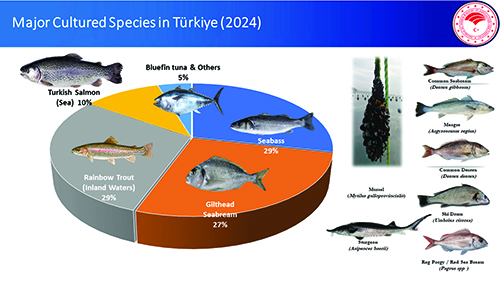
Aquaculture production in Türkiye is concentrated on high-value species, reflecting both ecological suitability and strong market demand. The main species are rainbow trout (Oncorhynchus mykiss), sea bream (Sparus aurata) and sea bass (Dicentrarchus labrax). Türkiye is the world’s largest producer for these three species. Over the past decade, Türkiye has also achieved remarkable success with “Turkish Salmon” (as a brand) farmed in sea cages that has rapidly gained international recognition. Production of Turkish Salmon increased from around 18,000 tonnes in 2020 to 60,000 tonnes in 2024, driven by strong export demand and investments in offshore farming technologies. Turkish Salmon has become one of the fastest-growing export items and an important symbol of the sector’s innovation capacity.
In recent years, diversification efforts have also accelerated, with growing interest in meagre (Argyrosomus regius), Mediterranean mussels and other emerging species. This development supports resilience and market flexibility. Value-added products, including fillets, smoked products and ready-to-cook items, are gaining importance in response to evolving consumer preferences in both domestic and export markets.
International competitiveness and trade performance
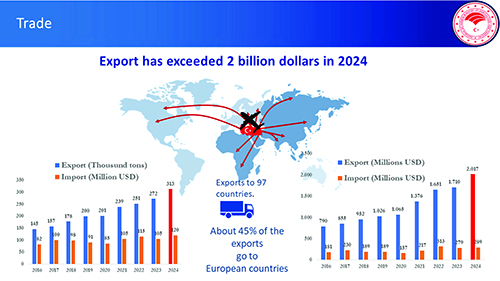
Türkiye has emerged as a key player in global aquaculture markets. It ranks 17th among the top 20 producers worldwide and is Europe’s leading producer of sea bass, sea bream, and trout. Turkish farmed fish enjoy a strong market position thanks to quality, food safety and competitive pricing. Export performance has mirrored production growth. In 2025, Türkiye’s total fisheries and aquaculture exports increased by almost 12% year on year to reach USD2.24 billion and 290,000 tonnes. The majority of these exports originate from aquaculture products such as sea bass, sea bream, trout, Turkish Salmon and tuna. Exports in 2024 went to 97 countries including the European Union, United Kingdom, Russian Federation, Japan, South Korea and an expanding range of markets in the Middle East and North America. This success is underpinned by a modern processing industry aligned with international food safety, traceability and sustainability standards. The sector’s export target for the coming years is to reach USD 3 billion.
Sustainability, planning and future priorities
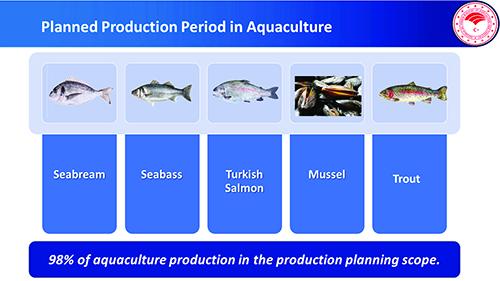
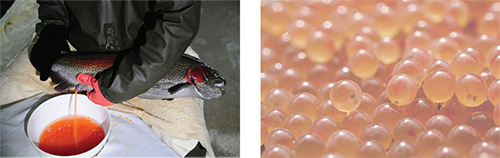
Sustainability lies at the core of Türkiye’s aquaculture policy. In recent years, the Ministry of Agriculture and Forestry has introduced an approach designed to optimise resource use and enhance long-term sectoral stability. Key species such as sea bream, sea bass, Turkish Salmon, mussels and trout are produced under a planned framework that now covers the vast majority of total aquaculture output. In addition, sturgeon, a fish of considerable economic value due to its valuable caviar and high-quality meat yield, and included in the Convention on International Trade in Endangered Species of Wild Animals and Plants (CITES), is developing in Turkey. Considering Turkey’s geographical location and the suitability of its water resources for cultivation, sturgeon farming is seen as a promising sector in terms of both domestic market and export potential.
At the international level, Türkiye’s governance performance has been formally recognised. Within the framework of the General Fisheries Commission for the Mediterranean (GFCM), Türkiye has achieved full compliance assessments for four consecutive years, providing a concrete demonstration of its commitment to international governance principles and science-based resource management. Environmental monitoring, spatial planning, offshore aquaculture technologies and improved feed efficiency are central elements of this approach. Together with digital monitoring systems and enhanced data collection, these measures contribute to transparent governance and adaptive management. Ongoing efforts to refine carrying capacity assessments, reduce nutrient emissions and improve feed conversion ratios aim to minimise environmental footprints while supporting continued growth.
At the same time, policymakers and industry are working to address emerging challenges such as climate change impacts, disease risks, input costs and competition for coastal space. Strengthening research and innovation, expanding training opportunities and deepening collaboration between public institutions, universities and the private sector are seen as essential to maintaining the sector’s competitiveness and resilience.
Building a resilient and sustainable aquaculture future
Türkiye’s aquaculture sector is a dynamic industry with continued growth potential, combining a strong institutional framework, competitive production and export-oriented structure with an increasing emphasis on sustainability. The sector is well positioned to respond to global demand for healthful, low-carbon animal protein and to contribute to national goals on food security, rural development and green growth. Looking ahead, continued investments in innovation, diversification, environmental performance and human capital will be key to maintaining growth while safeguarding aquatic ecosystems. In this context, Türkiye’s experience offers valuable insights for countries seeking to balance economic development with responsible aquaculture practices and to harness the full potential of aquaculture as a pillar of the blue economy.