This article was featured in Eurofish Magazine 2 2026.

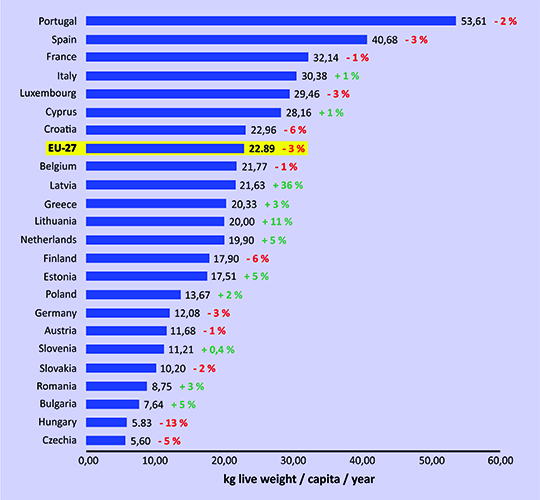
The EUMOFA Market Report 2025 estimates EU fish and seafood consumption for 2023 at 10.25 million tonnes (live-weight equivalent), the lowest figure since 2014. This corresponds to a drop in average per capita consumption from 24.6 kg/year to 22.89 kg in 2023. Fisheries products accounted for 7.32 million tonnes and aquaculture products for 2.92 million tonnes of supply, corresponding to per capita consumption of 16.36 kg and 6.53 kg, respectively.
EU countries undoubtedly rank among the world’s leaders in terms of average purchasing power. Educational levels and knowledge about healthy diets can also be regarded as high. Nevertheless, average annual per capita consumption of these healthy foods, at 22.89 kg, was only slightly above the global average, which the FAO puts at just under 21 kg for 2023. One weakness of such mean-value calculations, which, strictly speaking, are estimates, is that they smooth out differences between individual countries. Within the EU, the range runs from Hungary and Czechia, which do not even reach 6 kg of fish per person per year, to 53.61 kg in Portugal. Yet even this impressive amount, the highest in the EU, is actually a sharp decline within only a few years: in 2018, the average Portuguese citizen still consumed around 61 kg of fish and seafood per year.
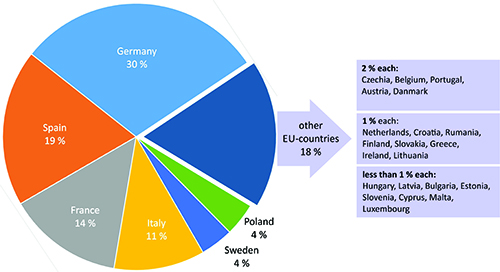
Largest EU consumer countries for processed products in 2024
(share of total sales volume in retail and foodservice).
Source: Euromonitor International, Packaged Food, Industry Edition 2025.
In almost all EU countries, retail accounts for the largest share of total sales of fisheries and aquaculture products, with processed products dominating in particular. The retail share ranges from at least 60% in Germany to a maximum of 90% in Romania. The only country where sales in foodservice were higher than in retail was Greece, with 44% in retail and 56% in foodservice. Across Europe, the impact of the COVID-19 pandemic is clearly visible in this analysis, as foodservice revenues fell sharply almost everywhere in 2020. Since restaurants reopened, they have been recovering gradually, while retail volumes slowly fell from their 2020 peak to their low point in 2024 (around 1.5 million tonnes). In most EU countries, retail volumes remained approximately stable in 2023 and 2024, according to the EUMOFA Market Report, but in Italy and Germany, two of the six largest consuming countries, the retail sector had to absorb painful declines of 7.5% and 4.1%, respectively, pulling the overall EU trend downwards.
Processed fish products are especially popular
Out-of-home consumption in the HORECA sector, which fell to its EU-wide low of around 370,000 tonnes in 2020, recovered again from 2021 onwards. Most recently, it exceeded 587,000 tonnes in 2023–2024, an increase of 4.7%. Nearly all countries recorded growth in out-of-home consumption, led by Germany which, with an increase of 13,100 tonnes (+5.4%), even surpassed pre-pandemic levels. Euromonitor estimates that out-of-home consumption will continue to rise over the next five years and could reach more than 660,000 tonnes by 2029.
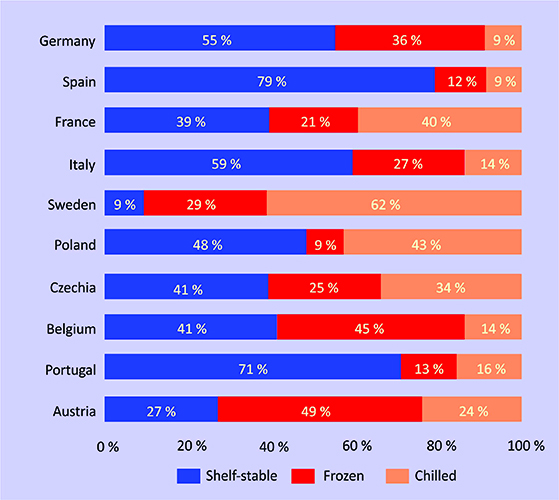
Main categories of processed products sold in retail and foodservice in 2024
(as % of total volume in the 10 EU countries with the highest total consumption).
Source: Euromonitor International, Packaged Food, Industry Edition 2025.
Traditionally, processed fisheries and aquaculture products play a particularly important role in the EU market. Consumption of such products in foodservice and retail reached just over 2.1 million tonnes in 2024, a rise of 1% compared with 2023. This continues the recovery that began in 2021 following the COVID-19-related decline in 2020. According to Euromonitor’s forecast, this upward trend is expected to continue, with an average annual growth rate of 0.7% through to 2029. The development is concentrated mainly in Germany, Spain, Italy, and France, the four largest consumer countries, which together accounted for 74% of total consumption in 2024. Germany alone contributed 30% of total consumption, followed by Spain with 19%, France with 14%, and Italy with 11%. However, looking at per capita consumption of these products reveals a more diverse picture. The largest consumers were Spain (just over 8 kg), Sweden (almost 8 kg), and Germany (just under 7.5 kg), followed by Denmark (just over 6 kg) and Croatia (just over 5 kg). France ranked sixth (just under 4.5 kg), ahead of Italy (just over 4 kg), and, at a considerable distance, Poland (around 2 kg).
Will Pre-COVID levels only be reached again in 2029?
Shelf-stable (preserved) products are the most important category among processed fisheries and aquaculture products in retail and foodservice. In 2024, they achieved EU-wide sales of more than 1.1 million tonnes. They were followed by frozen products with more than 565,000 tonnes, and chilled products with more than 400,000 tonnes. In 2024, the average share of shelf-stable products in total sales across EU countries was 40%, indicating strong demand for these products. In five of the 27 EU countries, shelf-stable products accounted for more than half of retail sales and out-of-home consumption of processed fish and seafood products. In Spain, this share was 79%, in Portugal 71%, in Slovenia 63%, in Italy 59%, and in Germany 55%. In three of the 27 EU countries (Sweden, Croatia, and Latvia), shelf-stable products were less popular, accounting for 9%, 11%, and 29% of sales, respectively. The average share of frozen and chilled products was 30% each. Croatia, at 69%, was the only EU country where consumption of frozen products accounted for more than half of retail sales and out-of-home consumption of processed fish products. For chilled products, this applied to Estonia (69%), Lithuania (65%), Sweden (62%), and Slovakia (51%).
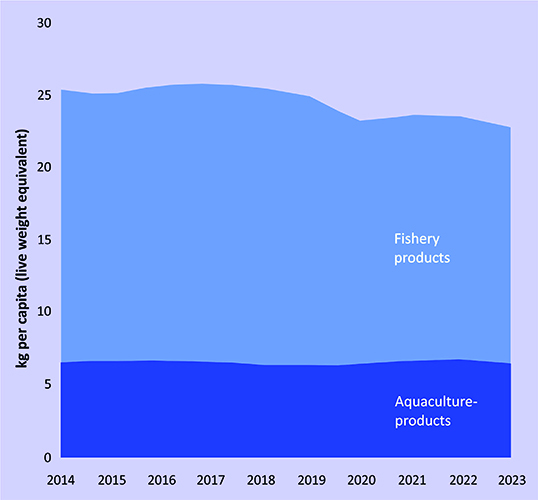
Per capita consumption of fisheries and aquaculture products.
Source: EUMOFA, based on EUROSTAT and FAO data.
Total out-of-home consumption of unprocessed products in the countries analysed reached only 665,000 tonnes by the end of 2024. In the view of Euromonitor experts, the pre-pandemic level of more than 736,000 tonnes will probably only be reached again in 2029. Here too, however, there are differences between EU countries. In Italy, consumption in 2024 was already almost 110,000 tonnes, which was even higher than the 107,000 tonnes recorded in 2019. France is expected to slightly exceed the pre-pandemic level by the end of 2025, Spain by the end of 2026, and Poland by the end of 2027. However, Germany and the United Kingdom are also expected to remain below pre-pandemic levels over the next four years.
Manfred Klinkhardt