This article was featured in Eurofish Magazine 1 2026.

The native European crayfish has long sustained a social and culinary tradition in Sweden, that of the summer crayfish party. However, disease and competition from the invasive signal crayfish have wiped out stocks of the native species in the south of the country. Today, in a case of adapting to economic and biological realities, Swedes feast on signal crayfish while protecting the European variety where it is present in the north.
For more than a century, Sweden’s lakes and rivers have been home to two very different crayfish stories, one of loss and another of adaptation. The native European crayfish (Astacus astacus) once thrived across the country’s freshwater systems, shaping ecosystems and anchoring one of Sweden’s most beloved culinary traditions: the annual kräftskiva, or crayfish party. Today, much of that role has been taken over by a foreign species, the North American signal crayfish (Pacifastacus leniusculus), once viewed as an ecological intruder, now considered both a symbol of summer and a source of income for small-scale fishers.
According to Per Pettersson, Swedish Inland Fishermen’s Federation, the turning point came more than a hundred years ago. In the beginning of the twentieth century, he recounts, Astacus were infected with Aphanomyces astaci, the crayfish plague, which led to a collapse of Astacus populations in the south of Sweden, except on Gotland. The disease, introduced inadvertently with imported species, decimated native crayfish and left both ecosystems and traditions
reeling. To restore what was lost, Swedish authorities looked for a substitute that could survive the same waters and preserve the cultural and economic importance of crayfish fishing.
A government approved invader
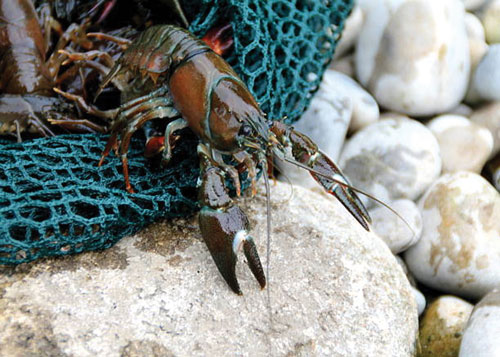
The solution arrived from across the Atlantic. In the 1960s, the government authorised the introduction of Pacifastacus leniusculus, a species native to the western United States. The first populations were stocked in Lake Vättern, one of Sweden’s largest and deepest freshwater bodies. The animal’s distinctive pale spots earned it the name signal
crayfish. Demand for crayfish has always been large in Sweden, says Mr Pettersson. We have a long tradition of eating them. Fishers, water owners, and authorities wanted a new crayfish, and the authorities decided that Pacisfastacus was the right one. The idea was to re-establish a fishery that could support rural livelihoods and keep the kräftskiva alive. Over time, signal crayfish spread throughout southern Sweden, establishing strong population in lakes and rivers once dominated by the native species. While it was an ecological compromise, it became an economic success. The fishery today is small-scale, Mr Pettersson notes, everyone is small in our lakes, and it is local communities that benefit, there are no big fish acting on the market. For many Swedes, the signal crayfish is now as familiar, and as celebrated, as the native Astacus. Even if some people know it is invasive, consumers still want fresh-cooked crayfish, and since it was introduced in agreement with the government, most people see it as a resource, he adds.
Cultural tradition meets ecological complexity
Sixty years after its introduction, signal crayfish have become both an asset and a ecological puzzle. Its abundance supports a popular fishery, yet its ecological footprint remains uncertain. Environmental changes complicate the picture. Agricultural runoff, chemical pollution, and earlier sewage mismanagement have all reshaped freshwater habitats since the 1960s, making it difficult to isolate the crayfish’s specific effects. Fishers believe that high densities of signal crayfish alter the physical environment. Where there is a lot of signal crayfish, there is less vegetation on the seabed, says
Mr Pettersson. Perhaps they also eat a lot of fish eggs, but we have not seen any real impact on trout, for example. What is clear is that Pacifastacus leniusculus carries the very pathogen that wiped out Astacus astacus in the first place making coexistence between the two species impossible. This biological barrier has effectively divided Sweden in two: the south, where signal crayfish dominate, and the north, along with the island of Gotland, where only native crayfish survive. Residents in those areas remain vigilant, determined to keep their waters free from the invader.
The challenge of restoration
For conservationists, the dream of restoring the European crayfish faces daunting practical limits. The only path to recovery would be total eradication of the signal crayfish in affected waters, a nearly impossible task. Even small-scale attempts illustrate the challenge. The organisation Sportfiskarna (Swedish Sport Fishing Association) has spent years trying to clear a small stream of signal crayfish yet after six years of effort they continue getting a lot of signal crayfish. As a result, most efforts now focus not on eradication but on protection and isolation, maintaining a healthy Astacus populations in areas still free of the plague. The few projects focus on keeping Astacus populations healthy and vital in Gotland and in the north.
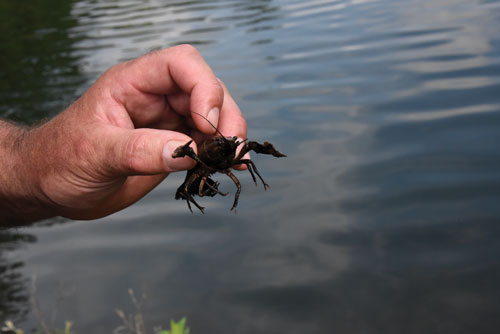
The European crayfish or noble crayfish has long been of cultural significance in Sweden, as the main item on the menu at crayfish parties, a fixture of the summer season.
Swedish authorities face a delicate balancing act. The signal crayfish sustains rural livelihoods and a thriving domestic market, yet it also represents a permanent ecological loss. While the species is listed as invasive in the European Union, it is so deeply integrated into Swedish society that reversing its introduction seems politically and economically unfeasible. The economy is important, says Pettersson, and since the government, authorities, academics, and consumers wanted a substitution for Astacus, efforts to turn the clock back are limited. This pragmatic coexistence highlights a broader dilemma in environmental management: once an introduced species becomes part of a country’s culture and economy, eradication efforts often give way to regulation and utilisation.
Managing the invader while protecting the native
Today, Sweden’s crayfish management reflects a dual reality. The signal crayfish fishery continues to generate local income and preserve long-lived traditions, while conservation initiatives aim to safeguard the last refuges of Astacus astacus. The future seems to be split between utilisation and conservation—enjoying the resource already existing, signal crayfish, and protecting the remainder of the native variety. In practice, this means accepting the signal crayfish as a semi-permanent resident of southern Sweden, while treating northern waters and Gotland as sanctuaries for the native species. For policymakers and scientist across Europe, Sweden’s experience offers an instructive case study in adaptive management. It shows how the line between invasive and native can blur when an introduced species meets strong market demand with cultural roots.
Ixai Salvo,
ixai@eurofish.dk