This article was featured in Eurofish Magazine 1 2026.

Across the EU, the green transition in fisheries is becoming a practical question about the future of fishing vessels as climate targets tighten, fuel prices remain volatile, and coastal communities look for viable paths to generational renewal.
LIFE, an organisation that represents small-scale fishers in Europe, argues that decarbonisation will require a mix of new strategies, new vessel designs, and changes to fishing operations, alongside wider reforms. It warns that electrification changes the fundamentals of vessel design, because weight, displacement, and space constraints can affect stability, hold capacity, and how gear and catch are handled. In its view, the transition is not just about swapping engines or retrofitting but instead implies building new boats that address stability and safety challenges in addition to being fit for purpose. At the same time, LIFE stresses that any transition will require updated seaworthiness certification, new skills, and shore-side capability, from recharging points and supply chains to technical service and repair. However, renewing or adapting the EU fleet, with over 65,000 vessels (2025), in line with decarbonisation targets will cost billions, while the EMFAF offers only around EUR 19 million for engine replacements and energy efficiency to 2027. With limited support, the burden risks falling back on fishers, many of whom operate older vessels and face uncertain prospects, especially where stocks are under pressure.
Rebuilding stocks will also reduce emissions
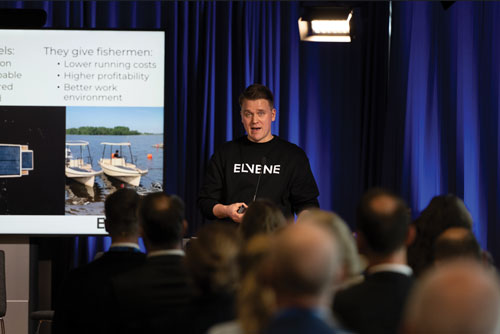
Catching fish more efficiently by improving stock health and management is another route to reducing emissions. The OECD’s work on mitigating the impact of fisheries on climate change highlights how rebuilding stocks can raise catch per unit effort and reduce fuel use intensity markedly. The OECD describes support for stock health and productivity as “low-hanging fruit” for mitigation, because it can lower emissions intensity without posing risks to resource sustainability. As these discussions proceed, a Finnish company, Elvene, is carving out a space for its solar-electric boats designed for coastal operations. Emil Finne, the CEO, traces the company’s origin to a simple frustration with how electrification was being approached in vessel design. There was too much focus on charging infrastructure, and not enough on designing vessels that could generate and manage their own energy, he says. Mr Finne, an engineer in vehicle technology by background, went through the numbers until he had an “equation that made sense”, built a prototype, and found it performed better than expected. Around 2020 he established the company and started building in earnest. On board, solar panels charge onboard batteries continuously, and the vessel’s duty cycle is used to balance consumption and charging. When the boat is moving, it draws on batteries while also taking power from the panels. When stationary, motors do not run, and the system is effectively charging. While the vessel is docked, the batteries are charged in preparation for the next trip. Mr Finne says the boats are modular, with solar and battery capacity configured to match the average energy consumption during the vessel’s normal work cycle. This enables routine fishing trips without plugging into shore power.
In performance terms, he claims top speeds of around 30 knots and suggests the purchase price is perhaps 20% higher than a conventional boat, with the difference largely attributed to batteries and electric motors. On the other hand, energy is effectively free to harvest once the boat is in service, removing fuel costs, which he calls the largest single cost for many fishers. Elvene’s solution specifically targets small-scale fishers with the incentive of zero running costs and close to zero maintenance costs thanks to the simplicity of the engine. Other advantages, apart from the environmental benefits, include an improved working environment with no noise, smell or vibrations. Over time the upfront investment is also likely to decline as the company replaces bespoke components with those that can be sourced off the shelf. To demonstrate proof of concept, Mr Finne took a trip in the Finnish archipelago of more than 200 nautical miles without charging from anything other than solar energy. The test was conducted and documented by an independent electric-boat evaluator, with battery performance tracked by a third-party GPS and data system. He also undertook a separate 200-nautical-mile run between Finland and Sweden and back again without using shore-based charging.
Efficiency starts with the hull
Mr Finne argues that the key constraint in solar-electric vessels is restricted energy input due to the limitations of batteries, compared with the unlimited power available when a vessel can simply carry more fuel. That constraint forces optimisation not only of the drivetrain, but also of hull efficiency. This has led to design choices such as direct drive without a gearbox, and cooling arrangements designed to reduce ancillary energy use. However, hull shape, he says, is the decisive factor and Elvene has invested years in optimising hull designs and has a concept that can scale across sizes, even if its current main model is around 6.5 metres. The importance of the hull means that while solar and electric retrofits might work for certain models, Mr Finne does not see retrofitting as the optimal way forward, because many traditional fishing hulls were not designed with energy efficiency as a priority.
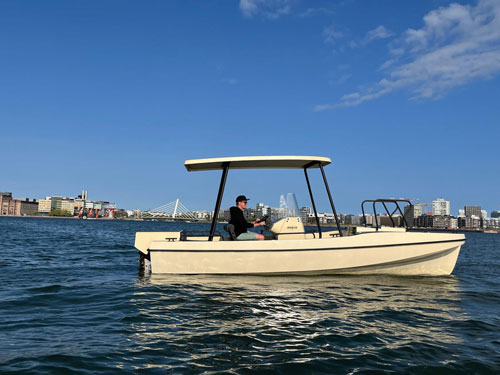
An independently certified trip of over 200 nautical miles was conducted by an
Elvene vessel in the Finnish archipelago using only solar energy and no shore-based charging.
If the technology case is partly about design, the market case, according to Mr Finne, is about policy alignment. He says interest exists, especially in Finland and the wider Nordic region where Elvene has focused its market research, but that selling electric fishing vessels in Europe is “impossible” under current conditions, because support mechanisms favour conventional propulsion. In response, he engages in lobbying and policy discussion, including presenting at an EU-focused energy transition event in Finland, and working with relevant ministries to pursue change. This mirrors the priorities of organisations such as LIFE which also call for a level playing field and equitable access to funds to transform fleets that remain dependent on fossil fuels. Mr Finne says Elvene has received EU support for product development and internationalisation through Finnish channels, including Business Finland. The company, he adds, has been awarded recognition for the “best technical solution to decarbonise European fisheries.”
Europe—stuck in the slow lane
The company has placed boats on three continents—North America, Africa, and Europe—of which the latter has proved to be the slowest-moving. While many of the vessels sold have been for the leisure and hospitality industries, the company is also selling fishing vessels, including to artisanal fisheries projects in Ghana. Decarbonising the fishing fleet also faces constraints related to the availability of low-carbon fuels. The OECD notes that achieving a low-emissions fishing industry will require “major transformations to vessels”, yet alternative fuels such as green methanol, hydrogen, ammonia, and e-fuels remain costly and constrained in supply, and can be technically difficult to install on smaller vessels with limited space. Moreover, as Mr Finne points out, alternative fuels are still burnt in internal combustion engines which only have an efficiency of 30-40%. He is particularly scornful of hydrogen as a fuel as it takes a lot of
energy to produce, transport, and store and is then burnt in a hydrogen combustion engine where efficiency is typically 25-35%. Biofuels are better, in his opinion, but the bio part uses food crops which may be better utilised for human consumption. By contrast, Mr Finne feels a solar-electric approach could be a far more efficient alternative for certain fisheries operations.
A fishing vessel that runs on solar power is viable if fishers can access finance, ports can support new maintenance needs, and regulation keeps pace with design change. It also needs to sit alongside better management and stock recovery, which the OECD highlights as powerful ways to cut fuel intensity while improving fishing outcomes. While the technology may be ready for parts of the fleet, the bigger question is whether Europe is ready to remove the policy contradictions that, in Mr Finne’s view, make the purchase decision irrational for fishers, and whether it can do so while guarding against the unintended consequences that both LIFE and the OECD warn about.