This article was featured in Eurofish Magazine 1 2026.

Few jobs sit so squarely at the meeting point between marine science and day-to-day fishing as that of the fisheries observer. Observers are placed on board commercial vessels to document what happens during fishing operations, using standardised methods so that scientists and managers can work with evidence rather than assumptions.
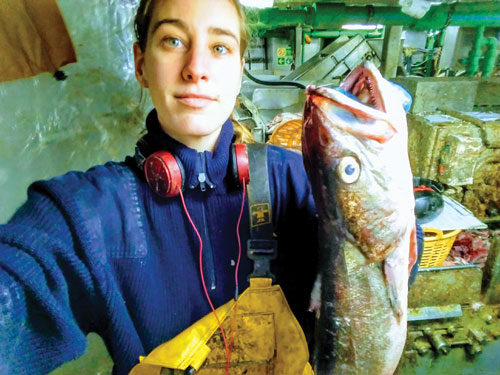
The work of a fisheries observer often happens in wet weather, cramped spaces, and shifting routines. Apart from the relevant educational qualifications, it also calls for particular human skills: the ability to live alongside a crew for weeks at a time, to remain neutral, and to earn enough trust to do the job properly. Carlota Noreña, a former observer who worked with Spanish vessels operating around the Falkland Islands, describes the role as one that brings the reality of fishing into full view. Data collection sits at the centre of the assignment, but the experience is also shaped by the relationships on board, the practical limits of regulations, and the wider questions of fairness in global fisheries.
From biology student to observer
Ms Noreña studied biology at Universidad Rey Juan Carlos in Madrid, with the aim of specialising in marine biology. She describes her choice as an extension of a long-standing wish to protect nature, with the sea at the centre of that commitment. A spear fisher from a young age, she credits that experience with giving her a direct sense of how marine ecosystems function, as well as how quickly they can be affected by pressure. Working on board fishing vessels as a scientific observer was for her a way to translate university learning into applied work. She also valued the opportunity to learn from crews. Fishers, she notes, hold knowledge of the ocean that does not appear in textbooks, knowledge that can help shape and improve policy. As an employee of the Spanish Institute of Oceanography (IEO) she worked as a full-time observer on Spanish vessels operating around the Falkland Islands (Islas Malvinas). Observers are often hired for a period of around three months, but Ms Noreña chose to extend her missions to up to six months at sea to follow a campaign from start to finish.
In the Falklands region, Ms Noreña specialised in monitoring trawl fisheries. She recalls that longer deployments helped her settle into life on board and understand operations in a way that shorter trips did not allow. Over time, she says, she began to feel like “a true sailor”, which also meant she could anticipate the practical constraints crews face when regulations meet real-world fishing. Her daily work focused on observing fishing activity as it happened. That included monitoring the fishing operation itself, documenting catches and discards, and recording the presence of non-target species. She tracked sessile benthic organisms such as white corals and bivalves, as well as fish eggs, when these appeared in the catch. Alongside this, she collected otoliths from commercial species for subsequent analysis, and logged wildlife sightings during the trip.
A good observer embodies certain traits
Ms Noreña’s sees respect for the people who work at sea as essential, coupled with a genuine willingness to learn from them. Without that, an observer may still record numbers but will struggle to understand the context that gives those numbers meaning. She also stresses adaptability. Observers need to function in challenging environments, often with limited privacy and changing schedules, while maintaining neutrality. For her, the credibility of the role depends on the ability to stay professional, even when tensions arise. On the technical side, the core requirement is rigour. Data collection is only useful when it is consistent and accurate, so the observer must be organised, careful, and able to follow protocols precisely. Preparation begins before sailing. Ms Noreña would review the objectives of the campaign, refresh identification skills for target species and typical bycatch, and check that field equipment and data sheets were ready. She also prepared herself for the human side of the assignment, building routines and focusing on emotional balance, because weeks at sea test far more than scientific competence.
The work is carried out within a close-knit workplace where everyone depends on each other’s professionalism.
Ms Noreña describes her approach as based on open communication and respect. She saw the experience as a chance to learn from people whose expertise is often overlooked, and she emphasises that understanding fisheries requires being present during daily operations, not merely analysing data afterwards. That does not mean the observer becomes part of the crew in a decision-making sense. The role is to observe and record, not to direct fishing activity. In
Ms Noreña’s experience, building trust helped the work proceed smoothly and allowed for conversations that helped explain certain practices.
Reports contribute to management decisions
Ms Noreña submitted detailed scientific reports to the IEO, bringing together daily catches, discard quantities, and measures of fishing effort. She also included information on environmental conditions, and gear specifications, as well as operational comments that could help interpret trends in the data. However, she did not rely on a single source of information. The reports were grounded in her own observations and field notes, supported by official vessel records such as logbooks, haul positions, and gear details. Where relevant, she substantiated observations with biological samples and photographs. This allows later users of the information to understand how the data were generated, and how reliable they are likely to be.
The reports contribute to monitoring and assessment work that can inform management decisions, including adjustments to quotas, the definition of management areas, and the design of future monitoring measures.
Any monitoring role raises the question of infractions. Ms Noreña says she encountered irregularities in reporting, particularly around discard quantities, and at times in the reporting of catches or the details of fishing operations. The discrepancies she describes are not always a simple story of deliberate wrongdoing. Sometimes, she suggests, they arise because regulatory limits are set without enough understanding of fishing practice, leading to thresholds that feel unrealistic to crews. In other cases, poor practice, or limited awareness of environmental consequences, plays a part. Her role did not include enforcement, and she was not there to “improve behaviour” in a formal sense. Still, she speaks of conversations with crew members that helped her understand their perspective, and she sometimes used those moments to explain the importance of respecting minimum sizes and catch limits. Monitoring works best when it is accompanied by mutual understanding: crews need to understand what is being recorded and why, while institutions need to understand which rules fit operational reality and which may need rethinking.
Technology complements the work of an observer
Ms Noreña has also worked on monitoring projects that use electronic systems, and she does not see them as a substitute for the human observer. Instead, she argues that the two approaches can complement each other, depending on the fleet and the data needs. Technology is well suited to recording what happens, particularly where consistent coverage is needed. In Ms Noreña’s view, a person adds a different layer: the ability to interpret why certain decisions were made, or why particular patterns appear in the data. That interpretive element is central to responsible management, because numbers without context can lead to measures that look sound on paper but fail in practice. Her preference is to combine digital precision with human judgement to strengthen transparency and improve data quality.

A fisheries observer gathers data from a fishing vessel but
adds value to the numbers by putting them into a context.
Monitoring can be perceived as a source of tension between the fishing industry and regulators, particularly where monitoring is considered policing. Ms Noreña argues that when observers and crew are properly trained, and when each side understands the other’s role, observation can be routine rather than confrontational. Moreover, observers generate data that support stock assessments and can demonstrate compliance, which matters for market credibility. The presence of credible monitoring can in fact strengthen the reputation of responsible fleets. She also feels monitoring standards are uneven across regions. The European Union has rigorous and relatively transparent monitoring expectations, but she describes the situation outside the EU as inconsistent. Some fleets operate without effective observation or control, even when fishing in the same areas as vessels facing strict requirements. When catches from less monitored fleets enter European markets, it represents an uneven playing field. To redress this monitoring and control need to be more consistent.
Small-scale and recreational fisheries should also be subject to monitoring
Monitoring challenges are not limited to distant-water fleets. In countries with large small-scale sectors, and in places where recreational fishing is popular, the absence of reliable data can leave managers guessing about overall fishing pressure. Ms Noreña believes voluntary participation, including anonymous data collection where appropriate, can encourage cooperation among recreational fishers and small-scale operators. When people understand why information is being collected, she argues, they are more likely to take part, and some may even feel pride in contributing
to stewardship.
Looking ahead, Ms Noreña does not expect observers to fade away. She anticipates change in the nature of the work, with observers increasingly acting as intermediaries who connect fishing practices with policy design and implementation. As technology becomes more common, observers may need stronger skills in data handling and system literacy alongside the necessary personal qualities. Ms Noreña also expects the scope of observation to broaden further into ecosystem monitoring and, where programmes allow, the documentation of social conditions linked to fishing activity. In her view, the observer of the future will still be a collector of evidence, but also a translator of context, helping management become both more effective and more tuned into life at sea.