This article was featured in Eurofish Magazine 3 2026.

A family-owned fish processor with a focus on salmon, Gimar puts its commitment to quality, sustainability, and worker welfare ahead of its bottom line. The goal is to ensure the long-term future of the company, says COO Carlos Jiménez.
At Seafood Expo Barcelona, discussions with exhibitors revolve around volume, margins and market access. At the Gimar stand, however, Carlos Jiménez, the COO of the salmon processor, emphasises something else: values. These are a set of principles inherited from his parents that still determines what the family company makes, how it makes them, what it will not make, which suppliers it works with, and how much business it is prepared to lose along the way.
Unwillingness to compromise on values
Gimar, a seafood company based in Petrer, Alicante, has over 30 years of history and a presence in both retail and HoReCa. The company officially defines itself around four pillars: quality of raw material, innovation in processes, the wellbeing of staff, and commitment to sustainability. The company is now run by the second generation. Carlos Jiménez and his brothers took over from their parents, whose passion, discipline, and sense of responsibility shaped how they thought a business should be run. He describes the company as not just a commercial structure but as a place where workers are treated well, products are made with conviction, and growth does not take precedence over values. During Covid and the raw material crisis that followed, for example, the company faced supply problems and falling quality. Its response was to walk away from certain species and shrink its portfolio rather than ship products it could not stand behind. Mr Jiménez says that decision cost them around 30% of their revenue.
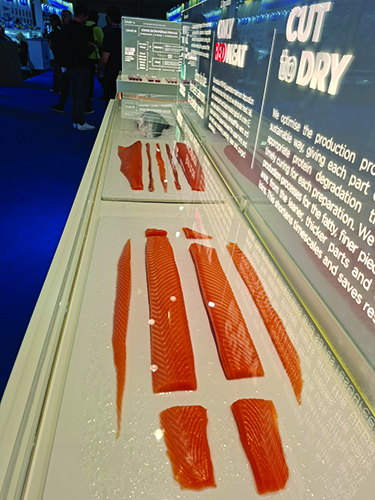
Salmon is trimmed and all blemishes such as blood spots are removed to give meat of the highest quality.
This follows from a simple but demanding commitment to the final consumer. After all, ultimately it is the person who opens the pack at home, cooks the fish, and who decides whether to buy it again. He is aware of the risks to this strategy. Other actors along the value chain need to be convinced of the benefits of this approach and not all of them are. This can lead to come partners being dropped and the need to find new ones which adds to costs and risks potential disruptions to supply. This commitment to the end consumer is why the company turns down commercially attractive propositions when Mr Jiménez does not believe in the product, and why it accepts a shorter shelf life if he thinks it protects the quality of the fish. This business model has earned him criticism, including from retailers who prefer more flexible competitors. The salmon market, he admits, is not an easy place for this philosophy. Prices swing, retailers push hard on cost, and when salmon gets expensive, supermarket shelves feel the pressure. The easy fix is to find a cheaper supplier and keep the volume moving. However, the company has often done the opposite, staying with suppliers who meet its standards even when it hurts. That includes sourcing salmon exclusively from the Faroe Islands, as well as wild tuna frozen at -50°C, and cod from specific Icelandic producers, all MSC-certified.
Eating salmon should be an experience
At the company, smoking salmon is a craft with a long history. Mr Jiménez talks about water, fat, protein, salt, drying, maturation and controlled transformation. The company’s salmon product range includes smoked salmon, carpaccio, tartare, burgers, steaks, fillets, portions, and sushi formats like saku and sashimi. For Mr Jiménez consuming salmon is not about satiating hunger or seeking nutrition, but about creating an experience. One example of the insistence on quality is the invention of trim stage G, (trim stages usually go from A to F) a trimming process that removes blood spots, discolouration or visual defects from the fillet, so only the highest meat quality reaches the consumer. At the company this is currently done by hand, though automated solutions are in development. The focus on quality is now second nature. We are completely transparent about our commitment to the final consumer, Mr Jiménez says, and in discussions with suppliers we make that abundantly clear so there are no misconceptions. The goal is long term profitability and as that is within reach, the company can afford to pick and choose its partners.
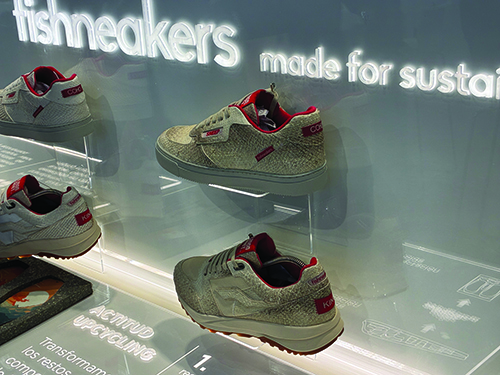
Salmon skins are upcycled to make shoes and bags. Commercial production of these products is due to start.
Another revered process is maturation. Mr Jiménez describes its importance for the final product. Salt draws water from the fish while different drying and curing stages produce different textures and flavour intensities. Products meant for cooking, burgers, fish balls, fillets, go through a gentler process. Longer curing produces firmer textures suited to tartare or smoked salmon. The final stage uses natural smoking with untreated hardwood. The payoff comes when the consumer experiences the organoleptic qualities of the salmon. This obsession with process eventually pushed the company into building its own machinery. For fifteen years as head of production, Mr Jiménez worked with equipment that did not quite fit what he was trying to do, machines that broke down, were hard to clean, and were designed for generic processing. As they built their palette of products, they found that the machinery they needed did not exist. The result was Divso (Divergent Solutions S.A.), a technology company linked to Gimar, built to develop machinery around their own production philosophy. Among its innovations is the use of magnets to drive certain machines rather than motors that tend to be susceptible to rust. The same spirit drove Salmon Planet, a start-up within Gimar focused exclusively on salmon.
Salmon skins used for leatherware
Gimar is also developing sneakers and bags using upcycled salmon skin. This fits with the company’s philosophy of sustainability as the salmon skin is recycled into a high added-value product that in time may generate another income stream. In Alicante, a region with a strong footwear and leather-goods tradition, the company could find the partners it needed to realise the idea. Mr Jiménez adds, however, that he changed tanning partners until he found a firm that could process the skins to his standards which essentially meant the use of vegetal ingredients rather than heavy metals. In keeping with the company’s philosophy, other materials used in the shoes and bags such as cotton and polyester are also recycled. In addition to recycling salmon skin, offcuts from the salmon processing go to cosmetics and pet food, and the company is also researching bioactive peptides and protein extraction. The aim is to use more of the fish, extract more value, and reduce waste. Mr Jiménez sees B2C (business to consumer) channels, including e-commerce, as increasingly important due to the direct interaction with the consumer and when commercial production of the leather goods starts, he expects to sell them online. While the shoes and bags will only be a niche product, they represent the same commitment to quality, sustainability, and workers’ welfare that characterises Gimar’s salmon business.