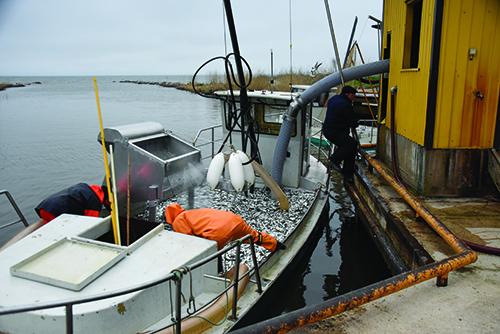
This article was featured in Eurofish Magazine 3 2026.

One of the objectives of the European Union’s Common Fisheries Policy is to achieve economically viable fleets that do not overexploit marine biological resources. By providing the right incentives Estonia shows how fleet capacity can be reduced without subsidies.
The Common Fisheries Policy has defined measures to adapt fleet capacity (main engine power and gross tonnage) to fishing opportunities. One of the measures for managing fleet capacity is the capacity ceilings set for Member States’ fleets—the total capacity of a Member State’s fleet, measured as the sum of the main engine power and gross tonnage values of the vessels, can never increase. Under the current fisheries fund (like the previous one), Member States have the opportunity to reduce fleet capacity through subsidies for decommissioning part of the fleet, whereby the capacity ceilings for Member States’ fleets have further decreased at the expense of those vessels. At the same time, the remaining fleet needs to be renewed to meet modern requirements for safety, working conditions, energy transition, etc. However, new vessels are generally larger and more powerful, which makes replacing an old vessel with a new one difficult if there is not enough free capacity.
Fishing vessel numbers dropped in Estonia both with and without subsidies
Let’s take a closer look at the Estonian marine fishing fleet. At the moment of accession to the European Union in 2004, the Estonian fleet totalled 2,104 vessels and the capacity ceiling for gross tonnage was set at 26,622 GT and for main engine power at 64,937 kW. Since then, 62 trawlers have been removed from the fleet with help from subsidies, and the capacity ceiling has fallen by 22%. For larger vessels, the decline has been even more drastic because, in addition to subsidies, vessels have also been removed without subsidies. Thus, compared to 2004, the total number of fishing vessels of 12 metres and longer fishing in the Baltic Sea has decreased from 154 vessels to 21 vessels, and the number of trawlers fishing in the Atlantic Ocean from 12 vessels to four. At the same time, capacity in terms of engine power has decreased by 68% and 29%, respectively. Nine tenths of the main engine power and 70% of the gross tonnage of the Estonian fleet’s capacity ceiling are already in use. Therefore, operators are currently in a situation where there is a growing demand for free capacity, and fleet renewal is a very large challenge and an obstacle to the further planning of their economic activities.
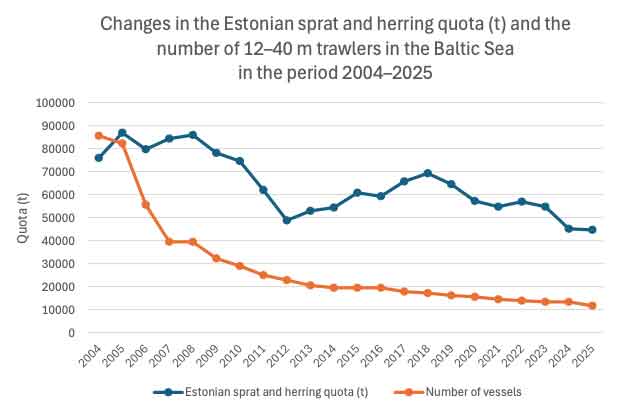
Figure 1. Change in the Estonian sprat and herring quota (t) and the number of 12–40 m trawlers
in the Baltic Sea in the period 2004–2025
An FAO analysis in 20251 concludes that traditional input and output-based fleet capacity limits are important but insufficient on their own, which is why they should be supplemented with rights-based systems, market-based instruments and social measures to reduce dependence on fisheries. In the context of reviewing the Basic Regulation of the EU Common Fisheries Policy2, it should therefore be asked whether setting a capacity ceiling for fleets is a necessary measure in adapting fleet capacities to fishing opportunities, or would other measures provide the same or a better result? We bring two examples from Estonia, which clearly question the added value a capacity ceiling provides in such a situation.
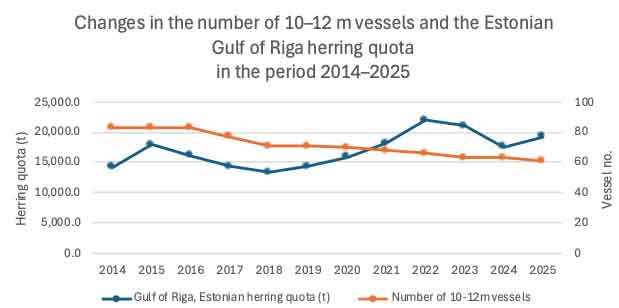
Figure 2. Changes in the number of 10–12 m vessels and
the EstonianGulf of Riga herring quota in the period 2014–2025
Market situation pressures operators to adapt their fleets
In Estonia, a system of individual transferable quotas (ITQ) is used in the trawl fleet, where annual fishing opportunities are distributed among operators according to historical fishing rights. An operator can allow their fishing opportunities to be used by other operators or can sell their historical fishing rights altogether. The ITQ system, influenced by various input (seasonal and spatial fishing restrictions, fishing right fees, etc.) and output (allowable catch volume) measures has given operators the freedom and also the motivation to adapt their fleets themselves, often without subsidies, according to the market situation (Figure 1). If fishing opportunities fall or input costs rise, there is no point in using inefficient vessels and they are removed from the register. For example, while in 2004 there were 68 vessels in the length class of 12–18 metre small trawlers, by 2022 there were no longer any vessels there. In addition, fishing in the Baltic Sea is very regulated and there is a constant overview of the activities of the vessels – AIS, VMS, ERS, monitoring increasingly carried out with drones, and in the future also risk-based CCTV and engine power measurement.
Coastal fishing capacity declines without support
A similar example exists for coastal fishing. In the Gulf of Riga, herring is caught with trap nets using 10–12 m vessels. Until 2015, a system of individual transferable fishing efforts (ITE) was in use together with a common herring quota, where the maximum number of fishing gears was divided among operators according to their historical fishing rights, but the herring quota was common to everyone. Just as in trawling, an operator can allow their fishing opportunities to be used by other operators or can sell their historical fishing rights altogether. From 2015, the common herring quota is divided among fishing gears based on ITE. After the transition to individual allocation, the fishing season lengthened significantly, while the number of vessels has decreased without any subsidy—in ten years, the number of vessels decreased by 27%, kW by 33%, and GT by 26%. At the same time, the Gulf of Riga herring quota has not fallen (Figure 2). Thus, when the ‘first come, first served’ fishing arrangement was eliminated, the need for more boats to bring as much herring ashore as possible before others also disappeared. Rising fuel prices have likely also contributed to the decrease in the fleet and the increase in efficiency. This clearly shows that operators adapt their capacity, i.e. the number of vessels, according to the actual situation.
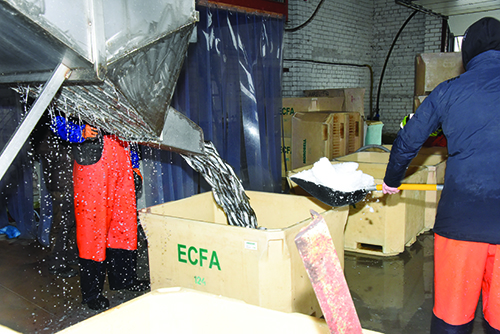
Freshly-caught herring being prepared for transport to the processing plant of
one of the Estonian producer organisations.
In summary, operators in this segment are restricted by several types of input and output measures—the type and number of fishing gears are limited, temporal and spatial restrictions have also been established for herring fishing, and the catch volume is limited. In addition to these, fishing opportunities (number of fishing gears and the allowed quantity of herring per fishing gear) are distributed on the basis of historical fishing rights; participants are able to lease and sell fishing opportunities. Furthermore, surveillance has become significantly more efficient over the years. Since 2024 all Estonian coastal fishers have been obliged to submit fishing data electronically through an application and these data enable monitoring in real-time.
Fisheries regulation in the European Union has become more complex over the years. At the same time, many stocks are still in poor condition and fleet capacities and fishing opportunities are not in balance. Member States need greater flexibility to choose the best solutions for their circumstances from the fleet capacity regulation toolkit. Measures such as capacity ceilings, which directly hinder fleet renewal thus jeopardising safety, decarbonisation etc. should be avoided.
Epp Meremaa
Ministry of Regional Affairs and -Agriculture
1 Davies, S., Durighello, A. and Van Anrooy, R. 2025. Implementation of the FAO International Plan of Action for the Management of Fishing Capacity (IPOA-Capacity). FAO Fisheries and Aquaculture Technical Paper, No. 723. Rome, FAO. https://doi.org/10.4060/cd8015en
2 Regulation (EU) No 1380/2013 of the European Parliament and of the Council of 11 December 2013 on the Common Fisheries Policy, amending Council Regulations (EC) No 1954/2003 and (EC) No 1224/2009 and repealing Council Regulations (EC) No 2371/2002 and (EC) No 639/2004 and Council Decision 2004/585/EC; https://eur-lex.europa.eu/legal-content/ET/TXT/?uri=CELEX:02013R1380-20230101.