This article was featured in Eurofish Magazine 3 2026.

The blue crab (Callinectes sapidus) from the western Atlantic was introduced into European waters more than 100 years ago and is causing increasing problems. At the same time, however, blue crabs are also highly sought-after seafood in many places because of their excellent meat quality. If the species is soon classified in the EU as invasive, that could considerably hamper its commercial use.
The blue crab, also called the blue swimming crab, owes its name to its intensely blue legs, which are often marked with irregularly distributed white spots and speckles. Its scientific name also refers to this appearance, combining the ancient Greek words kállos (beautiful) and nḗktēs (swimmer) with the Latin saphyrinus (sapphire blue). Particularly striking are the crabs’ bright blue claws, which in adult females often have red tips resembling nail varnish. Although the carapace sometimes shimmers slightly bluish, it is otherwise more typically crab-like in brownish, olive-green, or greyish tones. Blue crabs are fairly sizeable crustaceans whose carapace can grow to up to 23 cm wide and about 10 cm long. The size record is held by an animal caught in Chesapeake Bay that weighed just under 500 g and had a carapace 25.7 cm long. Under normal conditions, blue crabs typically weigh between 150 and 180 g.
As a decapod crustacean, the blue crab has five pairs of legs, the front pair bearing two differently sized claws as in lobsters. The larger is used to break open prey, while the smaller moves pieces of food to the mouth opening. Behind the claw-bearing legs follow three pairs of walking legs. The fifth and final pair are the swimming legs, whose paddle-shaped end segments are used for swimming.
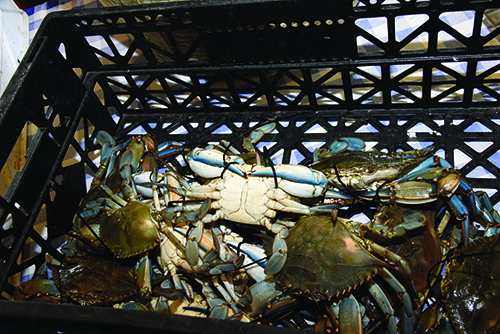
The blue crabs are rendered safe for handling by tying plastic strips around the claws.
The blue crab’s original home is the Atlantic coasts of North and South America, from Nova Scotia via the Gulf of Mexico to Uruguay. As a neozoon, however, the species is now also found in Japanese coastal waters, in the North and Baltic Seas, as well as in the Mediterranean and the Black Sea. It was probably introduced there in ships’ ballast water. It typically inhabits “subtidal coastal areas”, which include almost the entire shallow shelf region that is permanently covered by water, averaging 200 metres in depth below the low-water line. The habitats used by blue crabs change according to age, season, and sex, and include both marine and estuarine areas. When water temperatures fall towards winter, the animals burrow into muddy or sandy sediments in deeper waters. Adult crabs can tolerate temperatures between 6°C and 30°C, while juveniles need at least 15°C. Blue crabs generally live for two to four years. Although the species has spread strongly in recent years, blue crabs require high water quality. They react to pollution, particularly when it reduces the oxygen content of the water.
Voracious predator with high fertility
Blue crabs are omnivores that prefer animal food such as bristle worms (polychaetes), thin-shelled mussels, young crustaceans, and fish, but in times of scarcity they also accept plants, detritus, and carrion. As opportunistic feeders, they also show a strong tendency towards cannibalism in some areas. In a meta-analysis, American scientists evaluated 37 years of data on the diet spectrum in Chesapeake Bay and found that cannibalism is the most frequent cause of mortality for young blue crabs in the region. According to the study, adult blue crabs were responsible for 97% of all juvenile losses. By contrast, the number of predators that themselves threaten blue crabs is relatively limited. In the western Atlantic, the species’ original home, these include chiefly red drum and Atlantic croaker (Sciaenops ocellatus, Micropogonias undulatus), sea turtles (Cheloniidae), and the American herring gull (Larus argentatus smithsonianus). In shallow water they can also fall prey to large heron species (Ardeidae).
Blue crabs usually reach sexual maturity at the age of 12 to 18 months. Females mate only once in the course of their lives, whereas males can do so repeatedly. Transfer of the sperm packet typical of crustaceans (spermatophore) takes place immediately after the female moults, when her shell is still soft. She then carries the male’s sperm with her for several months until egg laying and fertilisation take place. Depending on size and condition, the female lays between 750,000 and 3,200,000 eggs. After about 14 days, the tiny nauplii hatch. They moult several times and pass through several larval stages within a few weeks before taking on the typical shape of a crab. Losses up to that point are immense, but this elaborate reproductive strategy enables the crabs to colonise new areas quickly and establish themselves there.
Rapid spread in European waters
Indeed, over recent decades the blue crab has spread in many European waters beyond its natural distribution range. The species was first observed in 1901 in Rochefort on France’s Atlantic coast. From there it probably advanced into the Mediterranean (first recorded in 1935) and later into the Black Sea as well. Today it is found almost everywhere: off Israel, near Alexandria and Rhodes, in the Gulf of Thessaloniki, as well as along the North African and Iberian Mediterranean coasts. Blue crabs are even caught regularly in the North Sea between England and the Netherlands. A specimen found off Usedom in 2023 is regarded as the first record of this crustacean species in the southern Baltic Sea.
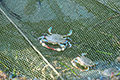
The animal has strikingly coloured blue claws tipped with red.
The average size is 150-180 g.
While populations in northern Europe are confined to only a few areas, the blue crab has spread almost continuously along the Mediterranean coasts. Because of the rapid colonisation of new areas, its enormous population growth, and its effects on marine ecosystems, the crab is considered one of the 100 most invasive species in the Mediterranean. The blue crab benefits from rising water temperatures. Nevertheless, experts do not agree on whether climate change is in fact the sole main reason for the “crab invasion”. Without its ability to outcompete other crab species, its high fertility, its capacity for sustained swimming, its tolerance of changing temperatures and salinities, and the absence of natural predators, the newcomer would hardly have established itself so successfully in the Mediterranean. Since about 2016, the population in the western Mediterranean, especially in the northern Adriatic, has risen massively.
Ecological threat and economic losses
The blue crab has become a genuine pest in many regions of the Mediterranean. Its spread damages native species and ecosystems and is responsible for losses in biodiversity. This also affects economic activities, above all fisheries and aquaculture. When the crabs attack oyster, clam, and mussel farms, they can destroy substantial parts of the harvest in a short time. Set gillnet fisheries also suffer losses because the predatory crabs eat fish caught in the nets, often become entangled in the meshes, and thereby render the gear unusable. In Tunisia, the blue crab caused such great damage after 2014 that many fishers gave up their trade. Tunisia’s fisheries sector, however, struck back, because the blue crab itself is a very high-quality and internationally sought-after seafood product. Together with the FAO, the Tunisian government launched a project in 2019 to catch and export blue crabs. By 2022 Tunisia was already exporting more than 8,100 tonnes of blue crabs worth about EUR 33 million. In 2024, 51 businesses were involved in the processing and trade of blue crabs.
It has been reported from Croatia that blue crabs have further reduced the stock of European eel in the Neretva. Italian shellfish farms on the Adriatic and Tuscan coasts have been especially badly affected. In the first half of 2023, a mass invasion of crabs suddenly occurred there, descending on oyster, clam, and mussel farms. In the Po Delta, harvest losses reached almost 50%. In August 2023, the Italian government therefore released EUR 2.9 million to combat blue crabs. Small crabs were disposed of in landfills, whereas the larger animals were used for culinary purposes. The crab cannot, however, be pushed back by consumption alone, but catching and using it is certainly sensible from an economic point of view, because blue crabs command attractive prices on the seafood market. Although prices vary by region, size, and season, a dozen medium-sized crabs on the east coast of the United States, where the crustaceans are especially popular in summer, can sometimes cost nearly USD 75. Large blue crabs fetch up to USD 13 each. Especially sought-after are freshly moulted soft-shell specimens.
Popular in the US, Asia, and, increasingly, the Mediterranean
Blue crabs are regarded as an excellent delicacy whose white, tender, yet firm meat has a sweet, intense, slightly nutty flavour said to be comparable to that of lobster. Traditionally, they are prized above all in the United States and in Asia, but they are also finding growing numbers of admirers in the Mediterranean region. Since 1980, fishery landings have varied worldwide between about 65,000 and 110,000 tonnes and have stabilised at 70,000 tonnes since 2020. At times, small quantities (maximum 500 tonnes) have also been produced in aquaculture.
It is therefore hardly surprising that on the Italian Adriatic coast some fishers, after only a short time, began supplying interested restaurant operators in the north-east of the country with blue crabs. Alongside traditional dishes, guests were now also offered new seafood variants such as blue crab salad, steamed blue crabs in rosemary sauce, or spaghetti with garlic and crab meat. The European Commission has announced a new risk assessment for the blue crab. It is intended to determine whether the newcomer must be classified as an “invasive alien species”. When the list was last updated in August 2022, this was not yet necessary. Should the blue crab now be added to the invasive list, however, it would be subject to several restrictions under Article 7 of the IAS Regulation. Particularly unwelcome is the fact that it could no longer be placed on the market, kept, used, or exchanged. That would, of course, make commercial use considerably more difficult. Exceptions to the ban on the “placing on the market of invasive species” are possible, but only “under strict justification and provided that all appropriate controls are carried out to prevent their further spread” (Article 19(2) of the IAS Regulation). If Italians, and their guests, are not to lose their newly awakened appetite for blue crabs straight away, a management plan for these crustaceans, and with it a certain bureaucratic effort, would appear to be indispensable.
Manfred Klinkhardt