This article was featured in Eurofish Magazine 3 2026.

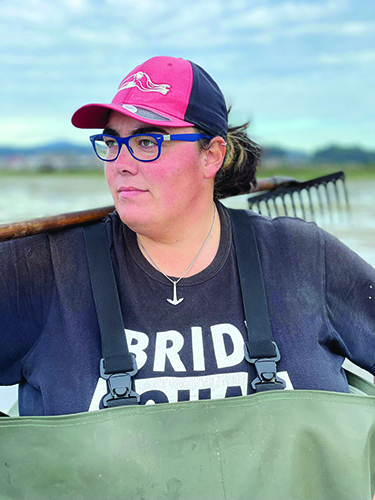
Picking shellfish on foot in the Galician rias is an occupation dominated by women that faces economic, environmental, and social challenges. If these are not addressed the future of the profession may be jeopardised, says Maria Fontán, a shellfish gatherer active on social media.
Whatever the weather, María Fontán’s work begins before dawn, yet she may still end the day with a basket of shellfish that falls short of the permitted quota. For her, being a mariscadora a pie, or on-foot shellfish gatherer, is not the picturesque activity collecting clams and cockles on a beach that outsiders sometimes imagine. It is a regulated profession shaped by biology, weather, public rules, and collective responsibility. There are minimum sizes, catch limits, assigned areas, working hours set by the tides, and controls intended to protect the resource. Behind the visible act of harvesting lies work that is less often filmed or understood: cleaning shellfish beds, reseeding them, moving shellfish to improve production, monitoring sizes, and helping ensure that extraction today does not destroy tomorrow’s livelihood.
Women collecting shellfish in Galicia has a long history
Ms Fontán’s brings a human voice to one of the most emblematic examples of women’s work in European fisheries. In the European Union, women are often undercounted in fishing statistics because much of their work takes place onshore, in family businesses, or in activities not always treated as fishing. A 2025 European Parliament study on women in fisheries notes that women account for only 3.8% of the EU fishing fleet workforce, but that the data can overlook onshore activities that support fishing businesses. It specifically highlights Galicia, where shellfish gathering on foot is largely carried out by women, and where women represent 95% of shellfish gatherers. Ms Fontán describes shellfish gathering as a profession with a long history of women behind it, a tradition of work, struggle, and support for families. The European Parliament study refers to Galician mariscadoras as an example of good practice and co-governance. Shellfish pickers cannot operate anywhere they wish; areas are assigned, and the activity is managed with temporal restrictions to protect the beds. Ms Fontán explains that shellfish gathering is not only about extraction. The resource is actively managed by moving shellfish to improve production, use different areas better, and avoid overexploitation. When beds are cleaned or reseeded, it is because, as she says, “if it is not cared for, it disappears.” Yet this maintenance that sustains the resource is not always valued as highly as harvesting. For Ms Fontán, this is one of the sector’s central contradictions—the work most important to the long-term future of the resource is among the least recognised economically.
Her view reflects a broader debate about women’s visibility in fisheries. Researchers at the University of Bergen note that fisheries are still often only imagined as men at sea, even though women do much of the background work including mending nets, baiting hooks, transporting fish, small-scale sales, and bookkeeping, as well as harvesting shellfish. Iselin Åsedotter Strønen1, who is conducting fieldwork among women in Galicia’s fisheries sector, argues that women’s contributions have been systematically rendered invisible, and that lack of recognition can exclude workers from rights and legal frameworks. Maria Fontán has chosen to challenge these structures that deny women their rights. Through social media she has shown the physical hardship of the trade, including rough weather, long hours bent over, and the effort of carrying heavy baskets across the shore. She says she began sharing her daily life because people were curious, but her aim now is to break myths, give visibility to the sector, and show the profession as it really is. She rejects the label “influencer” as too shallow, preferring to see herself as a communicator for the sector and a worker presenting reality without idealising it. At a personal level, she finds it gives her a connection with other people, opportunities, and above all the satisfaction of giving a voice to her profession.
Shellfish gatherers have intimate knowledge of the sea
For many consumers, shellfish arrives as a finished product detached from the people who make it possible.
Ms Fontán wants the public to understand that behind every clam or cockle there is effort, knowledge, and care for the sea. Shellfish gathering depends on ecological balance, but also on the skills of people who understand tides, the fishing grounds, mortality, species behaviour, market expectations, and who follow the regulations governing the trade. The economic reality is more fragile than many people assume. Ms Fontán points to one of the biggest misconceptions, namely that shellfish pickers earn a great deal. There are good days, but also many bad ones, and after costs, including self-employment contributions, the returns may be far lower than outsiders imagine. For incomes to improve, she believes the product and the work both need greater appreciation. Generation change is also a challenge. Entry into the profession is not straightforward as places are limited, and specific training is required in areas such as biology, regulations, and safety. Ms Fontán says young people see the instability and the hardship, and many are discouraged. For shellfish gathering to be seen as a dignified profession with a future, she argues that it needs more stability, better economic conditions, and stronger social recognition.
These goals align with Spain’s wider efforts to strengthen the role of women in the fishing sector. The Spanish Network of Women in the Fishing Sector2, promoted by the Ministry of Agriculture, Fisheries and Food through the General Secretariat for Fisheries, aims to boost women’s role in fisheries, support association-building, improve communication, and exchange initiatives and good practices among women working in, or wishing to work in, different areas of fisheries. The network also seeks to give visibility and support to women’s organisations and groups promoting equal opportunities in the sector. For Ms Fontán, however, visibility alone is not enough. The future of the profession is being tested by environmental change. In Galicia, she says climate change is visible every day on the shellfish beds. Torrential rains, lower salinity, temperature shifts, mortality, changes in species, and falling productivity affect work directly. Winter rains in January and February 2026 have resulted in a decrease in production estimated at over 50% in a majority of the shellfish picking areas, according to the Galician government. And recovery is expected to take two to four years. These changes make it harder for her to imagine a peaceful retirement from the sector. Her testimony shows why women’s knowledge matters in marine policy. The University of Bergen article stresses that women who harvest shellfish in Spain’s tidal zones hold detailed ecological knowledge and are closely connected to the ecosystems they work in; this is especially significant in the context of environmental degradation and climate change.
Sustaining the sector calls for changes in several areas
Ultimately, Ms Fontán is a worker in a regulated, women-led, environmentally sensitive profession that is still fighting to be properly valued. She speaks for a sector whose future depends on more than catches and prices. It depends on whether low visibility maintenance work on shellfish grounds is paid and recognised, whether young people can enter with confidence, whether climate pressures are addressed, and whether the people who harvest shellfish are treated as professionals with knowledge that deserves a place in decision-making. Looking to the future Ms Fontán’s feels her profession would benefit from greater recognition, more support, and stronger measures to protect the environment. These changes in turn may support generational renewal. As she says, if the sea is cared for, and the people who live from it are cared for, then there is a future. Otherwise, the profession stands threatened.
References
[1]: https://www.uib.no/en/svf/179103/exploring-hidden-contributions-women-fisheries “Exploring the Hidden Contributions of Women in Fisheries | Faculty of Social Sciences | UiB”
[2]: https://www.mapa.gob.es/en/pesca/temas/red-mujeres ”Red Española de Mujeres en el Sector Pesquero”