This article was featured in Eurofish Magazine 4 2026.

Legislative demands to reduce greenhouse gas emissions are getting stricter. All sectors of the economy must contribute—including aquaculture. A recent report from the European Climate, Infrastructure and Environment Executive Agency shows that targets can be met, but it will call for significant efforts.
The European aquaculture sector operates within an increasingly ambitious climate policy framework. The European Green Deal, introduced in 2019, sets out a roadmap to transform the European Union into a climate‑neutral economy by 2050. This ambition has been legally enshrined through the European Climate Law. Intermediate targets have also been strengthened. Under the Effort Sharing Regulation, Member States are required to achieve a 55% reduction in greenhouse gas (GHG) emissions by 2030, compared to 2005 levels. More recently, the European Commission proposed a 90% reduction by 2040, further tightening the pathway to climate neutrality. Although aquaculture accounts for a relatively modest share of total emissions—estimated at around 2 million tonnes of CO₂ equivalent in 2019 (0.05% of total EU GHG emissions)—it is nonetheless expected to contribute to these reductions.
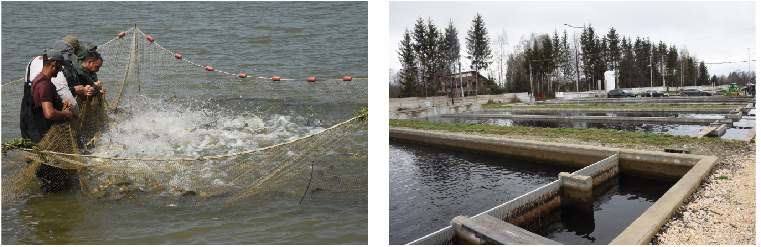
Fish from ponds (left) and raceways (right) represented 13% and 9% of EU aquaculture production
from 2005 to 2024 and were responsible for 20% and 10% of the emissions respectively.
Reaching climate neutrality in EU aquaculture by 2050 is technically achievable, but only under specific conditions. Even with widespread adoption of available technologies, the sector will continue to generate residual emissions—particularly from feed production, energy use, and transport. As a result, carbon offsetting will remain a necessary component of any credible pathway.
A recent study, commissioned by CINEA (European Climate, Infrastructure and Environment Executive Agency), examining decarbonisation options across European aquaculture shows that no single solution is sufficient to achieving net zero by 2050. Instead, a combination of measures—ranging from alternative feeds and renewable energy to digitalisation and integrated production systems—must be implemented simultaneously. Even then, progress will depend heavily on developments outside the sector, especially in agriculture and fisheries, which supply key inputs such as feed. The analysis also highlights that meeting interim climate targets for 2030 and 2040 will be challenging. Many of the most promising technologies are not yet ready for large-scale deployment, and investment costs remain significant. Nevertheless, the study confirms that progress is possible, provided that policy support, innovation, and supply chain coordination are aligned.
Mapping emissions across the value chain
A central component of the study is the development of a harmonised emissions inventory covering the period 2005–2024. This database spans five production systems—cages, ponds, raceways, recirculating aquaculture systems (RAS), and non-fed systems—and includes all major species farmed in the EU with the exception of macroalgae.
Using life cycle assessment (LCA) data, emissions were calculated per tonne of live weight within a cradle-to-gate framework. The analysis breaks emissions down along the value chain, including feed production, transport, on-farm energy use, and, where relevant, vessel operations. Because data are uneven across species and countries, the study uses proxy data and modelling adjustments to ensure comparability. Non-EU datasets were incorporated where necessary, with corrections applied to reflect European energy mixes and production conditions. This approach makes it possible to identify where emissions are concentrated—and, crucially, where reductions can be most effectively achieved.
Exploring alternative futures
To assess how the sector might evolve, the study develops a set of eight scenarios, each representing a different combination of policy ambition, technological uptake, and investment intensity. At one end of the spectrum is a business-as-usual scenario, assuming no significant change. At the other extreme are high-ambition scenarios that fully deploy all available technologies, including renewable energy, alternative feeds, and advanced digital tools. Intermediate scenarios explore more gradual or cost-conscious transitions, as well as the role of carbon offsetting.
Across all scenarios, a consistent message emerges: isolated measures deliver only limited benefits. Meaningful reductions require a combination of interventions, including improvements in feed composition, greater energy efficiency, the adoption of renewable energy, and the expansion of low-impact production systems such as non-fed aquaculture and integrated multi-trophic aquaculture (IMTA).
What will it cost?
Decarbonisation comes at a cost, and these costs vary widely depending on the chosen pathway and production system. Using a marginal abatement cost (MAC) approach, the study estimates the cost per tonne of CO₂ equivalent avoided. Across the different scenarios, average abatement costs range from approximately €69 to €574 per tonne CO₂ equivalent, depending on the production system. Over the full period (2026-2050), the overall average abatement cost is €220 per tonne. These figures reflect both technological maturity and economies of scale over time.
Significant differences also emerge between production systems. Recirculating aquaculture systems (RAS) show relatively low abatement costs, reflecting their high degree of control and efficiency. Pond systems also perform relatively well. By contrast, non-fed systems—despite their low baseline emissions—show higher marginal costs for further reductions, as fewer mitigation options are available. These findings underline that decarbonisation strategies must be tailored to specific production contexts rather than applying a one-size-fits-all approach.
Listening to the sector
Beyond technical modelling, the study incorporates input from industry stakeholders through surveys, interviews, and focus groups. This provides valuable insight into how different measures are perceived across the sector. The results reveal broad support for measures such as energy efficiency improvements and digitalisation, which are seen as both practical and cost-effective. However, more ambitious or capital-intensive options—such as large-scale shifts in feed ingredients or infrastructure—are viewed with greater caution.
Regulatory complexity and uncertainty also emerge as key concerns. Producers emphasise the need for clearer frameworks, more predictable permitting processes, and targeted financial support to facilitate investment. These perspectives highlight that successful decarbonisation depends not only on technical feasibility but also on economic realities and stakeholder acceptance.
The role of offsetting
One of the clearest findings of the study is that emission reductions alone will not be sufficient to achieve climate neutrality. Even under the most ambitious scenarios, residual emissions remain. Two factors explain this. First, certain emissions—linked to energy systems, transport, and infrastructure—cannot be fully eliminated with current technologies. Second, aquaculture depends on inputs from other sectors, notably feed derived from agriculture and fisheries, which themselves generate emissions.
As a result, carbon offsetting is unavoidable. This may include measures such as ecosystem restoration, carbon sequestration projects, or the purchase of verified carbon credits. The need for offsetting varies over time. In the short to medium term, reliance on offsetting is expected to be higher, as technological solutions scale up. Over the longer term, as cleaner technologies become more widely available, the relative importance of offsetting may decline—but it will not disappear entirely.
A systemic challenge
This study is based on the premise that the aquaculture sector has to abate scope 1 (direct emissions), scope 2 (purchased energy with emissions decreasing to 2050) and scope 3 emissions (feed production and feed transport). This is not to say that the costs related to reducing these emissions should be borne by the aquaculture sector alone, and indeed under the climate law the responsibility to reduce emissions falls to the relevant sector.
Under this premise, the target of carbon neutral aquaculture can only be reached if offsetting measures are taken. Carbon offsetting remains the subject of ongoing debate, particularly with regard to credibility, additionality, and certification standards. The EU’s Carbon Removals and Carbon Farming Regulation (EU/2024/3012) seeks to address these concerns by establishing a voluntary framework for certifying carbon removal and storage activities. Although aquaculture-based removals are not currently included, producers can participate in broader carbon markets to compensate for emissions that cannot be reduced directly.
To conclude, the EU aim to expand aquaculture production to strengthen food security, reduce reliance on imports, and support marine ecosystem health, while at the same time achieving carbon neutrality is demanding. It will require coordinated policy support at EU and Member State levels, sustained efforts to reduce emissions across the entire supply chain, and—at least in the medium term—the strategic use of offsetting mechanisms.
The full study report is available at: https://cinea.ec.europa.eu/publications/digital-publications/study-eu-aquaculture-greenhouse-gas-reduction-costs-and-pathways-net-zero-2050_en#files
Sander van den Burg, Pham Thi Anh Ngoc, Simona Paolacci, Callum Howard