This article was featured in Eurofish Magazine 5 2026.

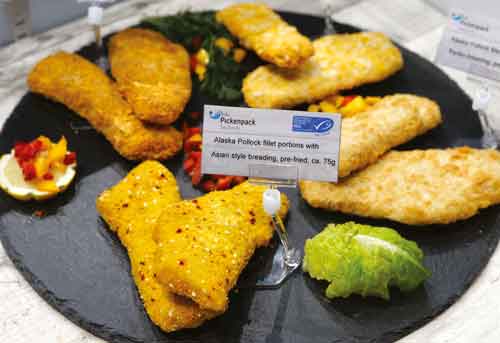
Products with breadcrumb or batter coatings are now indispensable in the fish and seafood sector. Whether fish fingers, kibbeling, or battered fish, it is the crisp coating that turns a good product into an outstanding one. The choice of breading machines with which small businesses, large-scale caterers, and professional users can apply coatings of every type and particle size is extensive and leaves little to be desired.
The classic breading line of flour, beaten egg, and breadcrumbs is now familiar even to every respectable domestic cook. With patience and growing experience, they usually achieve quite satisfactory results. But when speed, quality, and reproducibility of breading results are required, or even a complete all-round coating for irregularly shaped products, many reach their limits. In such cases, mechanical assistance is often unavoidable. Whether a craft-scale breading station for a snack bar or a compact industrial system for the needs of fast-food chains, each is a valuable kitchen aid that transfers manual work into machine processes. In the food industry, breading machines are available for almost every conceivable application, from wet and dry breading to flour pre-dusting. Their capacity can often be gauged simply from the width of the conveyor belt, which may range in several increments between 25 and 100 cm. Machines made from high-grade stainless steel usually prove very robust and durable in demanding day-to-day operation.
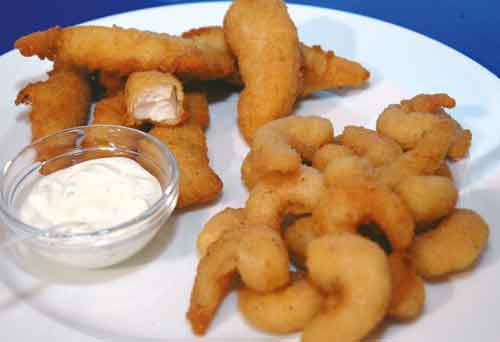
Smaller-piece product formats, such as trimmings or nuggets, can also be marketed very effectively with a suitable coating.
Despite minor differences and certain technical refinements, the breading process is almost always the same, or at least very similar, because it usually follows the sequence of the traditional breading line. To bind the coating securely to the product, it is normally pre-dusted with flour at the start of the process and provided with a protein layer whose adhesive properties form the basis for the breadcrumbs applied afterwards. However, the breading should not only adhere firmly to the product, but also cover it completely on all sides. For this purpose, the product is placed on a bed of breadcrumbs and generously showered with more from above. Vibrating shaker plates or rollers press the still loose coating more firmly into place. Excess breadcrumbs that do not adhere to the product after this procedure are blown off again in a strong stream of air. Once any lumps have been removed, the material is returned to the process and reused. All this takes place at high speed, with both fine and coarse breading materials such as crushed cornflakes or pretzel sticks. Some manufacturers of breading systems quote belt speeds of up to 30 metres per minute for their machines. Despite this enormous speed, the coatings are applied evenly and with an attractive appearance, making every bite a culinary experience.
Breading systems for different applications
Although the basic idea of breading remains unchanged, machine manufacturers have altered and adapted the “classic process” in some details. This is partly due to the differing requirements of users. At the same time, the range of convenience products sold in breaded form has become considerably broader. Where schnitzel, fish fingers, and battered fish once dominated the market for coated products, prawns, nuggets, fish cakes, surimi products, cheese sticks, and vegetarian and vegan alternatives are now offered just as routinely with a wide variety of coatings. It is also often overlooked that the diversity of breading media is growing steadily, both in terms of particle sizes from fine to coarse, and of the materials used for coating. Breadcrumbs made from ground white bread, or the Japanese variant panko, remain classics. Today, however, crushed cornflakes, nuts, oats, pumpkin seeds, sesame or poppy seeds, almonds, cashews, and crushed biscuits, crackers, pretzel sticks, or crispbread are also mixed into breadings. An Italian-inspired variation (“Milanese breading”) is enriched with a pinch of Parmesan or Pecorino. Each of these mixtures can create the glossy golden-brown crust with a crisp crunch that are expected and valued in breaded products.
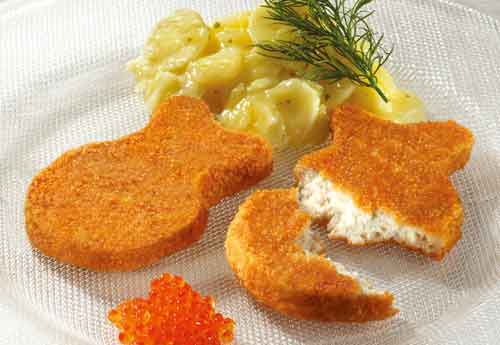
Products made from highly comminuted and therefore bone-free fillet meat, which are held in shape by their breading, are ideal for children.
Instead of the traditional wheat-based flours, some manufacturers prefer maize flour or maize starch, which produce a particularly light, crisp coating. Rice starch and rice proteins are also gaining ground rapidly because they are especially crisp and, thanks to their small particle size, bind the coating more firmly to the product. Such innovations are driven by modern food trends such as Asian-style and finger food, and by the growing health awareness of many consumers, who may deliberately choose gluten-free or plant-based alternatives to fish and seafood products. Suitable coatings can give often rather bland substitutes, which usually also lack sufficient structure, enough appeal to make them at least remotely resemble the texture, flavour, and bite of real fish flesh. Developments in breading mixtures are of course also driven by the desire of many manufacturers to offer customers something new time and again, and to stand out from competitors. Original breadings or batter and beer-batter coatings make this possible easily, quickly, and cost-effectively with comparatively little effort.
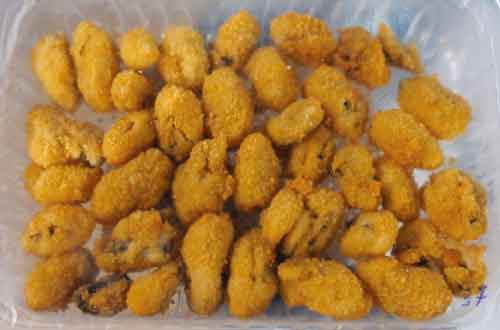
Pure mussel meat is made more visually appealing by applying a breading and can also be prepared with little time and effort.
The selection of ready-made industrial breading mixtures in different colours and blends is already very large and continues to grow. For suitable order volumes, most manufacturers are even prepared to develop individual recipes to customer specifications. This also makes unusual breading mixtures with special ingredients possible, for example with crispy inclusions or a smoky BBQ flavour. With additional equipment, industrial production lines can even apply coatings that give the finished product a hand-made appearance.
Optimised breading technologies
From a process-engineering perspective, a distinction is made between wet and dry breading, although in practice the advantages of the two methods are often combined. As the term “wet” suggests, wet-coating systems primarily use free-flowing liquid media. The products travel on a mesh conveyor through one or more dipping baths, in which the various components of the intended coating are applied in succession. Alternatively, they can pass through curtains of liquid egg and coating medium. Overflow devices and curtains of the medium ensure that the products are uniformly coated on all sides. These methods are also suitable for applying viscous batter, beer batter, or tempura batter to irregularly shaped products such as prawns or pure mussel meat.
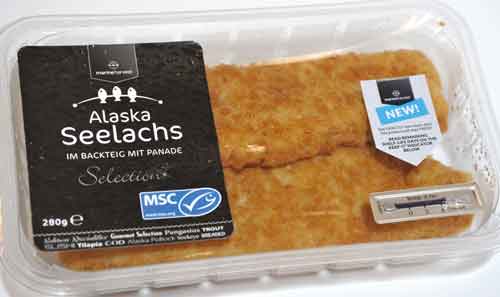
Battered fish is now offered not only frozen, but also chilled in modified-atmosphere (MAP) packs.
As already mentioned, wet breading is often used in combination with pre-dusting and the application of a dry breading. In such cases, the “wet” medium mainly serves to apply an adhesion layer for the subsequent dry coating. At the same time, wet coatings are also very well suited to distributing salt, spices, and flavourings precisely over the products. One challenge for manufacturers of breading machines is the complete and even distribution of liquid media, which quite often have different viscosities. The spectrum ranges from oil-based marinades to thick-flowing batters. Many processes therefore initially work with an excess of coating medium, which is then removed again in a second process step, usually with compressed air through an adjustable blow-off system, so that only a coating of the desired thickness remains on the product. To save resources and material, the removed excess is collected and returned to the process. However, trouble-free recirculation is possible only if the viscosity and flow properties of the medium are kept constant at the required level. The recovered coating material therefore passes continuously through sieves and filters that remove coarse particles. Some machine manufacturers also offer, as an option, cooling equipment for tanks and storage vessels. This can be especially useful with highly perishable substances such as liquid egg.
Breading machines and breading materials form a single system
Dry breadings are generally said to be especially crisp and to form a kind of “protective shell” that keeps juices and flavour inside the product. This desirable effect, however, depends greatly on the breading medium itself and on its particle size. As a rule, the finer the breadcrumbs, the more evenly and completely they can be applied. Such assessments also sometimes overlook the considerable influence that pre-dusting and the subsequent adhesion layer have on the final result of dry breading. This applies particularly to very coarse breadings such as cornflakes or oats. Breadings are now also available that adhere very well to moist surfaces, and therefore do not require additional adhesive layers such as beaten egg or other materials serving the same function.
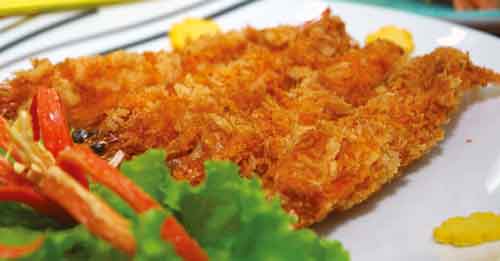
Prawns in a crispy coating are a universally popular snack for the finger-food segment.
All this already gives an indication of the requirements that modern breading equipment and systems have to meet. They can handle a very wide range of free-flowing coating media, work cleanly, quickly, and with little material loss, and deliver breading results of impeccable quality. Many products can of course also be breaded by hand, but above a certain throughput, breading machines and systems are practically indispensable. Thanks to convincing performance parameters, they relieve users of tedious kitchen routines and give them more time to use their creativity to develop new product ideas.
Manfred Klinkhardt