
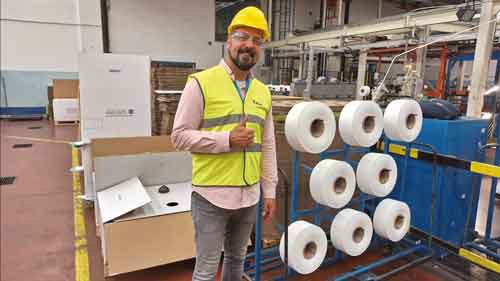
This article was featured in Eurofish Magazine 5 2026.

A Croatian initiative led by Božidar Blaslov, a fisher, is showing how end-of-life fishing gear can be kept out of the environment and returned to productive use. Working with WWF Adria, Aquafil (a manufacturer of yarn made by recycling complex nylon waste), and designer Kristina Burja of Krie Design, the project links fishing with recycling and fashion while exposing practical obstacles to a genuinely circular system for nets.
For Božidar Blaslov, the project began with an ordinary maintenance job. Mr Blaslov manages the family fishing business in Kali on the island of Ugljan and mainly targets sardines and anchovies with a purse seiner. In 2023, during the seasonal closure in January to allow for sardine spawning, his crew repaired a net and removed around two tonnes of worn material. Disposing of it through the municipal waste collection system would have shifted the material elsewhere rather than recovered its value. As he says, I would have solved my problem, but for nature, the problem was not solved.
Italian company offers a solution
Mr Blaslov began looking for alternatives and found Aquafil, the Italian-headquartered group whose Slovenian operation regenerates nylon 6, or PA6, through the ECONYL regeneration process. He contacted the company and agreed to start supplying old fishing nets. These he collected from other fishers including fellow members of the fishers’ cooperative Omega 3, where he serves on the board. The aim was to keep usable polymer out of landfills, informal dumping sites, incinerators, and the sea, and return it to manufacturing.
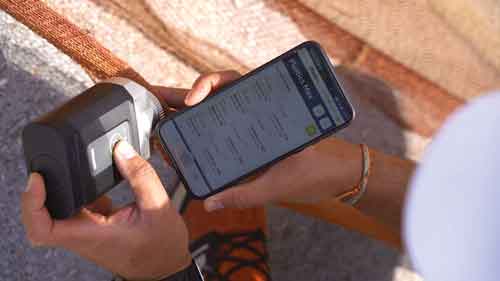
A portable spectrometer donated by WWF Adria and WWF Mediterranean allows the composition
of the nets to be quickly ascertained. Only one kind of nylon (PA6) can be chemically recycled at the Aquafil plant.
The reality proved more complicated. Fishing nets that look alike may be made from PA6, PA66, polyethylene, PET, or other polymers. Repairs can introduce patches or sections of a different material into a net creating a mosaic of polymers that are invisible until the net is spread out. Colour is not a reliable guide, and moisture can interfere with identification. Aquafil’s chemical regeneration process requires a suitable PA6 stream, so contamination, particularly with PA66, must be avoided. Sorting therefore became central. Nets are collected from ports, fishing companies, storage areas, and, in some cases, from the sea or coast. Floats, ropes, and other components are removed, while the composition of the netting is checked. The work is labour-intensive, and unrolling and rolling up a large purse seine or other net demands a certain degree of fishing knowledge.
WWF Adria helps turn collection into a system
WWF Adria has helped move the initiative beyond an improvised collection effort. According to Mr Blaslov, cooperation with WWF Adria and WWF Mediterranean led to a three-year agreement under which he received a portable spectrometer capable of identifying polymers in the field. The instrument allowed the team to test samples before transport and to separate PA6 from other materials. Although the instrument enabled rapid identification, it could not do so if the net was black, a challenge that is yet to be solved. For WWF, the project aligns with their wider work on abandoned, lost, and discarded fishing gear in the Mediterranean. Its Ghost Gear programme focuses on preventing gear loss and developing circular solutions for end-of-life equipment. WWF Adria says it has worked with Mr Blaslov to collect more than 100 tonnes of old fishing gear on land and send it for recycling, alongside separate operations to recover lost gear from the sea. Much of the material handled by the project is not ghost gear recovered from the sea but discarded equipment stored in ports, sheds, or other locations where it could eventually leak into nature—an outcome prevented by recycling.
From PA6 to ECONYL
Once sorted and baled, the PA6 nets are sent to Aquafil in Slovenia, where they enter the ECONYL regeneration process along with other nylon 6 waste. Mr Blaslov points out that PA6 can be recycled indefinitely. At the Aquafil facility the final product from the recycling process can be supplied as polymer or yarn that can be woven into fishing nets among other products. In fact, on his vessel, Mr Blaslov uses nets made from the recycled material as he feels strongly that initiatives that reduce pressure on the environment are critical to the future of the fishing industry. Quoting the American poet and novelist Wendell Berry, who said, “we do not inherit the earth from our ancestors; we borrow it from our children,” Mr Blaslov wants to leave the environment in better shape than what he inherited. He therefore takes the project to schools and kindergartens. He has produced children’s picture books explaining net recycling and responsible use of the sea, while an application he has had developed allows people to report abandoned or discarded gear.
While researching uses for regenerated nylon, Blaslov came across Kristina Burja, founder and designer of Zagreb-based Krie Design. Ms Burja had already used ECONYL in her collections and made sustainability central to her brand. Mr Blaslov proposed connecting the recovery of Croatian fishing nets with a finished product that people could see and wear. The Krie x Provir collaboration was launched publicly in 2024. In July 2026, the Future Adriatic Experience in Dubrovnik showed how far the collaboration had developed. The programme included education, demonstrations of net recovery, and products made with regenerated materials. Krie Design reported that the initiative had by then collected more than 120 tonnes of discarded fishing nets.
Policy is moving in the same direction
The initiative is developing as EU waste policy places more responsibility on the fishing-gear value chain. Under the Single-Use Plastics Directive, Member States must establish extended producer responsibility schemes for fishing gear containing plastic. Producers are expected to cover separate collection from appropriate port reception facilities, as well as subsequent transport and treatment. Member States with marine waters must also set minimum annual collection rates for waste fishing gear for recycling. EU port reception rules require adequate facilities for waste from ships and separate collection where this facilitates reuse and recycling. The Waste Framework Directive, meanwhile, puts prevention ahead of disposal through municipal waste management systems and establishes extended producer responsibility as a central principle of European waste policy. However, a European Commission report published in April 2026 found that about 22,900 tonnes of plastic-containing fishing gear were placed on the EU market in 2022, while only around one third was collected as waste. Mr Blaslov’s experience suggests that collection alone is not enough as recycling also depends on identifying polymers and separating incompatible materials economically. He makes therefore a strong case for greater standardisation in net manufacture. Clear information on polymer composition, or consistent design conventions for material types, would make sorting faster and cheaper.
By teaming up with other fishers, NGOs, companies that can recycle nets, and others that can use the recovered material, Mr Blaslov has shown that modest initiatives can grow into movements with a substantial impact. It is a step towards his dream of leaving his children an environment in better shape than it was in his own youth.