This article was featured in Eurofish Magazine 5 2026.

Researchers at North Carolina State University have developed a material derived from biological sources that could potentially help remove micro and other plastic particles from water bodies.
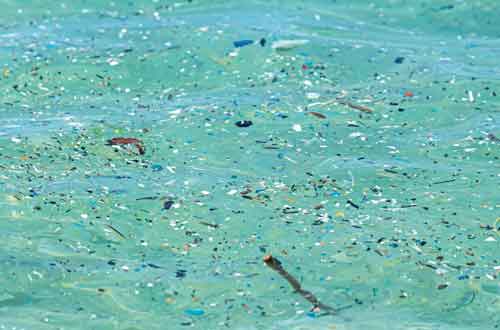
Marine plastic pollution is a global issue and presents a major challenge to marine ecosystems, with a continuous stream of around 9-14 million metric tonnes of plastic entering the ocean annually. The situation is similarly alarming in rivers, lakes, and even aquifers. Removing these particles is difficult because plastics differ widely in size, shape, density, and chemical composition. In addition, they degrade over time due to environmental factors such as ultraviolet radiation, oxidation, salinity and mechanical forces. The resulting microplastics, ranging from 0.1 µm to 5 mm, dominate the measured plastic counts and tend to adsorb greater amounts of pollutants and microbes because of their high surface-to-volume ratio. They can also enter the food chain and pose health risks to marine ecosystems and humans alike. Conventional filtration can remove larger particles, but becomes less practical for very small plastic fragments, as filters may clog and membranes can lose efficiency. Other removal methods are generally effective only for a limited range of particle sizes.
Microplastic removal method inspired by natural processes
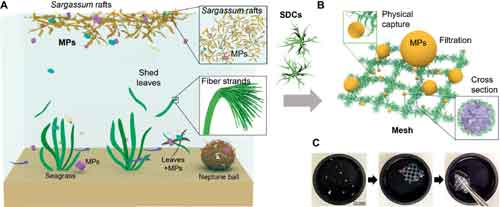
Researchers at North Carolina State University have now developed a material that attempts to address this problem by taking inspiration from natural processes in marine ecosystems. Their study, published in Science Advances, focuses on the way Sargassum seaweed and seagrasses collect plastic particles. Floating Sargassum can retain plastic debris among its branches, while fibrous remains of seagrass can form compact structures known as “Neptune balls”. These structures naturally trap plastic fragments before sinking to the seabed or washing ashore. The researchers recreated some of these properties using alginate and chitosan, two materials derived from biological sources. Alginate is obtained from brown algae, while chitosan is produced from chitin, which is commonly found in crustacean shells. The materials were processed into highly branched particles and then assembled into porous balls and meshes. The mesh combines two different forms of capture. Larger pieces of plastic are physically retained in its openings, while much smaller particles attach to a fine, fibrous coating on its surface. The large surface area of these fibres creates many points of contact between the material and plastic particles. Electrostatic interactions and van der Waals forces then help to keep the particles attached. The authors compare this principle to the way the fine structures on a gecko’s feet create strong adhesion.
New material shows exceptional promise in laboratory studies
Laboratory tests showed that the mesh could capture plastics across a much wider size range than many existing approaches. When tested with polystyrene particles ranging from 300 nm to 100 µm, the material achieved removal efficiencies above 90% by weight across all tested sizes. The researchers also tested plastics with different chemical properties, including polystyrene, polyethylene, polyethylene terephthalate, and polypropylene. Capture efficiency varied between the different polymers, partly because some plastics floated while others settled, which affected how often they came into contact with the mesh. The material nevertheless retained all four types. Any solution for capturing and removing plastics must be able to deal with particles that vary widely in their properties. The researchers also examined whether salt water would affect the performance of the mesh. High salinity can weaken some electrostatic interactions, but the overall capture efficiency remained high even at salt concentrations above those normally found in seawater. The mesh also remained structurally stable during agitation. Using plastic collected from Kamilo Beach in Hawaii, the researchers further tested the mesh with a more realistic mixture of particles. The samples contained particles ranging from around 200 to 300 nm to fragments larger than 5 mm. Millimetre sized particles were trapped within ten minutes, while most of the smaller particles were removed within 24 hours. Overall, a mesh containing 5 mg of material captured 11 mg of plastic, corresponding to a removal efficiency of 92%.
Overview of the biomimetic microplastic capture and removal system.
A: Illustration of the natural microplastic removal mechanisms found in Sargassum rafts and “Neptune ball” bundles from aggregated seagrass.
B: Concept of the hierarchically fibrillar mesh for microplastic capture inspired by these structures. C: Example of mesh testing for microplastic removal.
Source: Sci. Adv. 12 (32), DOI: 10.1126/sciadv.aeg0819
Testing under real life conditions is necessary
The results show the potential of the material, but the researchers also point to several questions that need to be answered before it could be used on a larger scale. The experiments were conducted under controlled laboratory conditions, and the concentrations of microplastics were considerably higher than those normally found in natural waters. Conditions in rivers, lakes, coastal areas, or the open sea are considerably more complex. Organic matter, microorganisms, biofilms, currents, and changes in salinity could influence both the rate at which plastics are captured and the long-term stability of the material. Another challenge is bringing the plastic particles into contact with the mesh. In the laboratory, the water and meshes were moved to increase contact between them. A larger system used in natural waters would therefore need water circulation or another way of ensuring that particles encounter the collecting material. The researchers suggest that the concept could also be applied as a coating on more permanent meshes or sieves, allowing existing systems to capture smaller plastic particles in addition to larger debris. Since the artificial Neptune balls are made from alginate and chitosan, they also have the advantage of being based on biodegradable, biologically derived materials. Whether they can ultimately be developed into a practical tool for cleaning natural waters will depend on further testing under realistic conditions. For now, the study shows how structures already found in marine ecosystems can provide ideas for tackling one of the more difficult aspects of plastic pollution.
Justus Dohmen, Eurofish,
justus@eurofish.dk