This article was featured in Eurofish Magazine 5 2026.

Global aquaculture production of aquatic animals reached 103 million tonnes in 2024, according to FAO, accounting for 53% of total aquatic animal production. Since the late 1980s, almost all growth in aquatic production has come from aquaculture. Further expansion will depend partly on producing more efficiently while coping with climate change, labour shortages, and stricter environmental constraints.
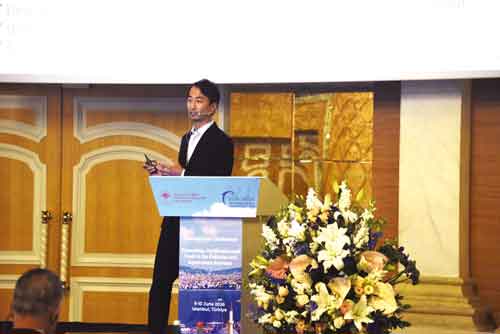
Based in Japan and Singapore, Umitron, a technology company founded in 2016, combines machine learning with IoT equipment, farm management software, and satellite remote sensing. Its products range from an autonomous feeder to software for production management and ocean environmental monitoring. Junichi Taniguchi, who leads international business development at Umitron, spoke at the recent Eurofish conference on seafood processing, certification, and trade in Istanbul. He describes technology as an “amplifier”— while the farmer still decides the overall production strategy, AI can analyse the data generated by onsite equipment such as cameras and sensors and help the farmer optimise farm operations.
Optimising feeding regimes saves costs and reduces environmental impacts
Feed commonly represents more than half of production costs in finfish farming, and overfeeding wastes money, increases nutrient discharge, and can impair water quality. A 2025 review of computer vision in fish feeding found that conventional timed feeding often fails to respond adequately to changing appetite. Machine vision, by contrast, allows feeding behaviour to be assessed continuously and without handling the fish. The company’s solar-powered feeder, christened Cell, learns fish feeding behaviour and releases feed only when the fish are hungry. It carries a camera that films fish feeding activity. The footage is processed by software which delivers a Fish Appetite Index value (FAI). Based on this value, feeding speed, pauses, and stopping points can then change automatically and autonomously according to thresholds set by the farmer. The processing occurs locally in the unit, so the feeder can continue operating even in cases where internet access is patchy. The system is decentralised so that the feeding parameters for each cage will be calculated based on an analysis of the feeding behaviour of the fish in that specific cage. To accurately analyse footage of fish feeding behaviour the AI has been trained on 10 years of farmers’ data, says Mr Taniguchi.
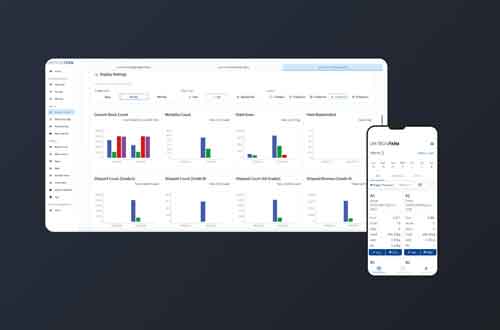
Farm-management software developed by the company records production variables including feed use, mortality, water temperature,
and costs, and calculates FCR and cost per fish or per production unit.
Umitron has continued to improve the system. A 2025 update allowed FAI models to be adapted more closely to species, environmental conditions, and individual producer requirements. In his Istanbul presentation, Mr Taniguchi reported feed-cost reductions of 20–25% and a reduction in farm-site working hours of more than 50%. In one Japanese case, he said, feed consumption fell by 30%, while profitability more than doubled. The same farmer was using a zero-fishmeal feed while maintaining a comparatively low feed conversion ratio. Feeding efficiency also contributes to a 22% reduction in feed-related CO2 emissions, according to Mr Taniguchi. Currently, the feeding units and the software go together, that is, a farmer cannot use the AI capabilities offered by Cell with feeders from another supplier as the two will not be compatible.
Data can also help farms respond to climate risk
Feeding optimisation becomes more valuable as environmental conditions become less predictable. Mr Taniguchi points to rising summer water temperatures in Japan, where farmers producing Seriola species can face higher mortality rates when high temperatures coincide with low oxygen availability and elevated metabolic demand. Another Umitron product, Pulse, combines satellite and other environmental data covering variables including temperature, chlorophyll, dissolved oxygen, salinity, waves, wind, and currents. Users can access 48-hour forecasts and alerts for environmental risks. One Umitron customer began combining water-temperature information with observations of fish appetite and behaviour. Mr Taniguchi says this gave the farmer greater confidence to stop feeding altogether when conditions became unfavourable, rather than continuing because withholding feed seemed commercially risky. Neighbouring farms suffered mortality during difficult conditions, he says, while the Umitron user was better able to adapt.
For aquaculture site selection, Umitron currently places greater weight on historical observations than on forecasts decades into the future. After criteria such as biological suitability (temperature, salinity, etc.), and structural suitability (wave height, depth, current, wind etc.) have been defined for each species, the Aquaculture Potential Map combines this information with socio-economic constraints (protected areas, presence or absence of infrastructure, competing uses of space) to identify areas suited to particular forms of aquaculture.
Existing farm records are a trove of information useful for an AI
Another opportunity comes from information already generated on farms. Umitron Farm, another product, is a platform that records production variables such as feed use, mortality, water temperature, fish movements between pens, and costs. It calculates indicators including FCR and cost per fish or production unit. Cell feeding records can enter the system automatically, while farms without Umitron feeders can also use the Farm software. Umitron has also added a generative-AI interface that allows users to query their farm data orally. Instead of searching spreadsheets or compiling reports manually, an operator could ask the system about past feeding performance or production costs and retrieve information from stored records. That may prove one of the less spectacular but more useful applications of generative AI. Aquaculture businesses collect increasing amounts of operational data, yet data has little value if staff cannot retrieve or interpret it easily. Natural-language interfaces could reduce that barrier, particularly for smaller farming operation farms that may lack IT expertise.
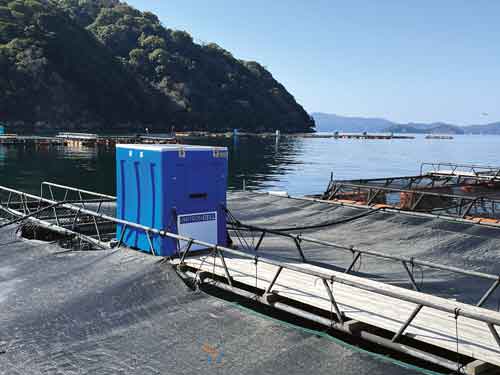
Umitron’s solar-powered feeder, Cell, uses a camera to monitor fish feeding behaviour.
Analysing the footage the feeder then automatically feeds the fish when they are hungry.
Disease detection attracts considerable interest because cameras and sensors can identify changes in appearance or behaviour before a problem becomes obvious to farm staff. Research has investigated computer vision for external disease signs, abnormal swimming, and other indicators. Image-based systems can provide non-invasive monitoring, although reflections, poor images, turbidity, and the three-dimensional aquatic environment complicate diagnosis. Researchers also point to the shortage of standard, shared datasets for training models. Mr Taniguchi feels that in principle, an AI model could learn to recognise behaviour associated with infection if sufficient reliably labelled data were available. A recent review of decision-support systems and digital twins found rapid growth in research on disease detection, water quality, and feeding, but only a relatively small proportion of studies reported sustained deployment on commercial farms. Models that perform well under controlled conditions still need to cope with the exigencies of a commercially operating farm.
Common standards for greater interoperability should boost AI use on farms
Aquaculture does not lack data-generating equipment. The problem is often that cameras, feeders, environmental sensors, and farm management systems come from different suppliers and cannot exchange information easily. A 2024 review of AI adoption in aquaculture identified data collection, standardisation, model interpretability, and integration with existing farm systems among the persistent obstacles to deployment. Mr Taniguchi concurs. Farmers may want one company’s feeder and another company’s management system, he says, only to discover that “they don’t talk to each other”. Umitron partly avoids that problem with Cell because the feeder can operate independently. Yet as farms add more digital equipment, common data standards and clear rules on ownership will become increasingly important.
Mr Taniguchi says Umitron treats management data, such as mortality and production records, separately from the behavioural data used to develop its feeding AI. Farm management data belongs to the producer, he says, and use for research requires the farmer’s agreement. That question extends well beyond one company. AI becomes more powerful when models can learn from larger datasets, but producers have legitimate reasons to control who can use commercially valuable information on, for example, mortality, feed efficiency, growth, and costs.
AI can optimise performance on farms of all sizes
Perhaps the most distinctive part of Umitron’s approach concerns who can use smart farming equipment. Much aquaculture automation has developed around large operations with reliable electricity, broadband connections, feeding barges, and sufficient capital to support centralised infrastructure. Many farms in Japan, the Mediterranean, and emerging aquaculture regions operate under very different conditions. Cell, the solar-powered feeder, was designed around those constraints. Solar power removes the need for an external electricity supply, while edge processing allows feeding decisions to continue locally when connectivity drops. Data can be transmitted to cloud services when a connection becomes available.
The implications of using AI extend beyond feed efficiency. Mr Taniguchi describes a Japanese farmer whose son reconsidered taking over the family business after automatic feeding reduced the physical burden associated with hand feeding. For an industry facing ageing producers and having trouble recruiting skilled staff, automation can change the character of the job as well as its cost. The technology can improve feeding, detect patterns that people may miss, and turn accumulated farm records into usable information. Its value, though, will ultimately depend on systems working reliably under commercial conditions and taking decisions that farmers can trust.