
Canada and Greenland are the most important producers of northern prawn. Quotas have been declining however in an effort to conserve the resource. Here, northern prawns cooked on board Canadian vessels are peeled at a factory in Latvia for the Scandinavian market.

As much as 15% of the total value of fish products marketed worldwide is shrimp. Shrimp prices have been lower than other fish products due to the spectacular growth in production (80% over the past ten years). Farmed, wild, marine and freshwater, as well as the ability to process it into a variety of product forms make shrimp a versatile commodity produced and traded in many markets.
From 1950 until 2000 shrimp catches increased continuously. Only in the 2000’s a certain stability began to be noticed, when production fluctuated between 2 and 2.5 million tonnes of shrimp. Today worldwide shrimp production stands at around 8 million tonnes, 56% of which is farmed.
Steep fall in northern prawn quotas
However, wild shrimp is still an important part of world production and trade. World production of northern prawn (Pandalus borealis) has been decreasing since 2004, when it reached its peak (450,000 mt). Since then, catches have fallen by 50% and are expected to continue to fall. The shortage of supply over recent years, due to the delicate situation of the resource, has resulted in a strong rise in prices. Up to around 300,000 tonnes of northern prawn are caught every year. This is the most important wild species in terms of capture shrimp volume. Four fifths of the catch come from Canada and Greenland making these countries the leaders in wild northern prawn production. In 2007 183,000 tonnes of shrimp were caught, but in order to conserve the resource, the quota has been decreased year after year to reach 116,582 tonnes in 2014. This change has had a negative impact on shrimp processing plants which add value to a large part of this volume.
Canadian landings of northern prawn have been decreasing since 2012 (143.348 tonnes per year) to only 86.271 tonnes in the period of January – September 2014. Despite these unfavourable conditions, Canadian exports of northern prawn have increased in the last two years (from 87,839 tonnes in 2012 to 94,348 in 2013). Demand in Ukraine, Russia and Norway has declined thus reducing the Canadian exports of northern prawn by 5.2% in the period from January to July, 2014. The European Union also imported 17% more the same period. The EU market annually imports around 6,000 tonnes of northern prawn from Canada. The lesser supply and the growth in European demand have caused prices to increase and even to double over the past four years (in June 2014, they were at 10.65 USD/kg). China and Russia are the second and third markets in Canada for this species (around 20,000 tonnes yearly, respectively), while exports to the USA are less than 1% of the total imported production. However, this market is a leading consumer of shrimp and the lack of whiteleg shrimp points to there being an increase in the demand in this country.
Greenland exports more to Russia
Greenland is the second largest producer in the world of this cold water shrimp species after Canada. Greenland is also the main supplier to the EU (38,000-39,000 tonnes yearly). Northern prawn production is mainly sent to Sweden, the United Kingdom and Italy. However, in the period from January to July 2014, Greenland exported one third less to the EU than in the same period the previous year. Overall, total exports of northern prawn from Greenland were down 17.5%. The country markets its shrimp products cooked and peeled. It also markets the whole shrimp, which is in demand from China, Russia and Sweden, however, in smaller volumes than cooked or peeled. Russia, for example, imported 17.3% more shrimp from Greenland in the first seven months of 2014 if compared to the same period in 2013. However, it is worth mentioning that China and Sweden imported less than in the same period in 2013.
Argentina has evolved into a major wild shrimp producer
An ongoing increase in catches over the past few years indicates that wild shrimp is also an important product in Argentina. In 2005, shrimp landings hardly reached 7,500 tonnes, but in 2013 it increased to over 100,000 tonnes. Although Spain and other countries are still the main markets for Argentinian shrimp, Asia is becoming increasingly important with Japan and China increasing the volumes of Argentinian shrimp imports. In 2010, Argentina exported shrimp to 28 countries around the world, and only 5,800 mt were sent to the Asian continent. In 2013, shrimp was exported to 48 countries and around 25,000 mt was bound for the Asian market – a 350% increase. Over these three years Japan increased its purchases of Argentinean shrimp by over 10,000 mt.
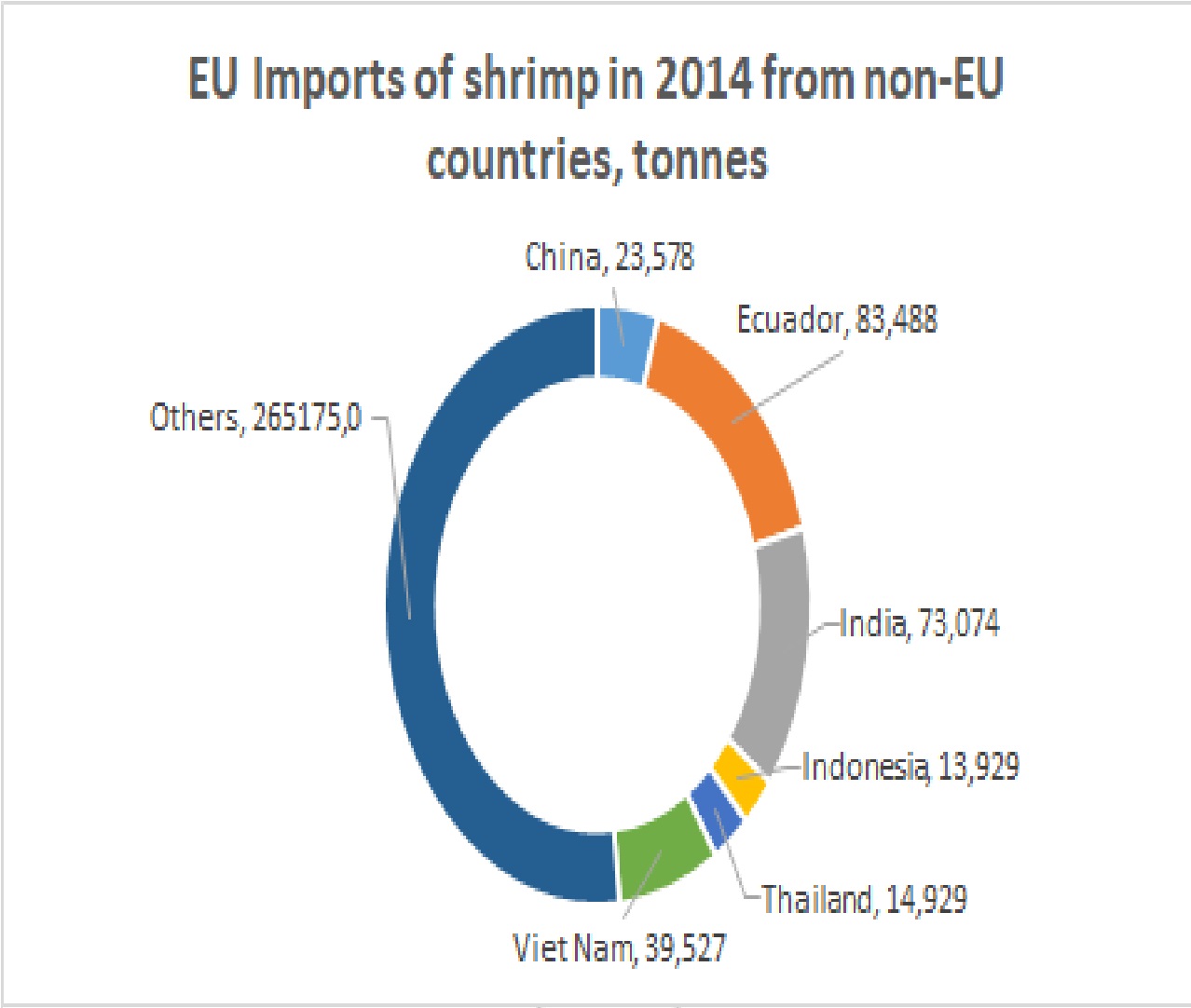 |
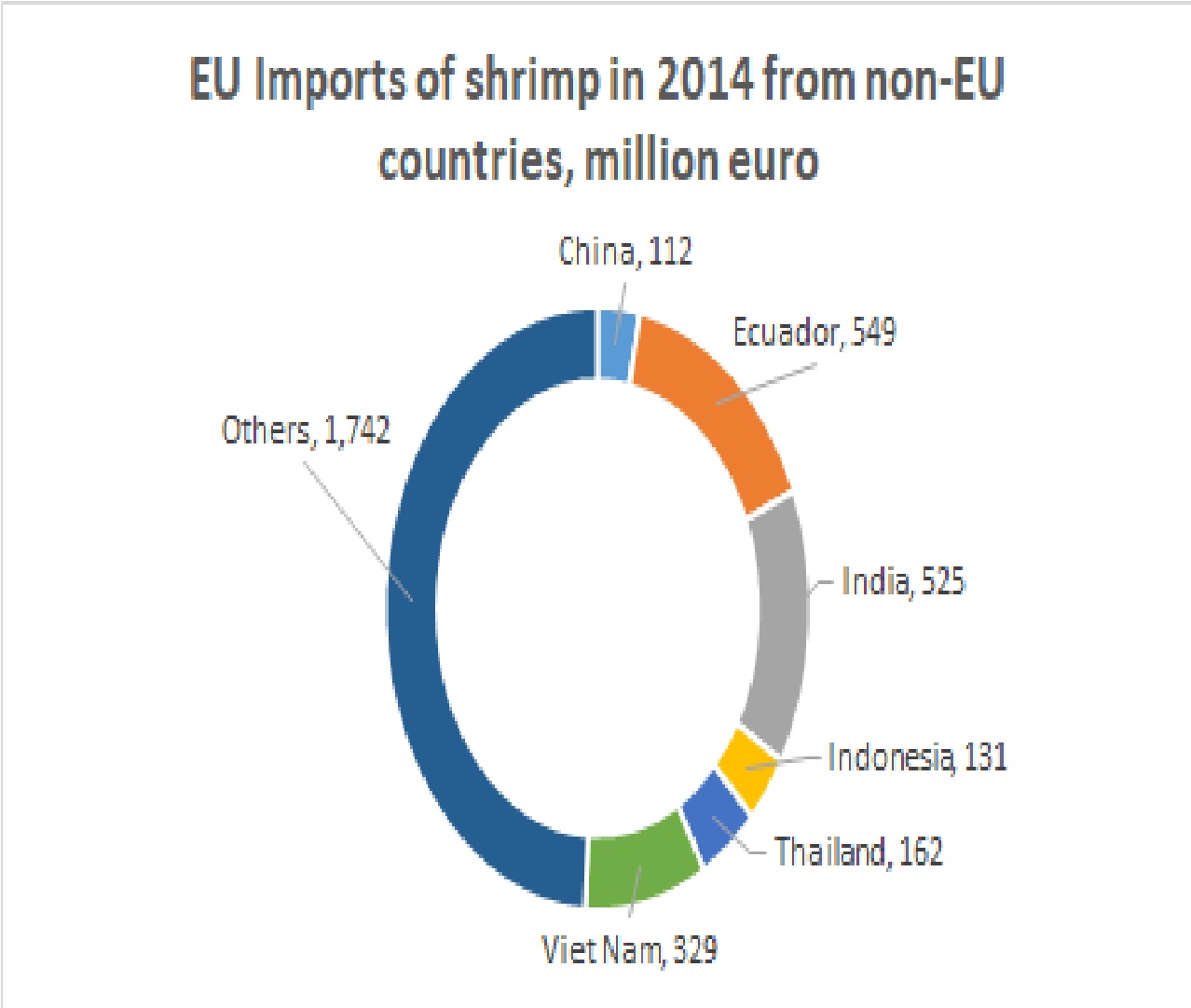 |
Huge increase in value of Vietnamese exports to the EU, US
Vietnam mainly exports its shrimp production to the USA, Japan and the EU. In 2014, Japan was the only market for shrimp from Vietnam that decreased both in terms of volume and value. Exports to Japan declined by 4% in value, possibly due to the yen’s depreciation against the US dollar, while exports to the USA and the EU grew by 48.3% and 50.6% in value, respectively. Shrimp exports are expected to peak at over USD4 billion, up 25% year on year. As bilateral agreements with the major markets are about to be signed, especially the Free Trade Agreement between Vietnam and EU, from the beginning of 2015, Vietnam seafood exports will enjoy better trade conditions.
Farmed shrimp affected by disease
Early mortality syndrome has had a very significant impact on shrimp supply from Thailand, where production has dropped by 60% over recent years, resulting in a loss of its status as the world’s main shrimp exporter. Exports of shrimp from Thailand to all its main markets have fallen since 2013. This country mainly exports its preserved and prepared production to Japan. Prepared and preserved shrimp is the main type of exported shrimp and only 6.61% of the total shrimp exports in January – July 2014 were fresh shrimp. The main markets are USA, Japan and EU, however, a year on year decline in total imports is noted in all the main markets.
In India, around 14.5 million people depend on fishing and aquaculture to earn a living. Even though consumption is growing at a rate of 20% today, over 99
% of processed sea products are exported. Over the past 14 years, exports in terms of value have quadrupled, surpassing USD5,000 million (around one million tonnes). However, by 2020 India aims to export goods worth USD10,000 million. Shrimp is the most important commodity in India’s fish exports, especially frozen, which today accounts for 31% of exports in terms of volume and 67% in value. All caught shrimp is exported to other countries. India, which has doubled its whiteleg shrimp production, is now the leading supplier of shrimp in the world in terms of value. Regarding volume, 48% of total shrimp production (wild and farmed) is exported. Southeast Asia is the main market for India’s fish products (26.4%), followed by the United States (25.7%) and the EU (20%). Over the last decade, wild shrimp catches have kept stable (around 350,000-450,000 mt per year), with small variations, depending on the climatic conditions. The future growth of the shrimp industry in India depends on aquaculture, mainly on whiteleg shrimp. The main challenges for the expansion of farmed whiteleg shrimp are the production costs, which have risen, and the scarcity of pathogen-free larvae to supply the growing demand of the producers.
Imports to the EU and the US increase
The main markets for wild and farmed shrimp are the US, the EU and Japan. Both the EU and the US increased their overall imports in the period from January to July 2014 compared to the same period in 2013. The EU imported more from Canada, India, Ecuador and Vietnam, but decreased its imports from Greenland and Thailand. In general, the EU market imported 3.6% more. The USA also imported greater volumes of shrimp in the period from January to July 2014 than in the same period a year ago. In 2014, the USA demanded more shrimp from Indonesia, India, Vietnam and Ecuador. However, it imported almost 50% less from Thailand than a year ago. The decline in imports from Thailand can be seen since 2012, when US imports declined by around 50%, too.
Although the main markets for shrimp have been the US, Japan and the EU, new markets for shrimp are emerging. China is one of them. At the moment China imports relatively low amounts of shrimp, but the country’s imports of shrimp are expected to grow. In 2013 Chinese imports of shrimp increased by 35% compared to the year before to 64,000 mt, while in the period between January and June 2014 China imported 28,000 mt, almost 16% more shrimp than in the same period a year earlier. With imports growing at this rate China is definitely a market to keep an eye on.
Source: Conxemar
Iveta Zvinklyte, Iveta@eurofish.dk