This article was featured in Eurofish Magazine 6 2026.

Founded nearly 40 years ago on Poland’s Baltic coast, Barkas has developed from a small family smokehouse into an established supplier of smoked fish. Rising raw material costs and changing consumer expectations present challenges, but the company continues to invest in its traditional strengths.
On Poland’s Baltic coast, summer brings holidaymakers looking for smoked fish to take home or eat by the sea. For Barkas, a family-owned fish processor based in Obroty, near Kołobrzeg, tourist demand in summer is an important source of revenue. The company supplies specialist shops along the western coast, while also serving wholesalers and export customers. While still primarily a supplier of smoked products, it has adapted to the lack of fish from the Baltic Sea, its historical source of raw materials, by buying fish from all corners of the world.
Successfully navigating major political shifts
Barkas was established in 1987 by Eugeniusz Świderek, when Poland was still under communist rule. Initially a small operation, it smoked mackerel and herring for Barka, a fishing company supplying the raw material. The political and economic changes of 1989 opened new opportunities, particularly through customers selling fish to eastern markets. However, after Poland joined the European Union in 2004, the emphasis increasingly shifted towards western Europe. Through successive expansions, including investments supported by EU funding, the family enterprise developed into a processor with a markedly wider range. Today the business is run by the founder’s children, Grzegorz Świderek and Anna Skorupińska, and her husband, Arkadiusz Skorupiński. Employing about forty people, the company manufactures some 800 tonnes of finished products annually including smoked, fresh, frozen, and salted fish.
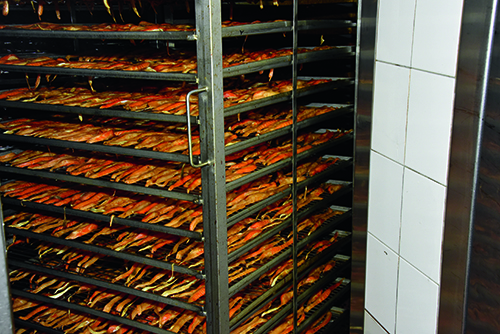
Smoked whiteleg shrimp, a new product in Barkas’ assortment, has proved very popular.
According to the European Market Observatory for Fisheries and Aquaculture Products (EUMOFA), Poland had 330 fish-processing enterprises with net turnover of EUR 5.1 billion in 2024. The industry is closely linked to international trade: salmon, which is imported from Norway, accounted for 63% of the value of Poland’s fishery and aquaculture product exports in that year, and Germany was the largest destination market. For Barkas, mackerel is the leading product, followed by an expanding salmon business and smaller volumes of species such as halibut, trout, redfish, and sprat. Its assortment also extends to eel, trevally, and herring preparations. The company’s product catalogue lists over 40 different products from around 25 species. Products are introduced in response to the market as well as to assess a new item. Not every experiment succeeds, but one relatively recent addition has proved popular. After hesitating for several years, Barkas introduced smoked whiteleg shrimp, purchased through suppliers in the Netherlands and Ms Skorupińska says demand has exceeded initial expectations.
Raw materials now come from countries around the world
The changing mix also reflects a major shift in sourcing. Back when the company was founded, a local fishing enterprise catching in the Baltic Sea was originally the sole supplier to the factory. Today, however, sprat is the only Baltic-caught raw material in its production. Much of the remainder is imported. Salmon is delivered fresh from Norway, while rainbow trout is sourced from Türkiye. Other fish arrive frozen. Sourcing internationally enables a diverse product range, but also exposes the company to international supply conditions, currency movements, and the cost of transport. Those pressures are particularly apparent in mackerel. For many Polish consumers, smoked mackerel has long been a familiar, relatively affordable food. Rising raw-material prices have discouraged some German buyers and reduced the company’s mackerel business in that market, even though the species remains popular in Poland. Attempts to use horse mackerel as a substitute have not worked due to differences in flavour and appearance. In the longer term the prospects for mackerel supplies look uncertain. Scientific advice led EU ministers to agree sharply reduced provisional mackerel catch limits for part of 2026.
Products preserved with salt alone
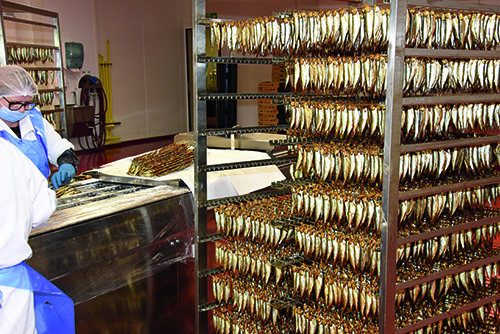
Baltic fisheries present another challenge to the wider processing industry. Processors have been historically dependent on local cod, but the fish has been unavailable for the last few years, a situation that is unlikely to change in the foreseeable future. This in turn has forced changes in raw-material procurement and in production. At its factory, the company combines traditional recipes with modern smoking equipment that uses alder and beechwood chips in chambers where production conditions can be monitored. EU-supported investments have helped introduce vacuum, and modified-atmosphere packaging, enabling products to be supplied in different retail formats. Some fish are sold in bulk for presentation in refrigerated display counters, while others are portioned and packed for consumers. Mr Skorupiński stresses that the company does not use any artificial ingredients to prolong shelf life. Smoked and packaged products enjoy a shelf life of 28 days with nothing added other than salt. The company holds IFS Food certification, supporting its quality assurance procedures. This is particularly important for demanding export customers, notably in Germany. He emphasises that retaining long-standing customers depends not simply on competitive prices, but on supplying products of consistently high quality.
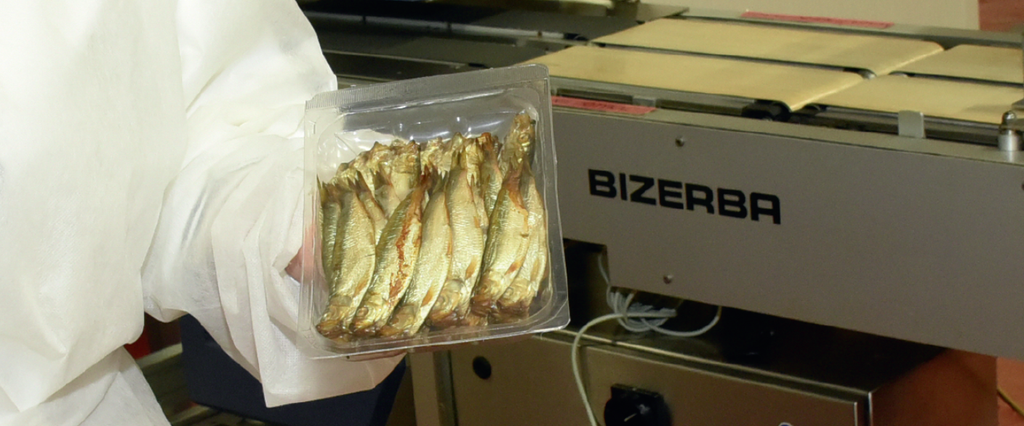
Whole smoked sprats are one of over 40 products that Barkas offers.
Independent retailers along the Baltic coast are among the company’s most important customers. Sales boom during the summer when tourists visit the area and the products are often sold under Barkas signs and branding, although the shops are not company-owned. Customers are concentrated all along the Polish west coast and onwards to Herringsdorf in Germany. Holidaymakers tend to buy higher-priced fish such as eel and salmon, generating much of the company’s annual business. The domestic market is supplemented by wholesalers and selected foreign customers. Romania has become a growing destination for Barkas-branded smoked fish as Mr Świderek sees similarities between Romanian and Polish tastes. Germany remains important, though its purchasing patterns have changed with mackerel prices. Distribution partners also supply retail chains, including products manufactured for private labels.
Staying aware of trends without necessarily following them
EUMOFA estimates that apparent fish consumption in Poland reached 13.67 kg per person in 2023, still well below the EU average. Ms Skorupińska sees demand for familiar smoked species but also observes that younger consumers increasingly seek food requiring almost no preparation. Even a smoked whole fish, ready to eat in principle, must be cleaned and portioned at home. She recognises the appeal of convenient servings and complete fish-based meals, one of the major trends in Poland and elsewhere, but is cautious about diversifying into products far removed from the company’s core expertise. The company is modernising its facilities and investing in photovoltaic panels and battery storage, using electricity generated during the day to help operate refrigeration equipment at night. It has also upgraded delivery vehicles and invested in a new smoking chamber. Labour is becoming more expensive, but machines cannot match the quality of manual handling, so it remains important. Approaching its 40th anniversary in 2027, Barkas faces higher input costs and a consumer market that is evolving rapidly, but retains assets such as long-standing customer relationships, local recognition, and experience in trading and processing a broad selection of species. Above all, it is a rare ability to adjust to different clients’ specific needs that has enabled it to thrive in a competitive environment.