This article was featured in Eurofish Magazine 6 2026.

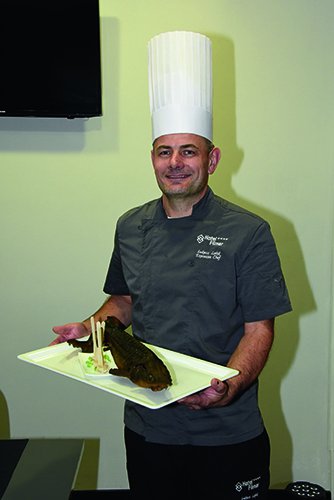
Łukasz Lofek, executive chef at Hotel Filmar in Toruń, Poland, finds that the appeal of sturgeon lies in its flavour, versatility, and connection to the country’s culinary past. His experience suggests that chefs could play a decisive role in bringing this unfamiliar fish back to Polish menus.
Three years since he first cooked sturgeon, Łukasz Lofek has made it one of the most popular fish preparations at Hotel Filmar. The executive chef, who has spent much of his career at the Toruń hotel, says diners respond to its delicate flavour and firm texture. He is convinced that a fish many Polish consumers know chiefly because of the price of its roe deserves far more attention for its flesh. To create awareness about sturgeon he is collaborating with the Polish Sturgeon Producers Organisation (PSPO), which is promoting farmed sturgeon through consumer education and cooperation with the catering sector. For many producers building a market for sturgeon meat is important for their business. Female sturgeons take 10-12 years to mature and produce eggs, and for that period meat from male fish is the only product a farmer can sell. Greater recognition and appreciation of the meat would secure sales and create demand beyond the narrow caviar market.
Sturgeon is a versatile fish than can be prepared in many ways
Mr Lofek is doing his bit towards enhancing the popularity of sturgeon. In his signature preparation he seasons fresh sturgeon fillet with salt and pepper, covers it with gently flavoured buttered leeks, and cooks it in the oven for around ten minutes. The fish is served with a buttery potato purée and tender broccoli, with Parmesan adding another savoury note. The leeks complement rather than dominate the fish, allowing diners to appreciate its own character. Sturgeon also gives the kitchen considerable freedom. Mr Lofek fries it, prepares it sous vide, and smokes it on site. He uses it in soup, dumplings, and mousses for finger food, making use of different cuts and preparations depending on the occasion. Its cartilaginous skeleton, without the bones found in other fish, makes it particularly convenient to serve, whether in a restaurant or at home.
For smoking, Mr Lofek buys whole fish rather than fillets. The fish is cleaned, immersed in a salt brine, dried, and then hot-smoked. However, fillets too can be smoked either cold or hot. He also has clear preferences for fish of roughly three kilograms; larger specimens do not give him the eating quality he wants. This practical experience is particularly valuable for the kind of campaign that the PSPO is running to introduce the fish to consumers. The hotel’s purchasing figures suggest that customers are willing to experiment. Mr Lofek estimates that the kitchen uses around 150 kg of sturgeon in a typical month, rising to approximately 300 kg in December, when Polish traditions bring more fish to the table. The orders cover restaurant service alongside banquets and catering. Salmon still accounts for a larger volume, but sturgeon has established a meaningful place in the kitchen’s repertoire.
A new take on traditional sturgeon recipes
Sturgeon once travelled up Polish rivers and appeared in traditional recipes, commonly salted, marinated, smoked, or baked. Overfishing, dam building, and changes to river habitats contributed to the collapse of wild populations, and subsequent listings on CITES outlawed capture fisheries and trade in the fish and its products. As a result, much of that culinary knowledge faded. Today, caviar and sturgeon meat come exclusively from farmed fish. To revive this ancient food tradition, Mr Lofek has collaborated with food historian Professor Jarosław Dumanowski of Nicolaus Copernicus University in Toruń. Prof. Dumanowski’s research into early Polish cookbooks has helped contemporary chefs reinterpret historic dishes. Mr Lofek also participates in Toruń’s culinary initiatives celebrating the era of Nicolaus Copernicus.
There are, however, commercial obstacles to the widespread uptake of sturgeon. One is the price—sturgeon is not the cheapest option. Mr Lofek says he pays more for sturgeon than he does for salmon. On the other hand, his supply comes from a farm near Toruń, giving him a comparatively short route from producer to kitchen. This proximity supports freshness and gives the chef direct knowledge of his supplier. The PSPO campaign will also help individual consumers locate domestic producers in their vicinity which may lead to greater sympathy for the relatively high unit price.
Will sturgeon be the next consumer trend?
EUMOFA, the European market observatory for fisheries and aquaculture, notes that sturgeon farming generates substantially more meat than caviar, making outlets for the flesh important to farm economics. Mr Lofek sees younger customers taking a greater interest in fish and, more generally, in what they eat. His experience shows how a positive experience with an initially unfamiliar fish encourages consumers to try it again and perhaps even prepare it at home. As he puts it, after periods when cod and then salmon held consumers’ attention, the future could belong to sturgeon.