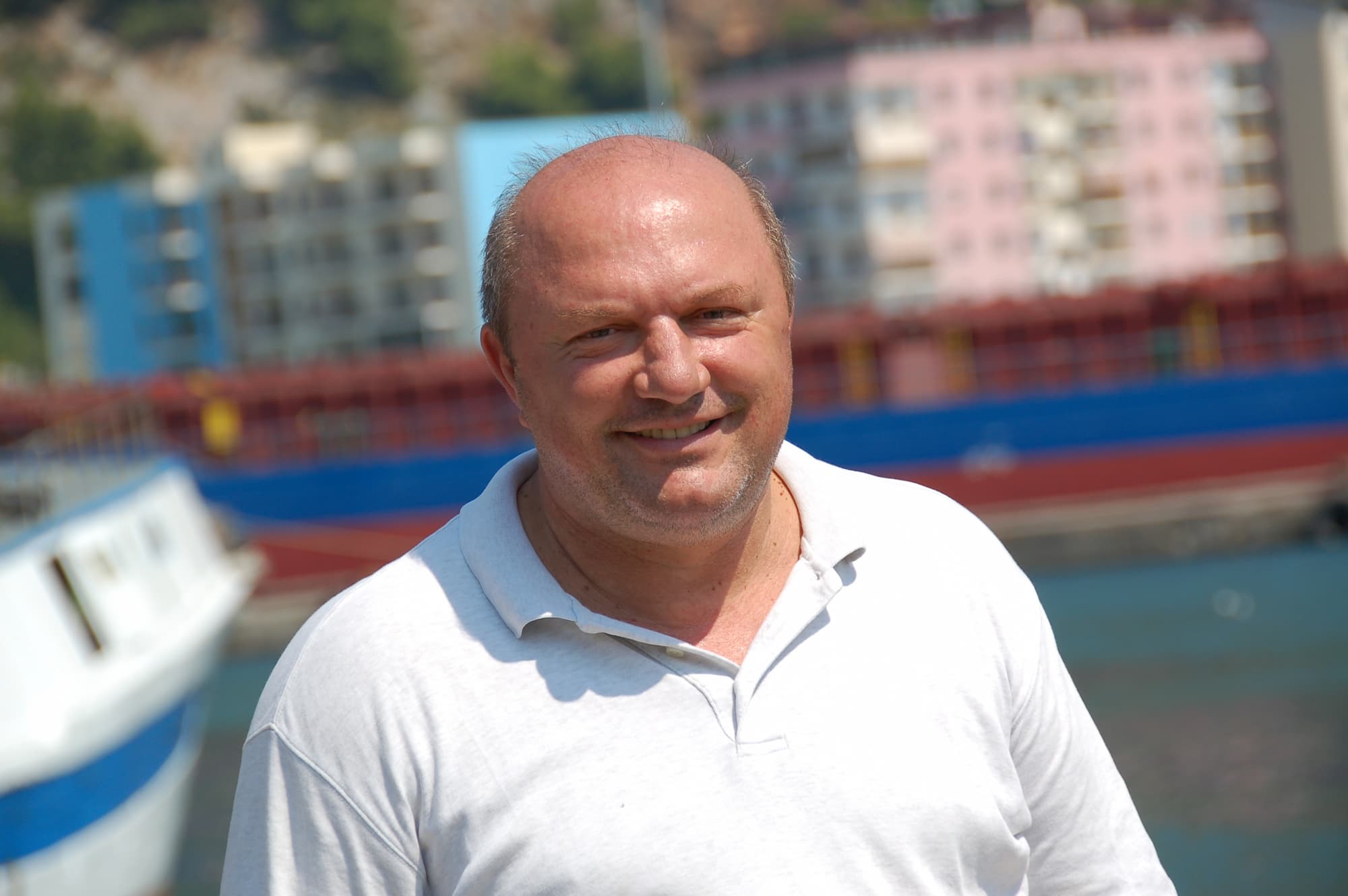
Marc Babani, the president of Mare Adriatik, a company active in fishing, processing, and mussel farming.

Mare Adriatik based in Shkoder is a company with interests in fishing, processing, and farming. It is the only enterprise to farm mussels in the bay in Shengjin in the north of the country as opposed to the traditional mussels cultivating grounds in the Butrinti Lagoon.
With some help from his son, a businessman based in the UK, Gjergj Sauraj has just invested in a fishing vessel that he will use to catch small pelagics, anchovies and sardines in the Adriatic. The second-hand vessel is 27 m long and used to belong to Mare Adriatik, a company that processes anchovies and sardines. Mr Suaraj used to work for the company, but has now decided to become a fisherman. His links with the company remain strong however, as his catches will be sold to his former employer.
Using lamps to target anchovies
With a crew of 10 men on board, Mr Sauraj fishes with a purse seine at a depth of 2,000 m, where he is familiar with the bottom and the conditions in the water. Pelagic fishers use lights to attract the fish and so the best time to go out is at night when weather conditions are good and there is no moon. Lights keep the fish in place allowing them to be surrounded by a purse seine and then captured. Catches are highest during the season in May and June, but in fact it is possible to fish all the year around for these species with the exception of August, when the heat of summer pushes up the temperature of the water, forcing the fish to swim deeper in search of cooler water. The external temperature has little impact on the quality of the fish however as the vessel is equipped with the ice necessary to keep the fish at the right temperature. The ice is collected from an ice facility in the port just before the vessel departs and is stored in the cold store on board the vessel.
Albania’s pelagic fishing fleet is relatively small as most fishers target demersal species which have a higher commercial value. In the Shengjin port there are only four vessels that target small pelagics of which two are used to twin trawl, while the fourth, which belongs to Mare Adriatik is under reconstruction. Shengjin port is the third out of the four ports in Albania in terms of size of the fleet. According to Mimoza Cobani from the Ministry of Agriculture, judging from the volume of catches, stocks of small pelagics are in fairly good shape in contrast to those of the demersal species. Mr Sauraj expects to catch about 140 tonnes of fish a month. As soon as the vessel docks the fish is loaded onto a waiting truck from the company, so that the fish can be driven straight to the Mare Adriatik factory some 50 km away, where they are processed.
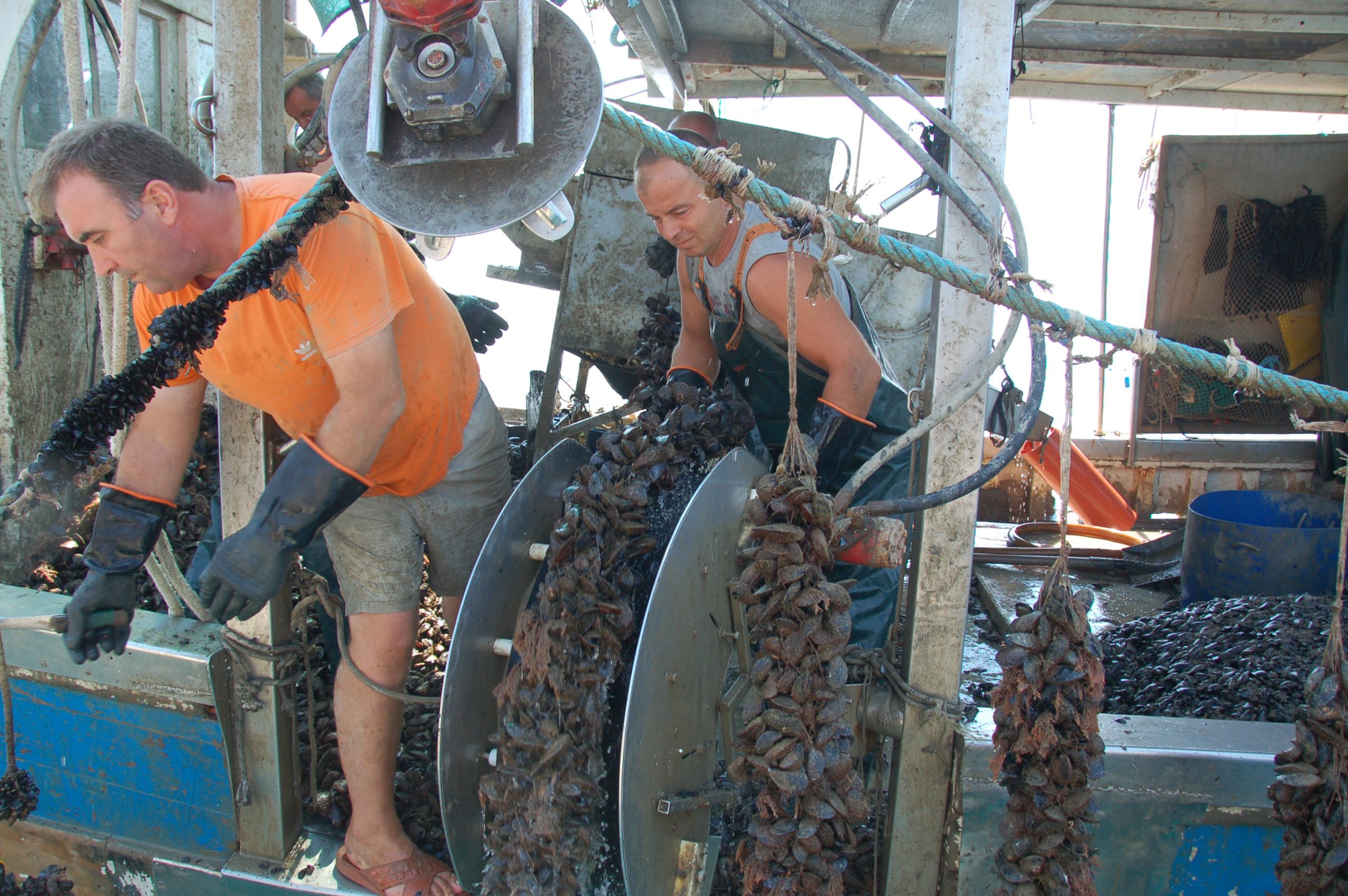
First mussel farmer in Shengjin Bay
The production of salted anchovies however is only one part of the commercial activities of the company. Mark Babani, the president, has also pioneered the farming of mussels in the Shengjin bay. With the help of Riccardo Germano, an Italian consultant, Mr Babani has established the first mussel farm in the bay. Farming mussels in Albania can be traced back at least to the 60s, since when they have been cultivated in the Butrinti Lagoon in the south of the country. At one point mussels from the lagoon were even exported to the EU, though that trade stopped some two decades ago following an outbreak of disease. Efforts to farm them in the north are more recent, the Mare Adriatik farm was established in 2008. Mussel farming has a commercial but also a social side to it, says Mr Germano. Most of the workers on the farm were working in Greece doing the same job. With the opportunity to work on a mussel farm at home they have now returned to be closer to their families. Mr Germano believes that the improvement in their circumstances has also made the workers willing to put in an extra effort when required. They can be relied to come in over weekends or work extra shifts in order to get the job done if necessary.
The lines are arranged at intervals of 40 m, which is not usual according to Mr Germano, but as there is 87 ha of surface area it was decided to do it because the wide spacing means the quantities the mussels feed on is more homogenous. The Buna River that marks part of the border between Albania and Montenegro drains into the Shengjin bay bringing with it nutrients that are consumed by plankton on which the mussels feed. The movement of the water in the bay caused by the discharge from the river keeps the water in motion which in turn helps the mussels stay free of epiphytes. This means the shell is lighter, which is an important consideration when the mussels need to be processed. Out of a total weight of 1 kg of mussels the raw meat constitutes 23-24%, while the cooked meat amounts to 16.3%. If the shells are light these figures increase, which is interesting from a processing point of view.
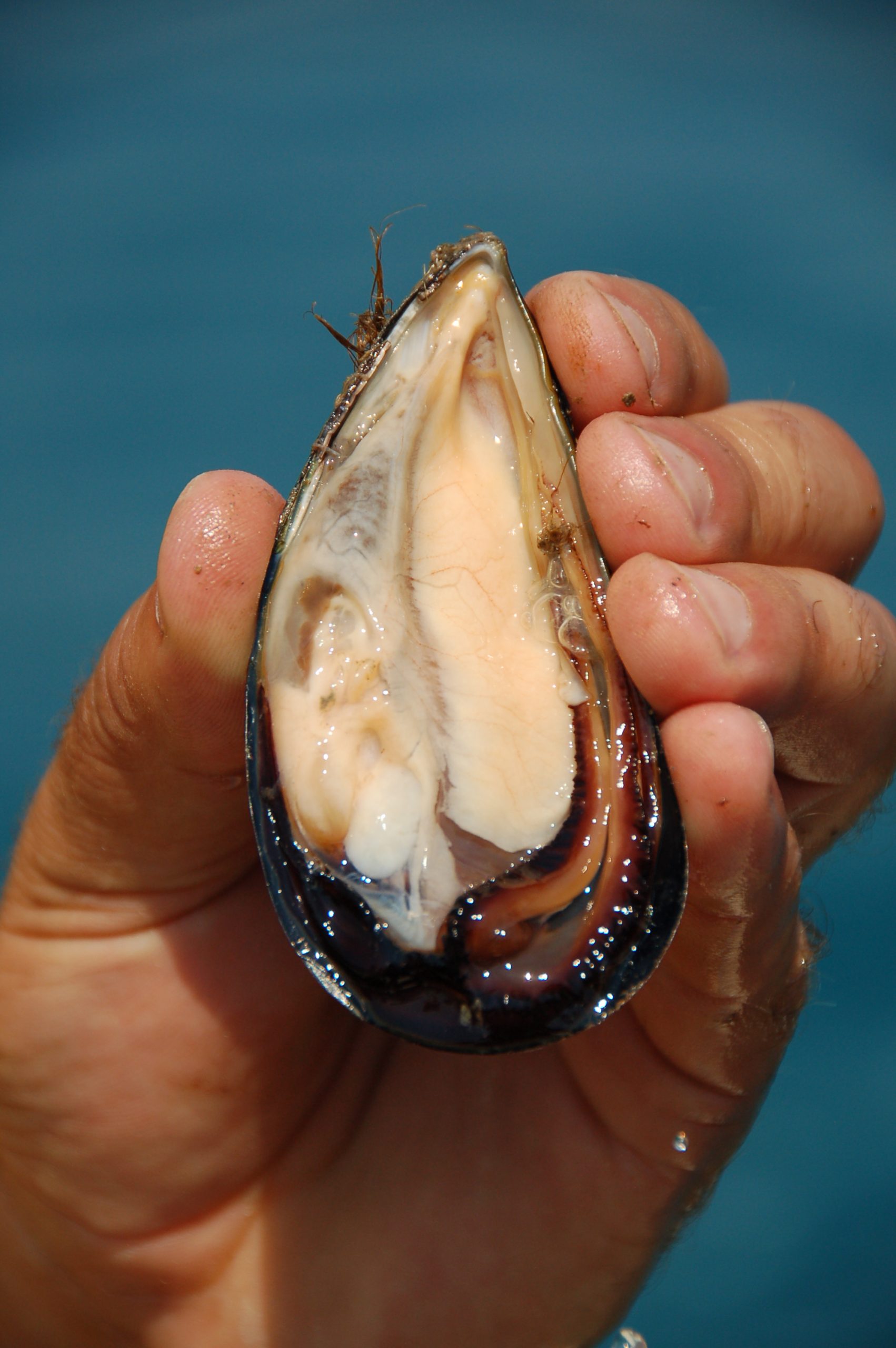
Closely managing mussels’ growth is critical
The lines are secured at the bottom by 20 tonne concrete blocks at either end and each line holds 10-15 tonnes of product. This makes for a stable system that can withstand the pressure of wind and waves, explains Riccardo Germano. The water depth varies from 6-15 m while the suspensions lines are 3 to 5 m long. The suspension lines cannot be longer because they need to have the space to be raised and lowered if there are changes in temperature. Mussels live very well at 21 or 22 degrees C. If the water gets warmer than that the line are lowered and if the water is too cold they are raised. The mussels’ growth has to be closely managed to ensure that they do not grow too fast. If they do they grow out of the sock and when the line is lifted out of the water these mussels fall off. One way of dealing with this would be to take the mussels out of the water and replace the net with a bigger one. But apart from the extra effort involved in replacing the net, any such handling sets back the growth rate as the mussels take at least a month to adjust to the change and start growing again. The only handling should be to raise or lower the lines if the temperature fluctuates.
Freezing mussels on board in the near future
| Mare Adriatik | |
|
Shelqet Shkoder President: Mark Babani | Products: Mussels, salted and marinated anchovies and sardines Volumes: 400 tonnes mussels, 1,500 tonnes finished pelagic products Employees: 300 Markets: For small pelagic products Spain, Italy, Albania, Germany, England, France; for mussels, Albania |
Today all the mussels grown in Albania are intended for the domestic market, but because mussels in the Butrinti Lagoon grow faster they are on the market in April, while those from the Shengjin Bay are only harvested in July. There is thus no overlap, but the low prices charged by producers from the lagoon have an impact on prices that can be charged by the producers in the north. The time to maturity in the Shengjin Bay is longer. Normally a mussel has a lifespan of 2 years. In the north the mussels are collected when they are 3-4 months old, placed in nets and put in the water. The net is changed again and by the third change, 12-15 months since the mussels were collected, the product is practically ready. At this point they are the best to eat, the shell is full, the meat is soft and the taste is delicate. Mr Babani is currently selling only fresh product, but the idea is to start processing the mussels into fresh flesh. Manually opening the mussels and removing the flesh is strenuous work, but the quality is excellent and the plan is to freeze the meat in the mussel’s own liquid thus retaining all the organoleptic properties of the fresh mussel. However the costs involved are substantial. The company has invested in the necessary machinery and will start a limited production later this year. Mr Babani would like to export the production in the first place to the Middle East. As he says, the site is strictly monitored by the authorities and year after year has been found to be a category A site. His vision is to become the first producer to export to Europe. To this end he is planning to invest in a vessel that can harvest and process the mussels on board giving a frozen product made from the freshest possible raw material.